Accelerating the creation of safe and secure communities through water-based PPPs: Becoming a strong partner for local governments with technology and services.
公開日:
What thoughts and stories were behind its development?
How will that connect to the people and societies living on Earth?
"SEKISUI | Connect with" is a future-creating media platform that connects you with Sekisui Chemical.
Water and industrial water supply play a vital role in maintaining urban functions and living environments. They are essential infrastructure for daily life. However, much of this infrastructure is facing deterioration. In the case of sewage systems, the number of sewer pipes exceeding their 50-year lifespan is rapidly increasing, making it a social issue that cannot be ignored. However, local governments are facing a shortage of staff, and are unable to secure sufficient budgets for countermeasures.
To overcome this situation, the "Water PPP (Public-Private Partnership)" is attracting attention. This is a new system in which local governments and private companies collaborate to formulate maintenance, management, renovation, and repair plans for water and sewage and industrial water, and to operate projects based on those plans. There are high expectations for maintaining a safe and secure living environment. Urban Infrastructure and Environmental Products (UIEP) Company, four people involved in the management and renewal of sewer pipeline facilities will appear to explore the benefits of water PPPs, how they are being implemented, and how they contribute to solving social issues.
What is "Water PPP," a solution to infrastructure challenges?
Even when heavy rain falls, roads are not flooded, and water used in toilets and kitchens is safely treated thanks to sewerage systems. Our lives are supported by this invisible infrastructure. Japan's total infrastructure assets have reached 993 trillion yen, of which sewers account for about 101 trillion yen. And 80% of these sewer systems consist of pipeline facilities ※. Pipeline facilities are pipes and tunnels buried underground to safely transport sewage from homes and buildings to treatment plants. However, this sewage infrastructure currently faces major challenges. Shunsuke Tanaka, head of the Urban Infrastructure and Environmental Products (UIEP) Company Government-Supplied Project Planning and Development Office, explains the current situation.
* "Japan's Social Capital 2023" (Director-General for Policy Planning, Cabinet Office)
"Like other infrastructure, the aging of sewage facilities is a serious problem. The lifespan of sewer pipes is said to be about 50 years, but in the future, there will be a rapid increase in aging pipes that are used beyond their lifespan. Aging pipes are prone to road collapses, increased burden on treatment plants due to rainwater infiltration, and problems such as foul odors and blockages. This increases the risk of directly impacting our lives."
Kozo Torikoshi, who has been in charge of negotiations with government agencies within the group, adds the following to the situation:
"While the aging of facilities is a 'material' problem, the reality is that there is a shortage of manpower and funds to solve it. In other words, 'people' and 'money' are also challenges. Sewerage system development began in the 1950s and peaked in 1990-2000, but the number of employees in local governments and public organizations has decreased significantly compared to that time. Furthermore, with declining revenue from sewerage usage fees, many local governments are in a difficult financial situation. They have little resources to spare for infrastructure development."
To address these challenges, water PPPs are attracting attention as a solution involving collaboration between the public and private sectors. Tanaka explains this system in which local governments and private companies cooperate to manage and maintain sewage systems.
"In the field of infrastructure, which faces various challenges, the government is increasingly moving to entrust tasks that can be handled by the private sector to the private sector. This is known as public-private partnership (PPP). Starting in the 2000s with buildings such as government offices, schools, and hospitals, this trend has spread to the civil engineering sector since the 2010s, with private companies taking on management and maintenance responsibilities. In June 2023, the government decided on the PPP/PFI Promotion Action Plan (revised for 2023), establishing a water PPP in the water and sewage sector, and outlining a policy to further strengthen public-private partnerships."
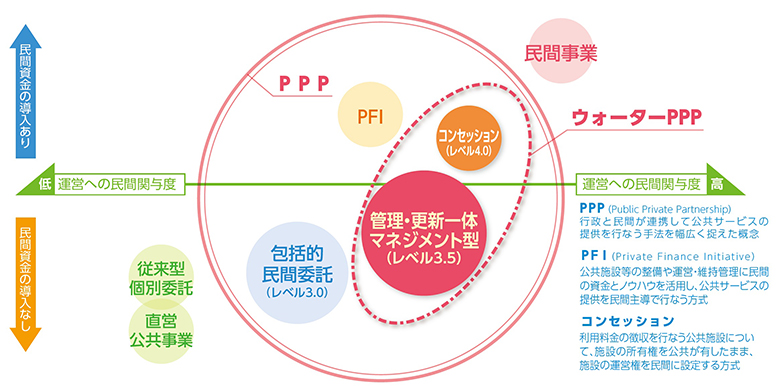
How does water PPP solve infrastructure challenges? Torikoshi emphasized that it "will be a solution to labor shortages."
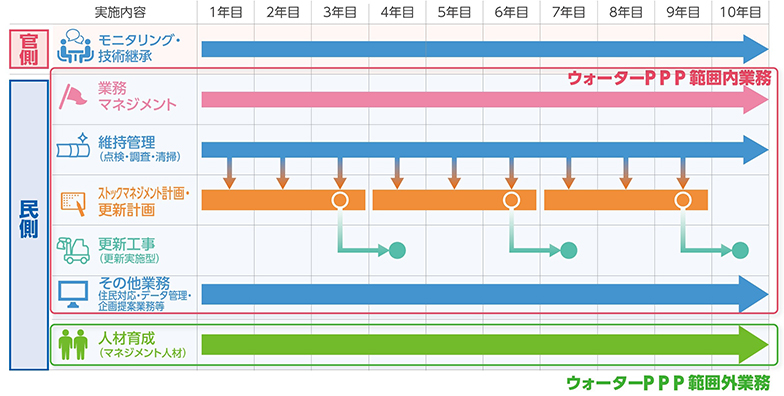
"By entrusting the work to the private sector, we can solve the challenges of resources, personnel, and finances. According to the water PPP guidelines compiled by the Ministry of Land, Infrastructure, Transport and Tourism, maintenance and renewal are managed in an integrated manner, and under a long-term contract of 10 years in principle, a private company will undertake the work as a whole. In one project we were awarded, by comprehensively outsourcing the work, the renewal of the pipeline was significantly accelerated compared to before, and we were able to return great benefits to the citizens."
Becoming a powerful partner that supports local governments with technology and services.
Sekisui Chemical has been handling the comprehensive reconstruction and renewal of municipal sewer systems since a project began in Kawachinagano City, Osaka Prefecture in 2014. In a project contracted by Kashiwa City, Chiba Prefecture from 2018, they became the first company in Japan to focus on the rehabilitation of sewer pipes as its main task, and implemented a new form of private outsourcing that emphasizes "preventive maintenance," taking measures before problems occur. Since then, they have steadily secured comprehensive projects nationwide, and in March 2024, they signed a contract for sewer management services ordered by Musashino City, Tokyo. This marks their sixth contract with a municipality for a similar project.
Why is Sekisui Chemical, a manufacturer, able to demonstrate its strengths in water-based PPPs? In response to this question, Tanaka cites "the technical capabilities to handle diverse construction methods" and "the ability to provide one-stop service that integrates products and technology."
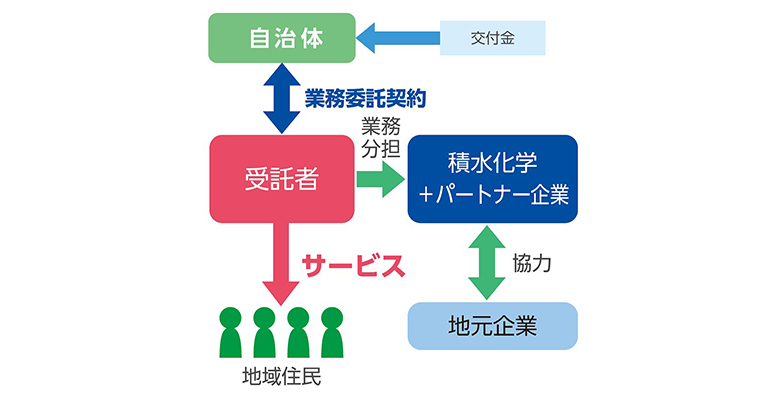
In water PPPs, a "profit-sharing" mechanism is required, where the reduction in construction and maintenance costs from the initial contract estimates is distributed between the public and private sectors. Furthermore, the overall requirements for the work generally only specify the performance to be achieved, and the specifications are basically left to the private sector, employing a "performance-based contracting" system. This provides an environment where Sekisui Chemical can fully utilize the technologies it has independently developed and accumulated.
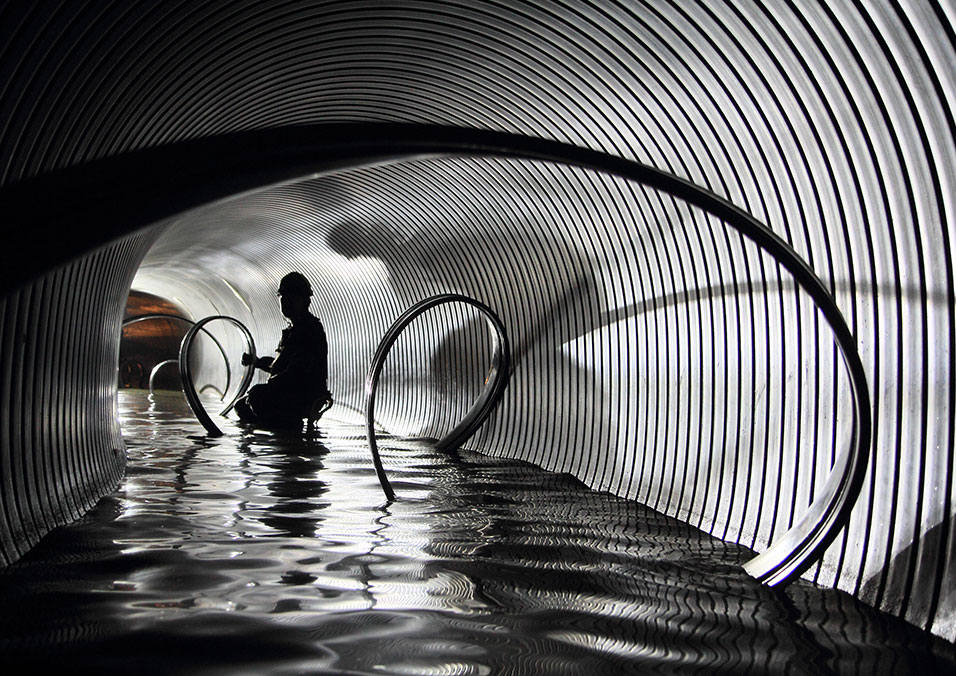
"There are various methods for pipe rehabilitation, that is, the technology for repairing sewer pipes from the inside, but the SPR method, which our company developed and maintains a competitive advantage over the existing pipe, involves creating a rehabilitation pipe made of rigid polyvinyl chloride inside the existing pipe and integrating the rehabilitation pipe with the existing pipe. It does not require excavating roads and can be carried out while sewer water is flowing, so it does not impose inconvenience on residents through traffic restrictions, etc. Sekisui Chemical has developed a variety of construction methods and has a rich product lineup. This allows us to make proposals that are tailored to the needs of each local government."
Projects led by the Public Procurement Project Planning and Development Office cover everything from planning and detailed design engineering to the sale of materials for pipeline rehabilitation, and even the survey and diagnosis of sewer pipes. A system is in place to manage the entire operation, with a project manager assigned to each local office, including in Musashino City. Masayuki Asano, the technical staff member, will provide a more detailed explanation of this "one-stop service capability."
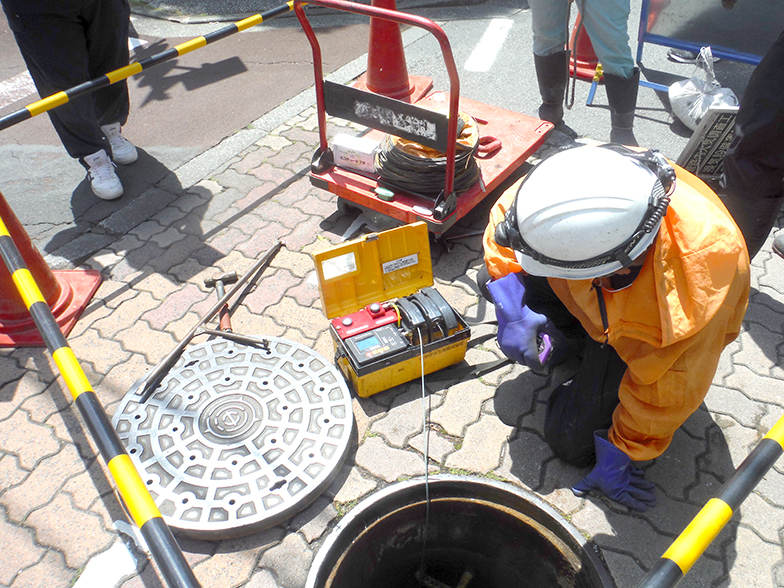
"In 2022, we developed the 'Expanded Type,' a medium-diameter pipe rehabilitation technology based on our conventional SPR method, further improving workability. Our strength at Sekisui Chemical lies in our ability to provide one-stop service from design and construction to maintenance and management."
In recent years, not only pipeline rehabilitation methods but also technologies related to inspection and diagnosis have evolved remarkably. Techniques for checking the condition of pipelines have been standardized, including the use of cameras for visual inspection, allowing for objective evaluation of pipeline conditions. Screening technologies for simpler inspections are also gaining attention, particularly for financially struggling municipalities. This enables more targeted preventative maintenance of pipeline facilities, prioritizing the treatment of critical problem areas.
Furthermore, we are also considering the use of AI-powered video analysis and efficiency improvements through big data analysis. By implementing these technologies on-site, we will have more opportunities to make new proposals. Ultimately, our goal is to manage infrastructure more efficiently and sustainably."
Water-based PPPs create new forms of regional collaboration and technological innovation.
Following the successful start of the project in Musashino City, neighboring municipalities are now considering placing orders. Expectations are high that this will serve as a starting point for urban water PPP models. Meanwhile, in Iwamizawa City, Hokkaido, Sekisui Chemical Hokkaido has been contracted to maintain the pipeline facilities since 2015, and as of 2024, the third phase of the project is underway. Iwai, seconded from Sekisui Chemical Hokkaido and involved in water PPP projects, discusses the background and expectations.
"A key feature of water PPPs is that the contract period is generally long, typically 10 years. Short-term contracts restrict the functioning of the PDCA cycle (plan, do, evaluate, improve), but a 10-year span allows for long-term management, including investment in personnel and equipment, by implementing the PDCA cycle."
In our collaborations with local governments, we believe that cooperation with local businesses is essential. During Hokkaido's harsh winters, the soil freezes and rises, sometimes creating uneven surfaces around manholes. To address these unique regional challenges, we, as a manufacturer, have made various proposals and worked in cooperation with local companies to solve the problems faced by local governments. We believe that this collaboration brings significant benefits to the infrastructure development of local governments and ultimately benefits the residents, and we are committed to this goal.
The government aims to introduce 100 water-based PPPs (Public-Private Partnerships) in the sewage sector over the 10-year period from fiscal 2022 to 2031, but the key year will be fiscal 2027. From that year onward, the introduction of a water-based PPP will be a mandatory condition for receiving national government subsidies for the reconstruction of sewage pipelines. Leading up to this milestone, Sekisui Chemical will provide meticulous support to local governments preparing for the introduction of these PPPs, while exploring the ideal form of implementation.
Torikoshi and Iwai emphasized collaboration with local governments and businesses, while Asano stated that they want to support the promotion of water PPPs by focusing on further improving products and technology. Tanaka, who oversees the team, is convinced that accelerating water PPPs will lead to solving social issues. As a leader, he spoke forcefully about the direction the project will take to support the future of citizens' lives.
"Based on our strength in pipeline rehabilitation technology, we will incorporate excellent technologies such as surveys and diagnoses to optimize projects that support water PPPs. Sekisui Chemical has a variety of solutions in addition to pipeline rehabilitation, such as disaster relief manhole toilets that appeal to disaster prevention and rainwater storage systems that mitigate flood damage."
We hope to strengthen our cooperation with local governments and contribute to society by having the solutions provided by Sekisui Chemical widely adopted in various regions. "Always offer creative and attractive proposals"—this is our team's motto.