
Corporate Governance
Basic Policy on Corporate Governance
SEKISUI CHEMICAL Group (hereinafter referred to as "our Group") has established the basic policy of corporate governance to pursue sustainable growth and enhance corporate value over the medium to long term. To achieve this, we will enhance management transparency and fairness, pursue swift decision-making, and, through the creation of social value set forth in our corporate philosophy, continue to meet the expectations of five stakeholders that our Group values: "customers," "shareholders," "employees," "business partners," and "local communities and the global environment."
SEKISUI Corporate Governance Principles
To further enhance our efforts to improve corporate governance and to communicate our philosophy and initiatives to our stakeholders, we have established and published the "SEKISUI Corporate Governance Principles."
In addition to the above principles, we have compiled and published our company's efforts and approach to the basic principles, rules, and supplementary principles of the Corporate Governance Code in a document titled "Our Approach to Each Principle of the Corporate Governance Code."
-
Corporate Governance Report (June 22, 2026)
(pdf:323KB) -
SEKISUI Corporate Governance Principles (June 19, 2026)
(pdf:501KB) -
Our approach to each principle of the Corporate Governance Code (June 19, 2026)
(pdf:511KB) -
Measures to realize management with capital costs and stock prices in mind (June 22, 2026)
(pdf:1,446KB)
Corporate Governance
Engine design
Our company has chosen a company with a board of auditors as part of its organizational design under the Companies Act. Under Divisional Company Organization System, we have introduced a Executive Officer system aimed at separating supervisory functions (directors) and business execution functions (Executive Officer) to quickly respond to changes in the business environment of each Divisional Company.
| Engine design | Company with a board of auditors |
|---|---|
| Total number of directors | 9 people (4 internal, 5 external) |
| Percentage of outside (independent) directors | 55.6% |
| Term of office of directors | 1 year |
| Executive Officer Adoption of the system | Yes |
| An organization that assists the CEO in decision-making. | Policy meeting |
| A voluntary advisory body to the Board of Directors | Nomination and Remuneration Advisory Committee Installed |
Previous efforts to strengthen corporate governance
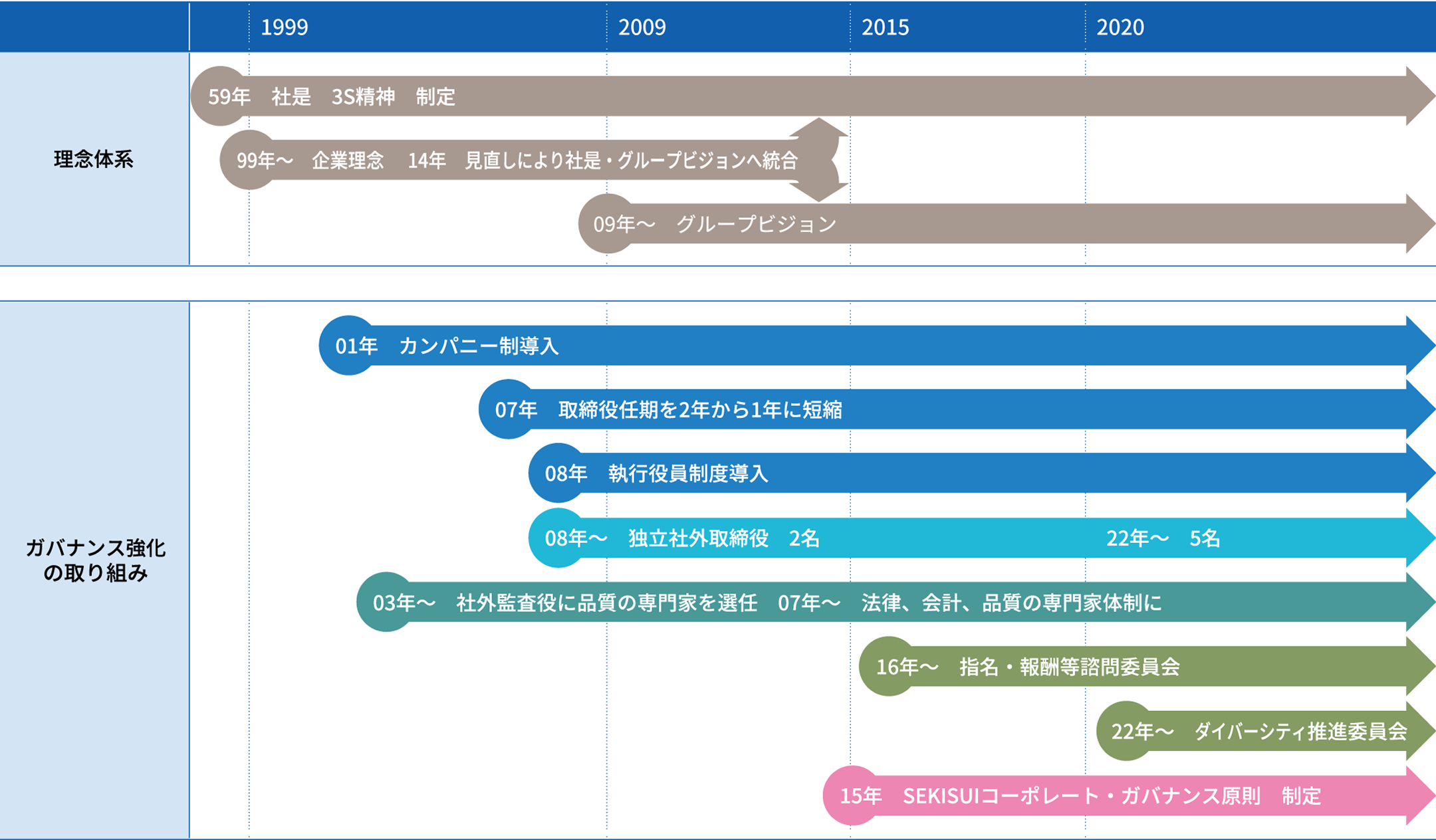
Corporate Governance Structure Diagram (as of June 22, 2026)
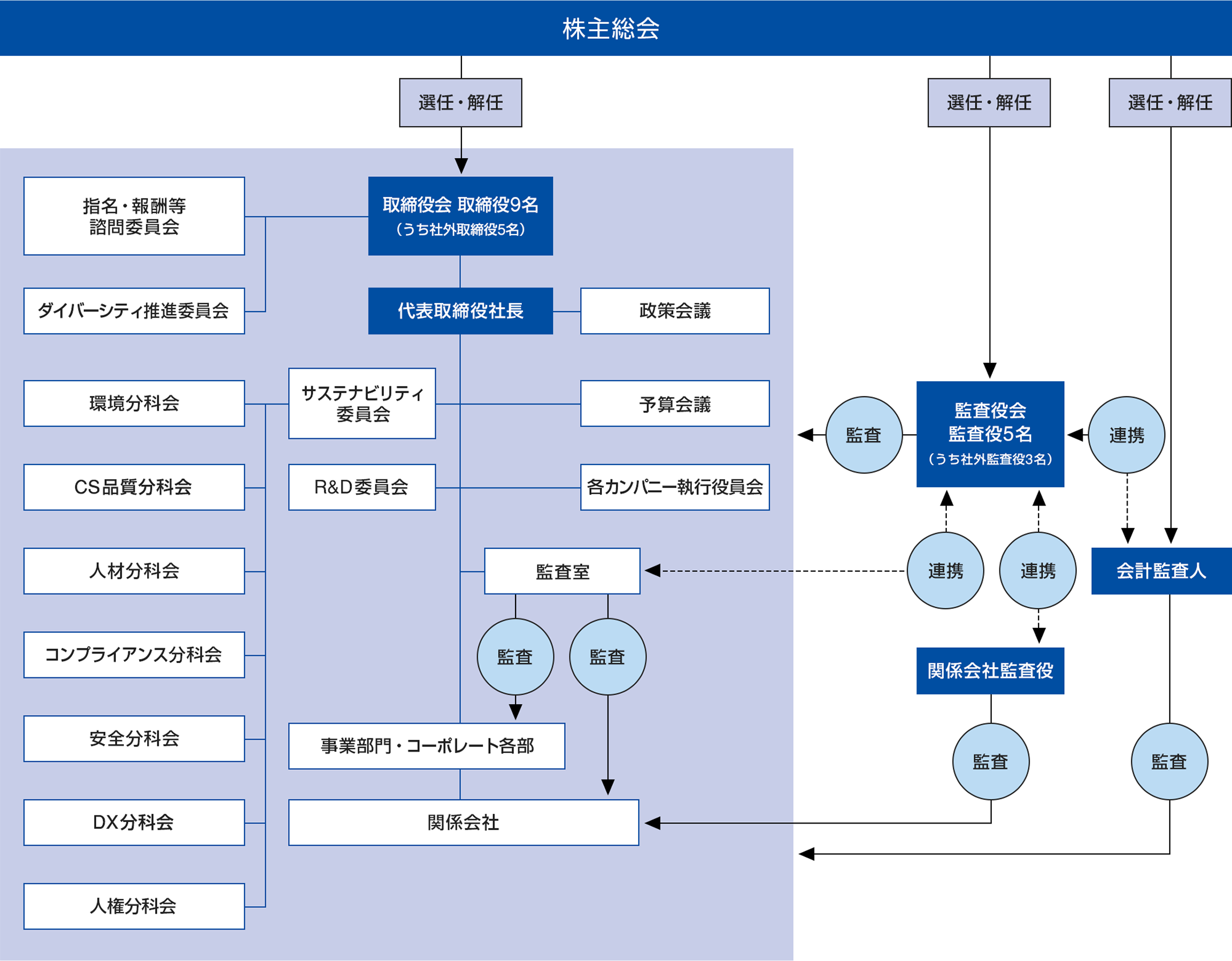
board of directors
Roles and responsibilities of the Board of Directors
The Board of Directors is positioned as the body responsible for determining the company's fundamental policies, making high-level management decisions, and supervising business operations.
By having the Chairman, who is a non-executive director, serve as the Chairman of the Board of Directors, and by appointing independent outside directors, we have established a highly effective oversight system for the directors, ensuring transparency and fairness in management.
Composition of the Board of Directors
Our company limits the number of directors to 15 or fewer, and we appoint several outside directors among them.
Our Board of Directors is comprised of directors who possess outstanding character, insight, and a high sense of ethics, as well as the knowledge, experience, and abilities to support them.
Furthermore, all auditors, including outside auditors, are required to attend board meetings. The board of auditors must include at least one person with knowledge and expertise in corporate finance and accounting, and at least one person with knowledge and expertise in legal systems.
Following the change in president in March 2026, the chairman, who is a non-executive director, now serves as the chairman of the board.
To ensure appropriate decision-making in line with our business domain and scale, we maintain diversity and an appropriate number of members on our board of directors.
We appoint corporate executives with extensive experience and expertise as internal directors, and include multiple independent outside directors with broad knowledge and experience, as well as auditors with specialized skills. This ensures a balanced diversity, appropriate size, and capabilities, allowing the board of directors to effectively fulfill its roles and responsibilities.
| full name | Our position | Years in office (At the conclusion of this general meeting) |
Attendance at our Board of Directors meetings (FY2025) |
Attendance at Board of Auditors meetings (FY2025) |
Attendance at Nomination and Remuneration Advisory Committee (Fiscal Year 2025) |
Promoting diversity Attendance at the Committee (Fiscal Year 2025) |
|---|---|---|---|---|---|---|
| Keita Kato | Chairman of the Board | 12年 | ●100% (17/17 times) |
― | 100% (9/9回) |
100% (3/3回) |
| Ikusuke Shimizu | President and CEO President Executive Officer |
7年 | 94% (16/17回) |
― | 100% (1/1回) |
100% (3/3回) |
| Tatsuya Nishida | Representative Director Senior Managing Executive Officer |
― | ― | ― | ― | 100% (1/1回) |
| Kazuya Murakami | Director Managing Executive Officer |
5年 | 100% (17/17回) |
― | ― | 100% (3/3回) |
| Hiroshi Oeda | Independent Outside Director | 8年 | 100% (17/17回) |
― | ●100% (9/9 times) |
100% (3/3回) |
| Haruko Nozaki | Independent Outside Director | 4年 | 100% (17/17回) |
― | 100% (9/9 times) |
100% (3/3回) |
| Miharu Koezuka | Independent Outside Director | 4年 | 100% (17/17回) |
― | 100% (9/9回) |
100% (3/3回) |
| Machiko Miyai | Independent Outside Director | 4年 | 100% (17/17回) |
― | 100% (9/9回) |
100% (3/3回) |
| Yoshihiko Hatanaka | Independent Outside Director | 3年 | 94% (16/17 times) |
― | 100% (9/9回) |
100% (3/3回) |
| Tomoyasu Izugami | Full-time auditor | 3年 | 100% (17/17回) |
●100% (15/15 times) |
― | ― |
| Michio Sakai | Full-time auditor | 1年 | 100% (14/14 times) |
100% (11/11回) |
― | ― |
| Yoshikazu Minomo | Independent outside auditor | 4年 | 100% (17/17回) |
100% (15/15回) |
― | ― |
| Wakyu Shinmen | Independent outside auditor | 3年 | 100% (17/17回) |
100% (15/15回) |
― | ― |
| Kenji Tanaka | Independent outside auditor | 3年 | 100% (17/17回) |
100% (15/15回) |
― | ― |
| full name | Knowledge, experience, and abilities possessed by directors and auditors | |||||||||
|---|---|---|---|---|---|---|---|---|---|---|
| management | Core functions of the manufacturing industry | Preparation for the long term | Strengthening the Management Foundation | |||||||
| Corporate Management, Business Strategy | Production, Safety, Quality | Marketing, Sales | environment | Innovation (Research and Development, New Business Development, Alliances) | Global Business | DX (Digital Transformation) |
Legal, Compliance | Finance , Accounting | Human Resources, Diversity, Human Rights | |
| Keita Kato | ● | ● | ● | ● | ● | ● | ● | |||
| Ikusuke Shimizu | ● | ● | ● | ● | ● | ● | ● | |||
| Tatsuya Nishida | ● | ● | ● | ● | ● | ● | ||||
| Kazuya Murakami | ● | ● | ||||||||
| Hiroshi Oeda | ● | ● | ● | ● | ||||||
| Haruko Nozaki | ● | ● | ||||||||
| Miharu Koezuka | ● | ● | ● | ● | ||||||
| Machiko Miyai | ● | ● | ● | ● | ● | |||||
| Yoshihiko Hatanaka | ● | ● | ● | ● | ||||||
| Tomoyasu Izugami | ● | ● | ● | |||||||
| Michio Sakai | ● | ● | ● | ● | ||||||
| Yoshikazu Minomo | ● | ● | ||||||||
| Wakyu Shinmen | ● | |||||||||
| Kenji Tanaka | ● | ● | ● | |||||||
(Note) 1. ● indicates the chairperson or chairman.
(Note) 2. The above list does not represent all of the knowledge possessed by the directors and auditors.
Regarding the age distribution of the executives
| Under 30 | 30-39 years old | 40-49 years old | 50-59 years old | 60 years of age or older | |
|---|---|---|---|---|---|
| Number of directors by age group (people) | 0 | 0 | 0 | 0 | 9 |
As of June 20, 2026
Outside Director
We have appointed independent outside directors who can provide oversight and advice based on their extensive management experience and expertise from a different background, thereby contributing to the enhancement of our corporate value. In particular, we receive advice from them from diverse and objective perspectives on initiatives that we are focusing on, such as global expansion, business model innovation, and strengthening ESG management.
Hiroshi Oeda Outside Director
He serves as a special advisor to Nisshin Flour Milling Group Inc., and we have appointed him because we believe that he will be able to leverage his broad experience and skills, cultivated as the head of Japan's largest flour milling company, in global corporate management, business strategy, and overseas M&A, to provide advice on our management and appropriately supervise our business operations, thereby contributing to the enhancement of our group's corporate value.
Haruko Nozaki Outside Director
He has experience in personnel and education at Horiba Manufacturing Co., Ltd., as well as deep insight into Promoting diversity and next-generation development. He currently serves as a director at Kyoto University and an outside director at West Japan Railway Company. Our company has appointed him because we expect him to provide accurate advice on medium- to long-term issues, focusing on human resource expertise, at the Board of Directors, and believe that he will contribute to enhancing the corporate value of our group.
Miharu Koezuka Outside Director
He has served as Representative Director and General Manager of Planning and General Manager of Sales at Takashimaya Co., Ltd., and has been involved in the company's management for many years as a member of the management team. He currently serves as an outside director of Japan Post Holdings Co., Ltd. and Nankai Electric Railway Co., Ltd. We have appointed him to our board of directors because we expect him to leverage his experience in various industries to provide multifaceted and accurate advice, and we believe that this will contribute to enhancing the corporate value of our group.
Machiko Miyai Outside Director
Having held executive positions at Panasonic Corporation and subsequently served as a director and head of the marketing department at Morinaga & Co., Ltd., he possesses broad work experience in industries different from ours, primarily in consumer-oriented roles. We have appointed him to the Board of Directors because we expect him to leverage his extensive experience and broad knowledge to provide accurate advice, thereby contributing to the enhancement of our group's corporate value.
Yoshihiko Hatanaka Outside Director
Having held various executive positions at Astellas Pharma Inc., he possesses extensive experience in global corporate management cultivated through his rich overseas experience in Europe, the United States, and other regions. In addition, his experience as head of corporate planning gives him a high level of expertise regarding corporate mergers and acquisitions. We have appointed him to the Board of Directors because we expect him to provide appropriate advice to the management of our group based on this experience and track record, and we believe that he will contribute to enhancing the corporate value of our group.
Evaluation of the effectiveness of the board of directors
Our company conducts an annual evaluation of the effectiveness of the Board of Directors.
Through surveys targeting directors and auditors, we confirm that sufficient deliberation time is secured at the Board of Directors, and that active proposals of opinions are made by directors and auditors, including outside directors.
Furthermore, aiming to further improve effectiveness, we review and revise as needed based on the responses from surveys, such as adding important management agenda items.
The main board agenda items for fiscal year 2024 were growth strategy (R&D, large-scale new businesses, large-scale capital investments, etc.) and foundational strategy (sustainability, digital transformation, safety, compliance, CS & Quality, etc.).
Support and collaboration with directors and auditors
For outside directors, to enhance deliberations at the Board of Directors, we continuously provide opportunities to deepen understanding of the business through pre-distribution of Board materials and prior briefings by the executive in charge of the secretariat, as well as orientations upon appointment and visits to business sites. Furthermore, to further enhance the effectiveness of outside directors' management supervision, we enhance deliberations by Nomination and Remuneration Advisory Committee whose majority of committee members are outside officers, and also conduct dialogues with auditors and accounting auditors. From the perspective of succession planning, we strengthen connections between current management and next management candidates by giving lectures by outside directors at quarterly Executive Officer liaison meetings and providing opportunities for directors, auditors, and Executive Officer to gather together after the new management structure after the shareholders' meeting.
Business site visit
In fiscal year 2025, the Housing Company Development Division conducted inspections focusing mainly on new products.
Understanding external trends in economic, environmental, and social areas.
At the quarterly financial results Executive Officer liaison meetings, alongside sharing financial results announcements, we invite external speakers to obtain the latest information on economic, environmental, and social trends directly related to management issues.
[Executive Officer 2025 Lecture Theme of the Liaison Committee
① Mr. Toru Muranaka, Attorney at Law, Daiichi Law Office
Theme: "Prevention of Insider Trading and the Responsibilities of Officers and Employees"
② Kirin Holdings Co., Ltd.
Mr. Yoshinori Isozaki, Representative Director, Chairman, CEO, and Chief Executive Officer
Theme: "Kirin's CSV Management and Challenges for the Future"
(3) Resona Asset Management Co., Ltd.
Executive Officer Tomoyuki Tsutaya
Theme: "Corporate Value and Engagement of Equity Active Fund Managers"
④ Mr. Takeshi Matsumoto, Japan Innovation Network (General Incorporated Association)
Theme: "How to Create Innovation for the Future"
Nomination and Remuneration Advisory Committee
To complement the functions of the Board of Directors and further enhance fairness and transparency in management, we have established a voluntary advisory committee regarding nominations, remuneration, and other matters.
Nomination and Remuneration Advisory Committee Deliberates on matters related to the appointment and dismissal of executive management, nomination of director candidates, director compensation systems and levels, matters related to improving the effectiveness of the Board of Directors, appointment and treatment of advisors and advisors such as former President and CEO, and provides opinions and advice to the Board of Directors.
Nomination and Remuneration Advisory Committee shall consist of seven committee members, with a majority of independent outside officers, and the chairperson shall be selected from among the independent outside officers.
Executive compensation, etc.
(1) Policy on determining remuneration, etc.
Our executive compensation system is based on the following principles in order to realize our group's management philosophy.
- This will contribute to the sustainable growth of our group and the enhancement of our corporate value in the medium to long term.
- Our company's executives share a focus on profits with our shareholders and enhance a shareholder-centric management approach.
- For our executives, it is a highly performance-linked compensation system that motivates them to achieve management plans.
- To enhance the competitiveness of our group, we need a system and standards that enable us to acquire and retain diverse and excellent management talent.
Furthermore, the compensation for our executive directors consists of base salary, bonuses, and stock-based compensation, while the compensation for outside directors and auditors consists solely of base salary.
- Basic compensation is paid within the executive compensation framework, at a fixed amount commensurate with the role and responsibilities. Executive directors are required to purchase a certain portion of their basic compensation through the executive stock ownership plan, thereby fostering a management mindset that prioritizes stock value.
- Bonuses are performance-linked compensation determined by reflecting the role multiplier set by job roles, as well as the achievement of targets for financial indicators (such as operating profit and ROIC) and non-financial indicators (environment, human capital, etc.) based on the current fiscal year's results, reflecting Divisional Company other multipliers (60%~120%) linked to the achievement of targets for ROE and dividend amounts
- Stock-based compensation is an incentive plan that sets the number of shares to be granted according to the director's duties, with the aim of further increasing the motivation of directors to contribute to the improvement of our group's medium- to long-term performance and increase corporate value. The system is designed so that directors can enjoy the rewards of their contributions to the improvement of corporate value in the medium to long term in the form of shares that reflect the value of the company upon their retirement, and is designed to be more closely linked to medium- to long-term shareholder value.
Our executive compensation is determined according to their position and duties, with performance-linked compensation ratios set so that higher positions increase, and the performance of the Divisional Company in charge is reflected in their duties.
Basic compensation and bonuses, which are monetary compensation, will be paid regularly during your tenure, while stock-based compensation will be paid in a lump sum upon retirement.
(2) Executive compensation determination process
When deciding on policies regarding the amount or calculation method of our directors' remuneration, we will deliberate in advance at Nomination and Remuneration Advisory Committee and report the results to the Board of Directors. The outline of the procedures handled by Nomination and Remuneration Advisory Committee is as follows.
- This committee is convened by the chairperson (an outside director).
- The agenda items for this committee are submitted by each committee member, and the secretariat compiles them and presents them to the chairperson.
- The committee's findings will be reported to the Board of Directors by the chairperson.
- The Board of Directors will make the final decision regarding the policy for determining directors' compensation, as well as the specific amounts, timing, and methods of individual director compensation, while respecting the recommendations of this Committee. Furthermore, members of this Committee and directors are required to make these decisions from the perspective of whether they contribute to the company's corporate value and, ultimately, to the common interests of shareholders, and not for the purpose of pursuing their own personal interests or the personal interests of third parties, including the company's management.
In the process of determining the amount of remuneration for the 104th fiscal year, the Board of Directors deliberated on the level of director compensation, individual evaluations of directors, and the details of compensation in Nomination and Remuneration Advisory Committee in June 2025 and May 2026, and then decided on it at the Board of Directors.
Furthermore, the performance-linked compensation indicators are selected to ensure that our directors effectively serve as incentives to enhance corporate value and achieve management plans, and to ensure a highly objective and transparent compensation process. We select Divisional Company performance that reflects company-wide performance targets such as operating profit and the performance of our group's Divisional Company Organization System, ROE as evaluation criteria for enhancing corporate value, ROIC, dividends to motivate shareholders to return these management results to shareholders, and other indicators. The method for determining the payment amount utilizes executive compensation data from external research agencies, regularly compares with companies of similar scale and performance to our group, and determines the balance of the above indicators.
Executive compensation for fiscal year 2025
(Amount: million yen)
| classification | Basic remuneration | bonus | Stock-based compensation | total | ||||
|---|---|---|---|---|---|---|---|---|
| Target Personnel | Amount | Target Personnel | Amount | Target Personnel | Amount to be recorded as an expense | Target Personnel | total amount | |
| Director | 13 people | 418 | 7 people | 312 | 7 people | 109 | 13 people | 841 |
| Our outside directors | 5 people | 72 | -given name | - | given name | - | 5 people | 72 |
| Auditor | 6 people | 83 | -given name | - | given name | - | 6 people | 83 |
| Our external auditor | 3 people | 36 | -given name | - | given name | - | 3 people | 36 |
(Note) 1. The above includes one director and one auditor who retired at the conclusion of the 103rd Ordinary General Meeting of Shareholders held on June 20, 2025.
(Note) 2. The above amount of compensation, etc. does not include the 48 million yen equivalent to the employee salary and bonus paid to the employee-director.
Guidelines for Executives Holding Company Shares
To further enhance the motivation to contribute to medium- to long-term performance improvement and corporate value growth for directors (excluding outside directors) and Executive Officer, we have introduced a "stock compensation system" and established "treasury stock ownership guidelines" requiring shareholders to hold a certain number of shares.
Executive Officer System and Executive Officer Meetings
To maximize corporate value, our company has established a management system based on Divisional Company Organization System. We assign Executive Officer dedicated to business execution in each Divisional Company, and have established the Executive Officer as the highest decision-making body of the Divisional Company, delegating significant authority from the Board of Directors. The term of office for Executive Officer is one year, and appointments are made by resolution of the Board of Directors.
By delegating authority to Divisional Company, the Board of Directors will be responsible for determining the basic management policies of SEKISUI CHEMICAL Group, making advanced management decisions, and supervising business execution, striving to continuously enhance corporate value.
Management structure
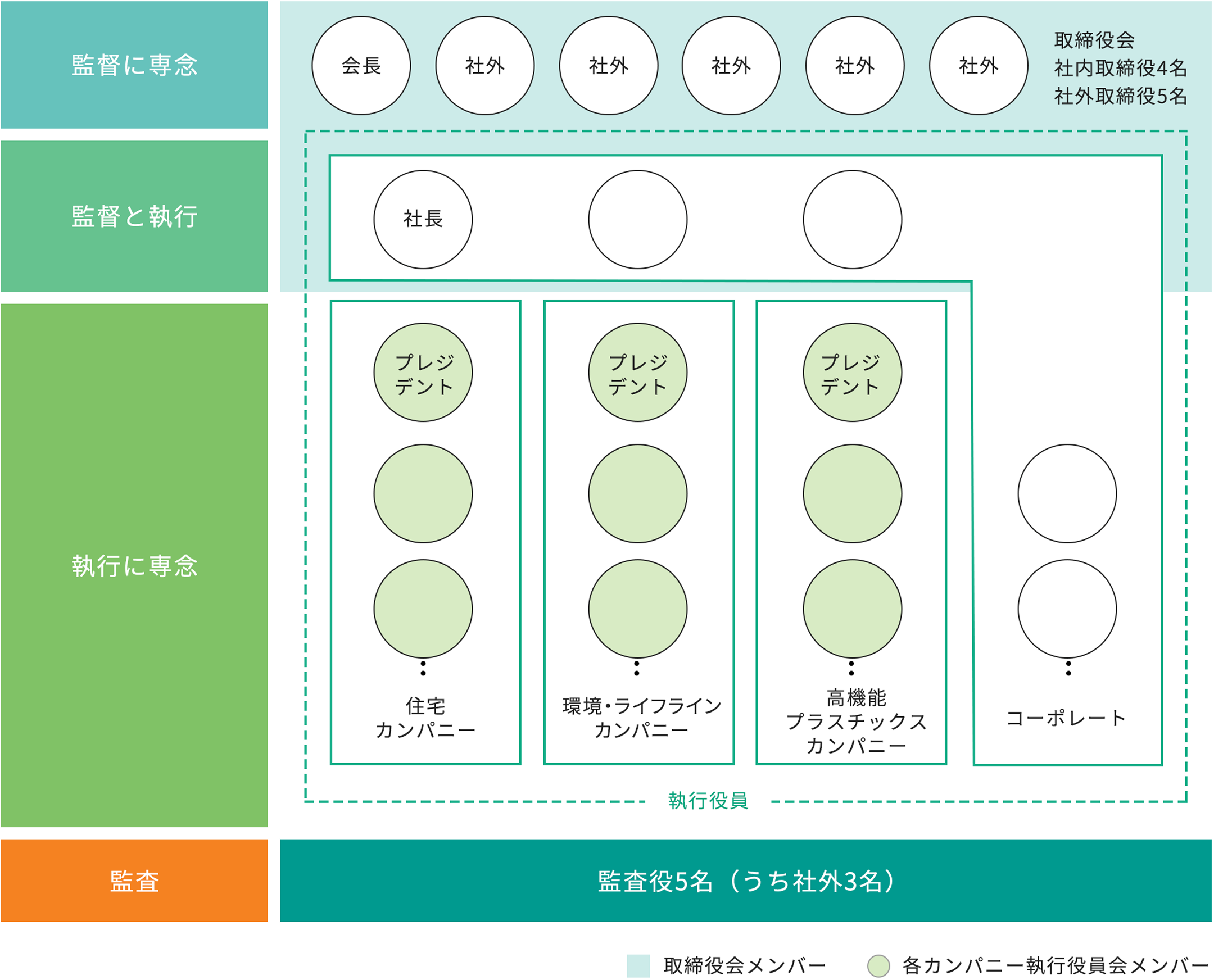
Audit System
Approach to the appointment of corporate auditors
The board of auditors consists of five members in total: two full-time internal auditors and three part-time external auditors. We strive to appoint individuals with knowledge and expertise in corporate finance and accounting (at least one), legal systems (at least one), and manufacturing and customer satisfaction (CS) quality (at least one), which are extremely important for a manufacturer.
For the 2026 fiscal year, we have appointed individuals with experience as factory managers and heads of our audit departments to serve as internal auditors.
Our external auditors consist of three individuals: a certified public accountant with experience working at an auditing firm, a lawyer with extensive experience in corporate law, and a university professor specializing in quality control.
Internal control system
In May 2006, the Board of Directors resolved to establish a basic policy regarding the construction of an internal control system to ensure the proper conduct of business operations within our company.
Specifically, based on the "Corporate Code of Conduct" which is rooted in the group's management philosophy, we are working to ensure proper operation across the entire group by strengthening coordination in command, control, and communication between our company and group companies, and by providing guidance, advice, and evaluation to group companies.
General internal control systems
In order to properly establish and operate the internal control systems of our company and group companies, our audit department conducted operational and accounting audits of our company and group companies based on the annual audit plan, and audited whether business operations were being carried out appropriately and efficiently.
compliance
The Board of Directors deliberates and decides on basic policies related to compliance. Additionally, as an executing organization, the Legal Department operates a compliance subcommittee with the secretariat. In this subcommittee, Divisional Company includes the head of the corporate management department and the head of the audit office as members, and discusses compliance activity achievements, reports on matters deliberated by the Compliance Council, and future activity policies.
Directors' performance of duties
To ensure the efficiency of the directors' duties, the Board of Directors held 17 meetings in fiscal year 2025. Furthermore, important matters related to our management policies and strategies were discussed in a policy meeting comprised of our internal directors (executive side), and then decided upon by the Board of Directors after deliberation.
Performance of duties by auditors
The corporate auditors confirmed the development and operation of the internal control system by attending various important meetings in addition to board meetings, conducting on-site inspections of relevant departments including group companies, and reviewing approval documents for important matters. They also received reports from various corporate departments responsible for various controls. In fiscal year 2025, the Board of Corporate Auditors held 15 meetings to share this information.
We regularly exchanged reports and opinions with our external auditors regarding the status of each other's audits, strengthening cooperation and enhancing the effectiveness of the audits. Our audit department reported on our audit policies, audit plans, and audit results, and we exchanged opinions with them. We also held meetings with the external auditors, the audit department, and the corporate auditors to promote coordination among the three audit departments. We exchanged information with the corporate auditors of our group companies to strengthen cooperation among them and improve audit quality. Furthermore, we held regular meetings with the representative director and exchanged opinions with outside directors.
Risk Management
SEKISUI CHEMICAL Group We have established a risk management system that centrally manages activities to prevent risks from occurring (risk management) and activities to respond when risks arise (crisis management).
In risk management activities, as the business environment becomes increasingly uncertain and complex, we comprehensively identify risks related to corporate value based on the "SEKISUI CHEMICAL Group Risk Management Guidelines." We have established an ERM (Company-wide Risk Management) system that quantifies each risk from the perspectives of "likelihood of occurrence" and "impact," identifies risks that should be prioritized, and shares and manages them within our group. For company-wide risks and risks identified within each organization, we conduct an annual management cycle (PDCA) in which we analyze and evaluate them, take countermeasures, and conduct ongoing reviews to make corrections.
In the unlikely event of a serious incident, crisis management activities are carried out based on the "SEKISUI CHEMICAL Group Crisis Management Guidelines." To ensure prompt and accurate responses, we regularly hold crisis management liaison meetings consisting of each corporate specialized department and Divisional Company personnel, conducting case studies and training.
Furthermore, since fiscal year 2021, as a group-wide initiative, all organizations have been revising and formulating initial response plans (ERP) with "life protection" as the top priority, and major business units have developed resource-based business continuity plans (BCPs) as "all-hazard BCPs" to respond to all crisis events.
Management of Group Companies
We have established a system for receiving approvals and reports from group companies to our company through our domestic and international affiliate handling rules and affiliate approval criteria. In addition, our audit department conducts internal audits, and the results of audits conducted by the auditors of group companies are compiled by our board of auditors.
Engagement
Our group believes that timely, appropriate, and proactive information disclosure is crucial for deepening mutual understanding and building trust with all stakeholders. To ensure that this principle is put into practice throughout our group, we have established "Corporate Information Disclosure Rules" under our "Corporate Information Disclosure Philosophy," outlining specific disclosure content and systems, thereby strengthening our internal information disclosure system.
Furthermore, the Corporate Strategy Department's IR Group is working to strengthen engagement with shareholders and investors. This includes not only disclosing financial results and other management-related information in a timely and appropriate manner, but also actively incorporating shareholder feedback into management decisions. Specifically, in addition to quarterly earnings briefings by management, we actively hold one-on-one meetings with analysts and institutional investors to listen to the voices of the capital market.
When disclosing information, we give full consideration to fair disclosure. Financial results and presentation materials are published simultaneously in Japanese and English on our website, and audio recordings of the presentations and Q&A sessions are also available.
Multi-stakeholder policy
Our company has established the following multi-stakeholder policy: