Delivering new value through "materials" to the automotive industry, which is undergoing a once-in-a-century transformation.
公開日:

What thoughts and stories were behind its development?
How will that connect to the people and societies living on Earth?
"SEKISUI | Connect with" is a future-creating media platform that connects you with Sekisui Chemical.
- New materials will support the era of carbon neutrality and electric vehicles.
- Providing services of the same quality worldwide. Implementation is progressing with a sense of urgency.
- Panoramic roofs and head-up displays—supplying products ahead of the trends.
- Leading the new era of EVs and shaping a new future through the value created by materials.
As the impacts of climate change worsen, carbon neutrality has become a common long-term goal worldwide. The Japanese government also aims to achieve this by 2050, and efforts toward decarbonization are progressing in all industries. In this context, the automotive industry is attracting attention. In Japan, the transportation sector, including automobiles, accounts for 17.4% of CO2 emissions (FY2021), making measures aimed at decarbonizing from the automotive sector particularly important.
At that time, the automotive industry is in the midst of a major transformation called the "once in a hundred years." New forms of mobility are being explored while suppressing CO2 emissions. What creates value here are the "materials" that ensure vehicle performance, safety, and comfort. Sekisui Chemical provides essential products for vehicles advancing electrification and supports the next generation of vehicles. What are the current expectations for high-value materials that bring innovation, as the electrification of automobiles accelerates due to environmental issues? High Performance Plastics (HPP) Company and members involved in Sekisui Polymatic's business, we asked.
New materials will support the era of carbon neutrality and electric vehicles.
The automotive industry is currently undergoing a paradigm shift known as "CASE." This is an acronym for "Connected," "Autonomous," "Shared & Services," and "Electric." In pursuit of carbon neutrality, the automotive industry is focusing on the "E" (electrification) aspect of CASE.
The electrification of automobiles is progressing through various approaches, including "EVs (electric vehicles)" that run entirely on electricity, "HV/HEV (hybrid vehicles)" and "PHV/PHEV (plug-in hybrid vehicles)" that use both gasoline and electricity, and "FCV/FCEV (fuel cell vehicles)" that generate electricity using hydrogen. From gasoline cars that emit CO2 to EVs—however, there are obstacles to EVs supporting our mobility and becoming widespread as the next generation of mobility. One of these is the challenge of "shorter driving range" compared to gasoline cars.

Sekisui Chemical provides "interlayers (laminated glass interlayers)" and "heat dissipation materials" as materials for vehicles. These two products serve as solutions to the challenge of driving range. Seiki Yamamoto, who is in charge of product strategy for interlayers at High Performance Plastics (HPP) Company, explains the starting point in the EV field.
"Automotive windshields, side windows, and roof windows utilize laminated glass, which consists of two panes of glass with a transparent film called an 'interlayer' sandwiched in between. The basic function of the interlayer is to increase the strength of the glass, prevent shattering, and enhance safety and security. By sandwiching a transparent film called an interlayer, various functions can be given to the glass. Our company manufactures and sells these interlayers globally. In recent years, there has been a growing need for heat-insulating and sound-insulating functions for EVs."
The heat-shielding interlayer blocks sunlight from entering the car through the windows, creating a more comfortable interior environment, and also contributes to extending the EV's driving range by reducing the power consumption of the air conditioner. "The heat-shielding film is the world's first nanoparticle dispersion interlayer developed independently by Sekisui Chemical," says Yamamoto and Takinami, who is at the forefront of the group.

"We have established the world's first technology to uniformly disperse nano-scale infrared-absorbing microparticles in an interlayer film. Sekisui Chemical is a Tier 2 (secondary component manufacturer) supplying interlayer films to Tier 1 (primary component manufacturers) glass manufacturers in the automotive industry's supply chain. Looking ahead to the era of electric vehicles, we have been repeatedly upgrading our products and conducting experiments to improve heat shielding performance. We are now releasing products that contribute to reducing power consumption and extending the driving range of EVs."
In addition to heat shielding, the sound insulation function of the interlayer is also attracting attention. According to Takinami, there are reasons for this that are unique to the EV era.
"EVs are characterized by their quietness, but this also means that noises that were previously masked by engine noise become more apparent. The sound-insulating interlayer we have developed reduces the transmission of noise coming from outside the vehicle, contributing to improved comfort inside the car. Noise originates from various sources outside the vehicle, such as wind noise from the mirrors and turbulence generated by the wipers. For this reason, the use of sound-insulating interlayers is expanding beyond the windshield to include side door windows and roof glass."

Another approach aims to extend the driving range of EVs by focusing on the batteries and chargers that power the vehicle's operation. The key is to control the heat generated by these devices and manage their temperature appropriately. If heat builds up inside the battery or charger pack, it can lead to performance imbalances, which can significantly impact vehicle safety and battery life.
"SEKISUI CHEMICAL Group provides heat dissipation materials—materials that contribute to improving battery safety and performance—based on the bonding, heat dissipation, and molding technologies we have honed over the years," says Taguchi, who has been involved in sales of heat dissipation materials at Sekisui Polymatech.
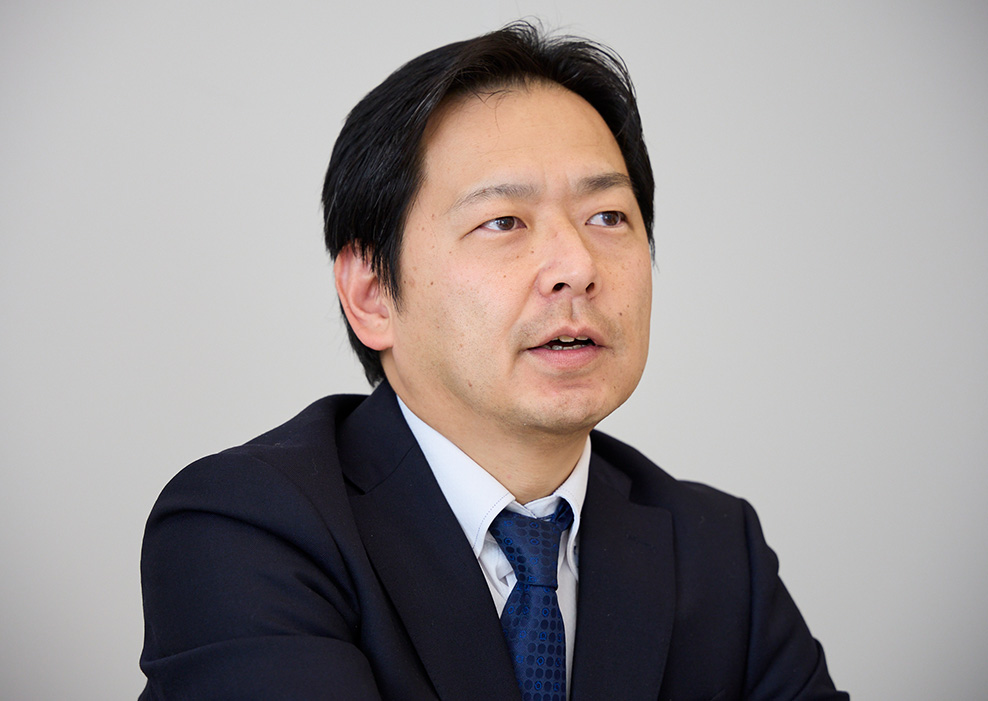
"It was European automakers who first focused on two-component curing grease heat dissipation materials. Our products have gained high praise and trust for use in EV batteries in European cars, and we maintain a leading position globally. Sales have spread from Europe to North America and then to the rest of the world," says Taguchi emphatically, describing the presence of heat dissipation materials. Inside EVs, sheet-type heat dissipation materials with excellent heat insulation and heat retention properties, as well as this grease-type material, are used. Sheets with high thermal conductivity and flexibility are the mainstream, but with the spread of EVs, there has been a growing need for heat dissipation materials that are ideal for automation to increase productivity, and for grease-type materials that can dissipate heat even in small amounts.
"While the heat dissipation properties of the heat dissipation material itself are a prerequisite, the key is how easy we can provide materials that are to use on the production floor. The keyword is 'customization.' These are materials that fit into Tier 1 production processes and are easier to use. We listen to the needs of European automakers and develop and provide products that contribute to the manufacturing site."
Providing services of the same quality worldwide. Implementation is progressing with a sense of urgency.
The heat-shielding interlayer reduces the air conditioning load, supporting the reduction of EV power consumption. How will they develop and release an interlayer that fits the EV era? "We have always manufactured products based on a market-in philosophy, understanding market needs, rather than a product-out approach where the product comes first," Takinami reflects.
"I was stationed in the Netherlands and have experience in marketing and sales in Europe. I recall conducting numerous interviews to understand what materials automakers were looking for. I supported development while anticipating the future of the market and how it would change. I believe that leveraging the advantage of gathering information on the ground in Europe, we not only analyzed the market but also delved deeper into the needs of manufacturers and identified the materials they required. That is the essence of Sekisui Chemical's manufacturing philosophy."
"Interlayer R&D is driven by research centers in various countries, while product sales and service are supported by collaboration between sales and technical teams at manufacturing sites in each country," Yamamoto said, highlighting the strengths of their global network.
"In addition to our development center in Japan, we have research centers in Europe, China, and the United States, where we are conducting research and development of high-performance interlayers tailored to local needs. In the CASE (Connected, Autonomous, Shared, Electric) sector of the automotive market, advanced in-vehicle products are being released in a timely manner from Europe and China, and technological innovation in the field of autonomous driving is also remarkable. New interlayer products are developed and implemented while keeping up with the innovations progressing around the world."
Furthermore, Sekisui Chemical has manufacturing bases in six locations around the world, and each base has sales and technical service members working there, providing one-stop service for product sales and service provision. This allows us to share and resolve technical challenges across all local locations, sell products of globally unified quality, and provide consistent service."
"First, we try making something. We have a technical culture that excels at customization," Taguchi says, referring to "Sekisui Chemical's unique approach to manufacturing" from the perspective of heat dissipation materials.
"Because we have a technological foundation that allows us to respond quickly, we can develop products that are in line with current trends and make improvements that reflect feedback from manufacturers with a sense of urgency. In 2023, Sekisui Polymatec established a new production base in the United States and started producing heat dissipation materials for EVs and other applications. This base will not only expand our production capacity and strengthen our global supply system, but will also accelerate our marketing activities in North America and Europe, and will focus on developing new mobility products."
Panoramic roofs and head-up displays—supplying products ahead of the trends.
The mobility sector is becoming a strategic area where companies are fiercely competing in development. What needs and trends will interlayers and heat dissipation materials identify, and how will they develop and provide new products?
As Yamamoto works on implementing new interlayers, he is closely watching the evolution of EV-specific layouts and exteriors. Because EVs have batteries under the seats, the driver's seat tends to be positioned higher than before. This raises the seating position and reduces headroom, creating a feeling of confinement. Therefore, to give the driver a sense of openness, automotive designers are focusing on panoramic roof glass.
"Panoramic roof glass provides benefits such as an open driving experience while ensuring sufficient headroom for the driver and passengers. Therefore, an increasing number of manufacturers are using functional automotive glass in their exterior designs to differentiate their vehicles."
We have released a new product that combines the aforementioned heat-shielding interlayer with privacy-colored tinting. This can be considered a good example of catching on to trends ahead of time."
"For the interlayer film used in panoramic roofs, we're not only focusing on design and coloring, but also on improving the specifications required for the product," Takinami explains, adding a technical point.
"As Mr. Taguchi mentioned regarding heat dissipation materials, our ability to customize is one of our strengths. When it comes to combining heat shielding and coloring, adjusting the transmittance and pigment composition is essential to achieving both the desired color and heat shielding. We are able to provide interlayers that are optimal for EVs thanks to the technologies we have refined, such as particle dispersion and control of optical properties."
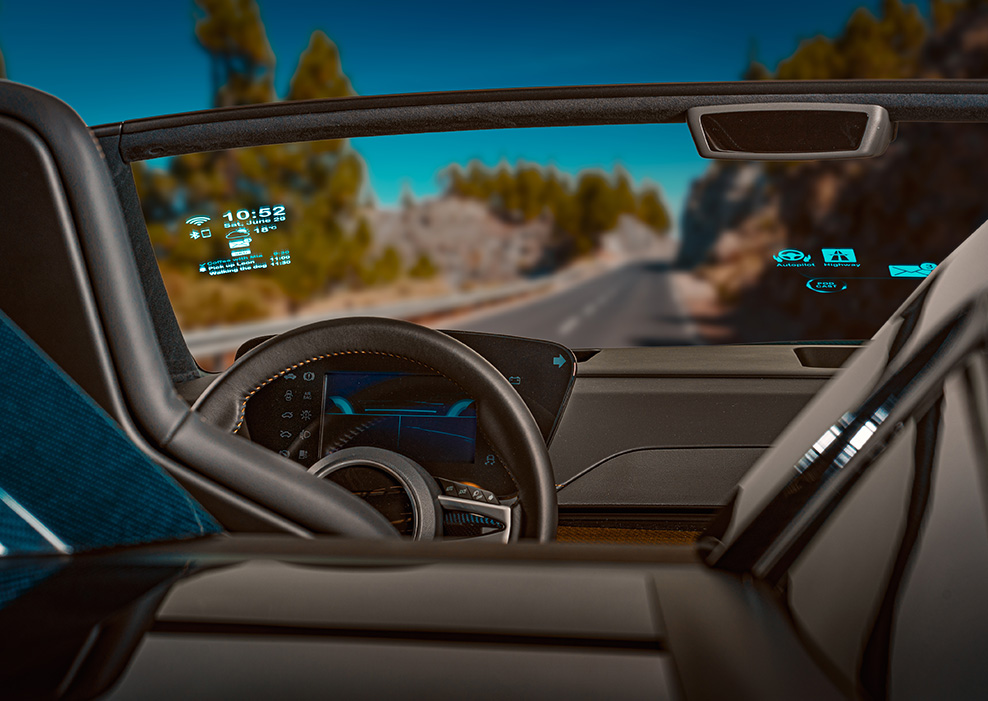
We're seeing an increase in the use of dimmable glass as a new privacy feature, and we expect head-up displays (HUDs) that show speed and lane information on the windshield while driving to become more widespread. Innovative ideas will continue to emerge and be implemented in EVs. We will fully utilize our global network's technological capabilities and proposal skills to provide new interlayers in a timely manner.
Taguchi explains that in the field of heat dissipation materials, there is a growing need for materials that support environmental considerations and operational safety.
"Our heat dissipation materials have been praised for their low thermal resistance, low specific gravity, and low volatility, but we also possess technologies to enhance safety by incorporating flame retardancy and heat absorption properties, as well as technologies for recycling heat dissipation materials. By promoting the recycling of heat dissipation materials, we aim to contribute to reducing CO2 emissions, and heat-absorbing materials are intended to prevent the spread of fire in the event of ignition. We hope to reach out to drivers for their safety and peace of mind while also being mindful of the environment."
Leading the new era of EVs and shaping a new future through the value created by materials.

With an eye on market trends in the EV era, we will deliver our products globally with a broad perspective. The members involved in the development and supply of interlayer and heat dissipation materials all agree that "product development and sales are inextricably linked to sustainability."
Takinami predicts, "As the automotive industry faces a once-in-a-century transformation, the relationship between people and cars will also change significantly." He emphasized that while salespeople tend to focus on short-term figures, a long-term perspective is also necessary for a business to continue sustainably.
"We've talked about the materials that support EVs so far, but what about the future beyond that? With autonomous driving, LiDAR, which uses laser light to grasp the surrounding environment, may be installed, and the design of cars may change dramatically. Also, when so-called 'flying cars' appear, what will be required for the windshield and interlayers? We want to continue discussions with our members and external partners to envision the solutions that will be needed."
"The strengths of Sekisui Chemical's interlayer film business lie in the collaboration between sales and technology, and our global network," emphasizes Yamamoto. "We want to further leverage these strengths and become a leader in this field," he says, expressing his aspirations.
"We will bring together our technologies and propose solutions. This stance will never change, no matter what era we are in. First, we need to create strong cross-departmental collaboration across all departments within the company. We want to revitalize cross-departmental activities between development, technology, sales, service, and marketing, so that we can respond to the unique challenges and needs of the EV era. Strong cross-departmental collaboration will also connect us with external partners and become a hub for co-creation."
Taguchi, who outlined the R&D and implementation processes surrounding heat dissipation materials, reflected, "The needs that manufacturers have for heat dissipation materials have changed, from the challenge of cruising range to weight reduction, and then to production efficiency and safety." He then spoke of his aspirations to support society and the planet beyond that.
"We find hints in casual remarks and questions from manufacturers and OEMs like, 'I wonder if you could make a product like this?' We will continue to be attentive to our customers' needs and provide them with the optimal products. We believe that this will lead to safe, secure, and high-performance EVs, and ultimately contribute to society and the global environment."
Aiming to achieve carbon neutrality and contribute to society, high-value-added materials such as interlayers and heat dissipation materials will support the new era of mobility centered on the keyword "CASE".