
Message from the New Head of the Business Strategy Department (2026)
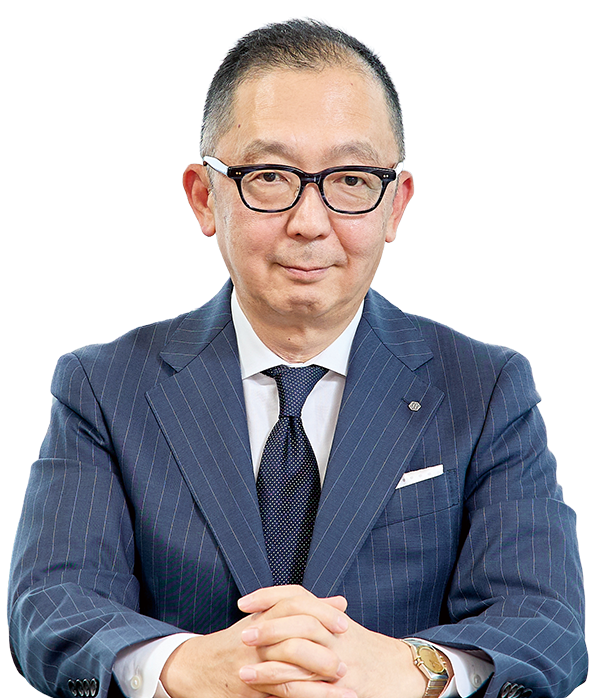
You were appointed Head of the Business Strategy Department in March 2026.
Looking back on your career to date, could you tell us about the principles you value and what you keep in mind when making management decisions?
I have spent most of my career in the field of corporate management, working in taxation, corporate planning, finance and accounting, and business strategy. Building a foundation for understanding management through numbers early in my career has been an invaluable asset.
In my late twenties, I was seconded to a U.S. company shortly after it was acquired. With almost no other Japanese employees in the workplace, I learned that nothing would move forward unless I clearly articulated my own views. I believe that experience has shaped my approach to work ever since.
I spent the longest part of my career in corporate planning. Beginning in 1998, when the Company posted losses for four consecutive years, I saw firsthand senior management being forced to make difficult decisions. In 2000, while the Company was still in the red, we introduced the Divisional Company System, which remains the basis of SEKISUI CHEMICAL’s organizational structure today. While implementing emergency management measures, I experienced firsthand both the importance and difficulty of simultaneously carrying out reforms with an eye to the future.
I then took charge of corporate management at the Urban Infrastructure & Environmental Products Company in 2009. At the time, we also needed to restructure businesses following M&A. I experienced the reorganization, transfer, and withdrawal of acquired businesses, which in some respects proved even more difficult than the acquisitions themselves. This also trained me to make decisions with a rigorous focus on future returns rather than the scale of investments already made.
For roughly the past decade, I have been responsible for finance and accounting at corporate headquarters, and I now serve as Head of the Business Strategy Department. In communicating with President Shimizu, I try to focus not simply on what options are available, but on what our first choice is, and why, so that I can support his decision-making. Having spent much of my career in corporate management, it is relatively easy for me to point out risks and apply the brakes. However, what the Company needs most now is disciplined risk-taking based on a careful assessment of the risks so that we do not miss opportunities. This is something I also make a conscious effort to keep in mind when communicating with President Shimizu.
How do you assess the previous Medium-term Management Plan?
Please tell us about its achievements and remaining challenges.
We pursued the previous Medium-term Management Plan based on two pillars: Strategic Innovation and Organic Growth. In Strategic Innovation, the standout achievement was undoubtedly film-type perovskite solar cells. We decided to commit investment and human resources on a scale unprecedented for the Company, putting the business on a path to commercialization. We also took the necessary steps to expand our aircraft-related businesses and new infrastructure materials (FFU) overseas.
In Organic Growth, we also made preparations with an eye to the future, including investments to increase production capacity in the Electronics field, such as semiconductor materials, and M&A in housing-related businesses. Meanwhile, after completing demonstration testing for the Biorefinery Business, we decided to defer commercialization. I believe this was an appropriate management decision because we focused on future returns rather than the scale of investments already made. The Housing Business and Medical Business also fell short of their operating profit targets under the Medium-term Management Plan. However, during the previous Medium-term Management Plan, we took measures to reshape their earnings structures, including shifting management resources within the Housing Business toward growth areas such as the Renovation Business. In investment decision-making, I believe we still had challenges in terms of speed, including the timing of decisions on capacity expansion investments. Under the new Medium-term Management Plan, I intend to keep firmly in mind that losses from failed investments and losses from missed opportunities should be given equal weight and apply this principle to our decision-making going forward.
What thinking went into the New Medium-term Management Plan, Accelerate 2028?
The New Medium-term Management Plan, Accelerate 2028, represents Phase 3 on the road to achieving Vision 2030, under which we aim to double the scale of our business by FY2030, reaching net sales of ¥2 trillion and an operating profit margin of 10% or higher. This is a period in which we will deliver results from the themes prepared under the previous Medium-term Management Plan while continuing further preparations, implementing proactive ESG management through the dual pillars of business strategy and foundation strengthening.
We have set numerical targets of ¥1.6 trillion in net sales and ¥150 billion in operating profit, representing an operating profit margin of 9.4%, based on the premise of increases in both net sales and operating profit across all segments. For businesses where we project growth exceeding the rate of market growth, we formulated the plan after clearly identifying the basis for that growth, and I am confident in the plan.
At the same time, there are concerns such as difficulties in procuring raw materials and rising prices due to geopolitical risks, but we expect the impact of these factors on our performance to be limited. We have been able to implement price revisions as planned, which I see as evidence that we are providing products with sufficient value for customers to accept the resulting price increases.
What business strategies have you developed under the New Medium-term Management Plan, Accelerate 2028?
Under the business strategy for Accelerate 2028, we position businesses categorized as growth-driving and growth-potential as growth drivers and will focus management resource allocation on them. Growth-driving businesses are existing businesses that are expected to grow faster than their respective markets. In the Mobility field of the High Performance Plastics Company, a prime example, we expect growth to outpace the overall automotive market because our mainstay high-performance interlayer films for automotive laminated glass are expected to be adopted across a broader range of vehicle models. In the Urban Infrastructure & Environmental Products Company, meanwhile, demand for sewer pipeline renewal is expected to expand, and we believe we can achieve growth that outpaces the market by leveraging strengths such as labor-saving construction methods and licensing. The key is to deploy resources at the right time. We must not miss sales opportunities because demand is there, but our supply structure is not ready.
At the heart of our growth-potential businesses are film-type perovskite solar cells. This is a co-creation business that brings together strengths from across the Group, including the High Performance Plastics Company’s production technologies, the Urban Infrastructure & Environmental Products Company’s engineering capabilities, and potential future applications in the Housing and Town and Community Development fields. It is both a new business and a large-scale business that symbolizes Group-wide synergies. We plan to commence operations at the new Sakai Plant in FY2027 and expect the business to become profitable in FY2028, although challenges remain, including improving product performance and production efficiency. To establish a competitive advantage, the Group must build an entire value chain encompassing not only production but also design, installation, and operation after power generation begins. Collaboration with external partners will be essential, particularly in downstream areas such as installation and operation, and the key to success will be advancing such collaboration while leveraging our own technological capabilities. Through these initiatives, personnel exchanges and technological collaboration across the Group are also advancing.
In the Housing Business, we will also seek growth in the new housing business by expanding into new product areas that do not compete with our existing offerings. At the same time, the Housing Business plays an important role in supporting growth investments across the Group. Precisely because it generates stable cash flow, we can maintain a sound financial position even while undertaking investments of approximately ¥700 billion under Accelerate 2028.
How do you intend to link environmental value to business growth?
The common thread across all of our businesses is the idea of translating environmental value into growth. We are working toward carbon neutrality and a circular economy not simply to fulfill our social responsibilities, but because we view these efforts as a growth strategy in their own right, one that enhances product value and creates new business opportunities. Products to Enhance Sustainability embody this approach. Because we incorporate contributions to environmental and social issues into product design from the new product development stage, it is difficult to imagine us launching a new product in the future that does not contribute to sustainability.
However, designation as a Product to Enhance Sustainability is not the ultimate goal. While contributions to environmental and social issues are evaluated against certain objective criteria, whether a product truly delivers value should ultimately be judged by whether customers recognize that value and whether it generates high profitability. That is precisely why the Medium-term Management Plan positions net sales of highly profitable Products to Enhance Sustainability as an important KPI. We will increase the number of products that customers value for their contributions to sustainability, including their environmental value. This is the foundation of the Group’s environmental strategy.
Please tell us your views on and initiatives for portfolio management and growth investment.
I consider the diversity of businesses in our Group to be one of our strengths in terms of reducing volatility in business performance. However, this does not mean that we can simply continue holding businesses without a clear purpose. ROIC is the KPI for portfolio management. We focus not only on whether return on invested capital (ROIC) exceeds WACC, but also on whether that can be sustained into the future. Whether we are the best owner is another important criterion. At present, viewed at the individual business level, we essentially have no so-called problem businesses whose ROIC consistently falls below WACC.
When reviewing our portfolio, what matters is not the profits a business generated in the past, the amount invested in it, or any impairment loss that might arise upon withdrawal, but rather an assessment of its future potential. Improving capital efficiency and maintaining a sound financial foundation provide the basis for future growth investment. We will continuously assess our current position while making greater use of debt than in the past to fund investments. Even after executing the investments planned under the Medium-term Management Plan, we will maintain sufficient financial flexibility and a financial foundation that enables us to make agile investments in future growth opportunities.
How are you strengthening the management foundation that supports sustainable growth, including human resources and R&D?
The Human Resources Strategy lies at the core of our ESG management foundation. We have spent considerable time encouraging employees to take on challenges, based on the belief that the opportunity losses from not taking on challenges are greater than the losses that may result from trying and failing. While failures resulting from challenges are readily visible, the losses from not taking on challenges are much harder to see. That is precisely why it is important to encourage employees to take on challenges in a variety of ways, and top management itself has repeatedly communicated this message with conviction. At first, quite a few employees were unsure what “taking on a challenge” meant in the context of their own work. However, we have also stressed that taking on a challenge does not always mean doing something as dramatic as leaping off the stage at Kiyomizu Temple; changing or breaking through the status quo is itself a challenge. I feel that this mindset has now taken root to a considerable degree. Under the new Medium-term Management Plan, we have set a target of raising the Challenge Action Rate from 62% to 72%. As part of our efforts to achieve this, we conduct employee surveys and use the results for each organization not simply to look at the numbers, but to delve into and discuss the factors behind them. Rather than defining a single form that a challenge should take, we encourage each employee to consider what taking on a challenge means for them and support their growth. We will also identify issues from the data we have accumulated and evolve our human resources development measures to make them more effective.
It is precisely these employees who take on challenges that will drive the creation of new technologies and businesses. To strengthen R&D, we are pursuing the goal of “creating prominence in technologies.” We define the groups of core technologies that are sources of competitive advantage as technology platforms (TPFs) and will not only refine individual technologies but also combine multiple technologies to create new businesses and products. We are also proactively utilizing Materials Informatics (MI) and other tools to accelerate the pace of R&D.
How will you strengthen the management foundation that supports corporate value, including internal control and DX?
In internal control, we are shifting from post-incident response to proactive prevention across all five areas of major incidents. Rather than simply detecting information leaks or accounting fraud after they occur, we are focusing on putting systems and business processes in place to prevent incidents from occurring in the first place. We also recognize that risks change as new businesses emerge and market conditions evolve. Accordingly, each divisional company and business division regularly provides opportunities to continuously reassess what constitutes a risk now and implement appropriate countermeasures.
In DX, we have worked to build a foundation that enables the use of standardized data across the Company, including through the introduction of an integrated ERP (SAP) system. The next step is to utilize that data to strengthen internal control and competitiveness. We are also using AI to improve operational efficiency, but going forward, we will expand its use into areas directly linked to business growth, such as sales and design. For example, in the Housing Company, we aim to deploy best practices from high-performing sales and design activities more broadly throughout the organization. In this way, our goal is not simply to improve productivity, but to use AI to drive business growth.
Could you tell us the thinking behind the revision of materiality?
Materiality is a statement of our commitment identifying the things that we, as a company, must never lose sight of, and serves as an overarching concept that guides our business strategies and new product development. We reviewed our materiality to ensure that it is recognized and understood more accurately. The key issues themselves have not changed significantly, but under the new Medium-term Management Plan, we reorganized them into the two categories of Value Creation Fields and Value Creation Drivers to present them in more concrete terms.
Externally, this enables us to communicate our approach to value creation more clearly, while internally, I believe it makes it easier to translate that approach into business strategies and specific measures.
Please tell us about your commitment to achieving the Medium-term Management Plan.
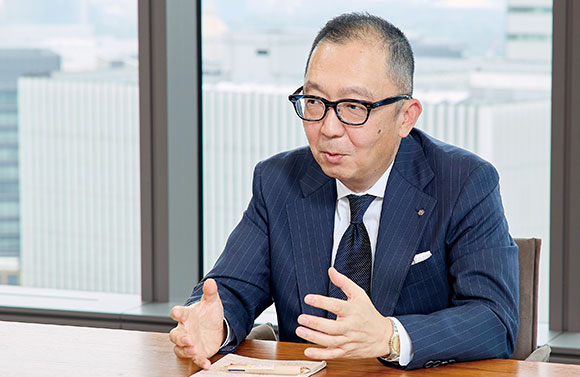
As we work to realize the New Medium-term Management Plan, Accelerate 2028, I will support management in taking the risks that need to be taken, based on a proper understanding of those risks, so that we do not miss growth opportunities, while also keeping a firm grasp on the financial aspects. The current Board of Directors, including the Outside Directors, also supports appropriate risk-taking for growth. While ensuring that risks are fully understood and shared, I intend to support swift decision-making and contribute to enhancing corporate value.