
Roundtable Discussion Between Outside Directors (2026)
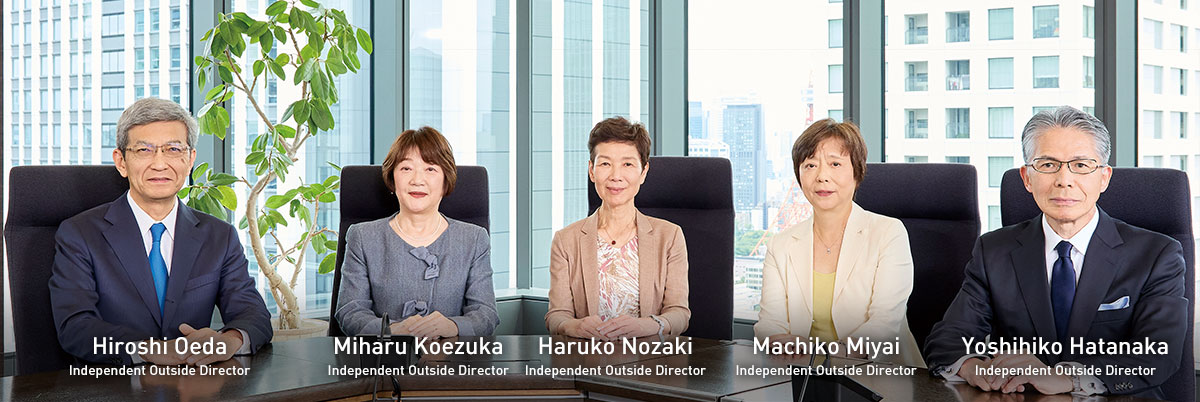
Following this fiscal year’s general meeting of shareholders, the Board of Directors transitioned to a new nine-member structure comprising six Directors focused on supervision (including five Outside Directors) and three Directors responsible for both supervision and business execution. Under the new structure, both Directors focused on supervision and Outside Directors account for a majority of the Board.
In this roundtable discussion, the five Outside Directors share their expectations for the new structure, the challenges ahead, and their views on medium- to long-term growth.
As the Company transitions to a new structure, could you once again share your expectations for the Board of Directors and what you personally keep in mind in carrying out your duties?
Oeda:One of the fundamental roles of the Board of Directors is to supervise the executives responsible for management. The new structure has drawn a clearer line between supervision and business execution. The Board can focus on supervision, while management has greater authority to execute business operations. I believe it is important for both sides to fulfill their respective roles while maintaining smooth communication and an appropriate degree of constructive tension.
Nozaki:The essence of management is to sustainably enhance corporate value. To achieve this, the Company should continue creating value for all stakeholders, including shareholders, customers, employees, and suppliers. Going forward, it will be increasingly essential to consider what value we can provide to each stakeholder. I approach Board discussions from the perspective of an individual member of society, always asking myself, “What would employees think?” and “How would customers view this?”
Koezuka:Both the composition of the Board of Directors and that of the committees under the new structure were decided after repeated discussions in which we Outside Directors participated. I believe the new structure enables the Board to function more effectively in terms of both strengthening governance and achieving sustainable growth. Fulfilling the supervisory function sometimes requires making pointed observations, while at other times it means recognizing and approving sound proposals. I feel we now have a Board capable of conducting discussions with this kind of clear focus and balance.
Miyai:One major benefit of separating supervision from execution is faster decision-making. Today, companies must respond quickly to changes in the market while taking appropriate risks. That is precisely why executive management should focus on swift decision-making and execution, while the Board makes judgments with transparency and objectivity and helps enhance the effectiveness of execution. I believe the great value of this new structure lies in clearly defining these respective roles.
Hatanaka:I believe the ideal relationship between execution, supervision, and the Board of Directors depends on what a company seeks to achieve and what value it aims to provide to society. In pursuit of a sustainable society, the Company has set a management objective of accelerating the creation and market expansion of Products to Enhance Sustainability. An important supervisory role of the Board is to support executive management so that it can make flexible and agile investment decisions regarding the investments needed to create new business domains and review and strengthen the existing portfolio.
How do you assess the current Board of Directors, and how do you think it needs to evolve going forward?
Oeda:Over the eight years I have served as a Director, the Board has steadily evolved in response to changes in the business environment, and I believe it has reached a high level in terms of both effectiveness and transparency. I also value the fact that the Board continuously improves by running a PDCA cycle through its annual effectiveness evaluation.
Hatanaka:I see the autonomous management and strong competitiveness of each divisional company as major strengths of the Company. At the same time, we need to deepen discussions on resource allocation across divisional companies and the optimal allocation of resources on a global basis. As overseas sales continue to grow and Japan’s share of sales comes to more closely reflect the relative size of its economy, it will become increasingly important to take a global perspective in governance and the allocation of management resources. I hope to actively raise such forward-looking issues for discussion at Board meetings.
Independent Outside Director
Oeda:At the risk of sounding self-congratulatory, I believe the current Board has an optimal and highly diverse composition: all five Outside Directors have corporate management experience and each brings different expertise. The commitment and enthusiasm that every member brings to the role is one of SEKISUI CHEMICAL Group’s strengths.
Nozaki:I agree that this is a strength. In terms of effectiveness, I also highly value the careful preparation by executive management to ensure that it can fully answer questions from Outside Directors. On the other hand, I sometimes feel that agenda items are already too neatly packaged by the proposal stage. The Board can become even more effective if the divisional companies and Directors engage in a more open exchange of questions and views—asking, for example, “What about this perspective?” or “How are we addressing this?” With members from such diverse backgrounds, we should be making greater use of the knowledge and expertise they bring.
From what perspectives did the Outside Directors participate in discussions on the formulation of the new Medium-term Management Plan, Accelerate 2028?
Hatanaka:This is a company whose vision for its businesses is clearly aligned with the value it seeks to provide to society. In formulating this Medium-term Management Plan, our discussions focused on what investments should be made and how organizational capabilities should be strengthened in light of the Long-term Vision, Vision 2030. M&A is an especially important theme for the Company, given its emphasis on creating businesses in innovation areas and strengthening future growth potential, because it is a means of bridging gaps in the time and capabilities required to generate innovation.
Koezuka:I am confident that over the next three to five years the Company can steadily grow its earnings and deliver the results set out in the plan. However, looking further ahead to growth ten years from now, M&A will clearly be a key factor. We did not use the full M&A investment allocation under the previous Medium-term Management Plan, but I understand that management has been steadily exploring potential opportunities. That makes it all the more important for management to bring potential deals to the Board promptly and for the Board to discuss them thoroughly. I believe continuing that process is critical.
Hatanaka:I believe the ability to discuss medium- to long-term growth strategies from these perspectives was a major feature of the process for formulating this Medium-term Management Plan.
Independent Outside Director
Nozaki:From the perspective of developing the next generation of human resources, initiatives are also progressing with attention to indicators such as successor candidate preparation rate. At present, however, even this perspective extends only about five years ahead. The business portfolio could look very different ten years from now. Whether the Company can respond flexibly to those changes from a human resources perspective will be an important factor in determining future growth. At the same time, amid heightened uncertainty, we need to be ready to quickly reassess what needs to be done—our “To Do”—as circumstances change. The Company’s desired future state—our “To Be”—must meanwhile be shared throughout the organization from a long-term perspective. I believe it is important to continue communicating that desired state in clear, readily understandable terms.
What are your expectations for film-type perovskite solar cells?
Miyai:With expectations running high both inside and outside the Company, film-type perovskite solar cells have finally entered the commercialization phase this year. The “E” in ESG—environment—represents social issues that transcend national borders, and film-type perovskite solar cells could become a game changer for renewable energy. If we can establish the technology, it should give us the competitiveness to expand globally. The business is also highly significant from the standpoint of economic security. During my career, I had the bitter experience of watching Japan lose its global lead in solar panels to China. That experience makes me feel particularly strongly about this: Japan is one of the world’s leading producers of iodine, the principal raw material for perovskite solar cells. If we can secure the raw material domestically, we can avoid the risk of other countries controlling the supply chain. I very much hope SEKISUI CHEMICAL Group will take the lead in commercializing the technology in Japan and quickly grow it into a business capable of competing on the global stage.
Hatanaka:Film-type perovskite solar cells are a project of enormous value both to SEKISUI CHEMICAL Group and to society as a whole. That is precisely why speed in decision-making is so important. Competitors are rapidly strengthening both their technological capabilities and their ability to implement the technology in society, and because this project involves many stakeholders, we cannot afford to lose momentum in decision-making. Since decisions must be made without a clear view of the future, the question is how much risk we are prepared to take. Success will require us to capitalize on the high risk tolerance afforded by the Company’s current business structure—one of its strengths—and take bold risks.
Oeda:I also believe that a new product with such a promising market worldwide comes along perhaps once every 50 years. It is well worth taking substantial risks and committing both capital and human resources aggressively to the challenge. My concern, however, is China. Over the long term, we must consider how to protect the Japanese market from Chinese companies. At the same time, rather than simply protecting the domestic market, I hope we can establish a presence overseas ahead of our Chinese competitors. As President Shimizu said at the press conference following his appointment, film-type perovskite solar cells are a business on which the future of SEKISUI CHEMICAL Group rests.
Miyai:I completely agree. For SEKISUI CHEMICAL Group to take the lead in this field ahead of Chinese companies, collaboration with partner companies as well as our own efforts will be essential. Management will therefore need to determine the right balance between prioritizing speed and emphasizing profitability. To compete globally, there may be times when speed must take priority.
How do you assess the Company’s ESG management, and how would you like to see it evolve?
Koezuka:I believe the Company practices ESG in a way that is closely integrated with management, as demonstrated by the large share of sales accounted for by Products to Enhance Sustainability. Initiatives in the environmental field in particular are making steady progress, and an important role of the Board is to ensure that they continue in the right direction. Human resources, meanwhile, is an area that needs to be strengthened further. From a diversity perspective, challenges remain in areas such as the management talent pipeline, mid-career recruitment, and the development of female managers, and executive management is also keenly aware of the need to address them.
Independent Outside Director
Miyai:Since joining the Company’s management, I have been struck by how seriously the Company takes ESG. Establishing a ten-year long-term vision and sharing it throughout the organization has likely played a major role. The fact that this thinking has thoroughly permeated the organization from top management to the front lines is a major strength. At the same time, that very sincerity has sometimes led to initiatives becoming too broad and diffuse. ESG is management itself when viewed as a means of enhancing corporate value, so I have argued that we should now shift toward a more proactive ESG. Products to Enhance Sustainability are at the heart of that effort. Communicating their value to society in a clear and compelling way should lead to further enhancement of corporate value.
What kind of human resources will SEKISUI CHEMICAL Group need to achieve future growth?
Koezuka:To compete globally in film-type perovskite solar cells, it will be more important than ever to develop global talent, including people capable of handling overseas sales and lobbying activities. The Company is also nurturing technological seeds that could become the second and third film-type perovskite solar cell businesses. With an eye to developing these technologies into businesses, the Board continues to discuss how to develop the human resources needed for long-term growth and how to acquire such talent through mid-career recruitment.
Nozaki:Overseas management talent in particular should be sent abroad at an early stage and developed through hands-on experience. We should start now, while we still have sufficient financial and human-resource capacity, with the resolve that sending 100 people abroad and having 10 emerge as successful global leaders would itself be a success.
Oeda:I believe there is room to strengthen corporate human resources, particularly executive talent, compared with talent at the divisional companies. In specialized fields such as DX and AI, an increasing number of companies are appointing executive officer-level personnel from outside, so mid-career recruitment will also become an important option for us. We are making steady progress in developing women and non-Japanese employees at the managerial level, but diversity at the executive management level is not yet sufficient. I would like to see a diverse range of people such as mid-career hires, women, and non-Japanese employees play active roles as Executive Officers.
What kind of organization is needed to encourage every employee to take on challenges?
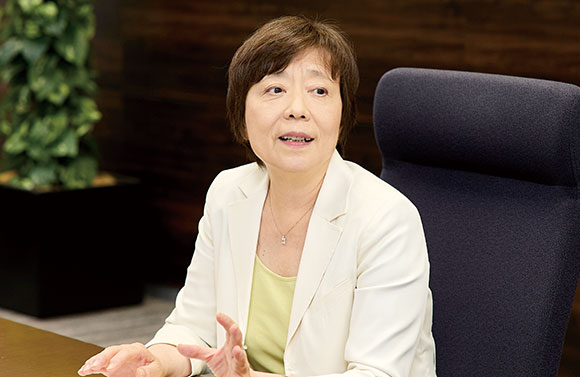
Nozaki:When it comes to developing human resources, I believe we need to make taking on challenges part of our organizational DNA and give employees opportunities to test their capabilities. Systems are already in place for internal transfers, volunteering for new businesses, and internal competitions, but overall the institutional design can be somewhat too detailed. With a little more room for flexibility and experimentation, employees may be able to exercise their abilities more freely.
Miyai:I agree. The Company is a technology-based company, and being well managed is certainly a strength. At the same time, I sometimes feel that there is too much management and not quite enough room to experiment. I think we need to create more “white space” for people to explore.
Independent Outside Director
Nozaki:Taking on challenges does not only mean creating something from zero to one. Turning 10 into 100, turning 100 into 1,000, and making one quality improvement after another are all challenges too. It’s about continually pushing ourselves in small ways across everything we do. Of course, not everything will work out, but learning from small failures along the way can help us avoid bigger ones. In fact, top management itself encourages employees to take on challenges without fear of failure, and those efforts are steadily bearing fruit.
Miyai:In my four years with the Company, I’ve seen the concept of “challenge actions” become well understood and increasingly embraced by employees across the organization.
Finally, what do you consider most important for the Company to achieve sustainable growth?
Independent Outside Director
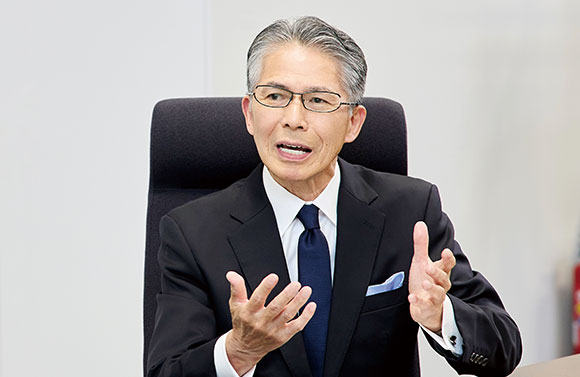
Hatanaka:Under Innovation for the Earth, the Company is developing numerous innovative technologies and intriguing research themes. To commercialize them quickly and scale them up in global markets, however, we need to develop our own people while actively drawing on external capabilities. From a human resource development perspective, my own experience at my previous company has taught me that people are often developed more by products and businesses than by formal development programs. From this standpoint, today’s growth-driving and growth-potential businesses themselves—including the interlayer film business and the film-type perovskite solar cell business—play a major role not only in enhancing corporate value but also in developing people. Expanding these opportunities to take on challenges further could lead to a form of human-resource development that is unique to the Company.
Nozaki:To make effective use of external capabilities, I also think it is important to move away from a “not-invented-here” mindset. The Company has grown through the prominence of its technologies and has a corporate culture that places great value on technological capabilities. Innovation, however, unfolds in stages: first creating something from zero to one, and then growing it. I sometimes feel that we are focusing a little too much on these initial stages. The Japan Perovskite Solar Cell Promotion Council (JPSC), is a good example. We need to pinpoint the Company’s core strengths—whether in sealing technology and durability, verification technology, procurement and construction capabilities, or our ability to take on challenges—and complement them with the strengths of other companies to establish the global de facto standard. Perhaps we should take a fresh look at the Group’s diverse strengths, including the enterprising, tenacious people behind our technological capabilities.
Miyai:Exactly. Although SEKISUI CHEMICAL Group is managed around its Companies, I also sense that interesting seeds may be lying in the spaces between them. By taking a cross-Company view of human resources, R&D, and other areas from a Corporate perspective, we should be able to further enhance the value of the Group as a whole.
Oeda:Considering SEKISUI CHEMICAL Group’s recent scale and growth rate, I am impressed by how successfully the Company has developed so much of its talent internally. I want to see SEKISUI CHEMICAL Group build on its strong tradition of developing people and reach a new level of growth, and as an Outside Director, I will continue to support that journey.