
Regarding the status of soil surveys at the Shiga Minakuchi factory site
March 24, 2010
Our company believes that reducing the environmental impact of our business activities and fulfilling our role in environmental conservation and creating a comfortable environment is a corporate social responsibility. Therefore, we are proactively undertaking initiatives to reduce the environmental impact and risks associated with our business activities and production. As part of these proactive efforts, we are systematically conducting soil surveys at all of our business sites in accordance with the Soil Contamination Countermeasures Act. We recently conducted a survey at our Shiga Minakuchi Plant.
The investigation revealed that several types of heavy metals exceeded the standard levels in the soil on the premises, and that dioxins exceeded the environmental standard levels near the northern boundary of the business site. We will now report on the current status of the investigation and the countermeasures being taken.
Note
1. Survey site (Please refer to the attached document)
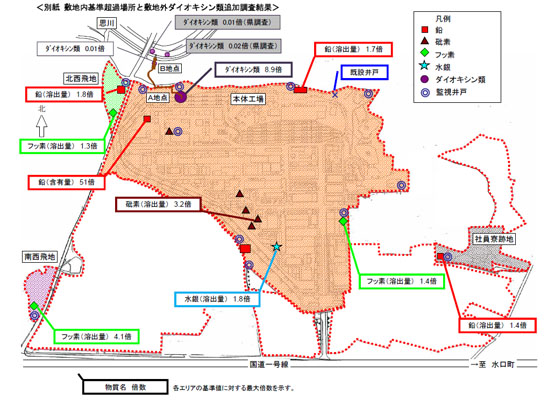
Soil surveys were conducted at four locations: within the Shiga Minakuchi Plant (hereinafter referred to as the main plant), the northwest exclave, the southwest exclave, and the former employee dormitory site.
2. Investigated substances
The substances investigated included 21 substances of three types as defined by law: solvents, heavy metals, and PCBs. Because the site had previously had an incinerator, dioxins were also investigated.
3. Regarding the survey results
1) Solvents (11 substances surveyed)
There were no exceedances of the standards specified under the Soil Contamination Countermeasures Act.
2) Heavy metals (9 substances surveyed)
There were exceedances of the standards for lead, arsenic, fluorine, and mercury. A summary is provided in the table below. There were no exceedances for the remaining five substances.
<Summary of Heavy Metal Survey Results>
| Survey location | item | Number of lots exceeding the standard | Designation Criteria | Maximum concentration (compared to specified standards) | Depth exceeding standard |
|---|---|---|---|---|---|
| Inside the main factory | Lead (content) | 8 plots | 150 mg/kg | 7,700 mg/kg (51.3 times) | 0.5m |
| Lead (eluted amount) | 1 plot | 0.01 mg/L | 0.017 mg/L (1.7 times) | Less than 0.5m | |
| Arsenic (leaching amount) | 6 plots | 0.01 mg/L | 0.032 mg/L (3.2 times) | 0.5m | |
| Fluorine (leaching amount) | 1 plot | 0.8 mg/L | 1.1 mg/L (1.4 times) | Less than 0.5m | |
| Mercury (eluting amount) | 1 plot | 0.0005 mg/L | 0.0009 mg/L (1.8 times) | Less than 0.5m | |
| Northwest Enclave | Lead (eluted amount) | 2 plots | 0.01 mg/L | 0.018 mg/L (1.8 times) | 2.4m~2.9m |
| Fluorine (leaching amount) | 1 plot | 0.8 mg/L | 1.0 mg/L (1.3 times) | 2.1m~2.6m | |
| Southwest Enclave | Fluorine (leaching amount) | 12 plots | 0.8 mg/L | 3.3 mg/L (4.1 times) | Deeper than 5.4m |
| Former employee dormitory site | Lead (eluted amount) | 1 plot | 0.01 mg/L | 0.014mg/L (1.4 times) | Less than 0.5m |
3)PCB
There were no violations of the standards.
4) Dioxins
(1) Site surrounding the incinerator
There were no exceedances of the environmental standards set by the Basic Environment Law.
(2) Leaks from wastewater piping of the waste incinerator
Based on information that there had been a leak from the wastewater piping of the incinerator's exhaust gas cleaning system in the past, an investigation near the estimated location revealed dioxins exceeding standard levels.
| item | Environmental standards (pg-TEQ/g) | Maximum concentration (pg-TEQ/g) | Comparison with environmental standards |
|---|---|---|---|
| soil | 1,000 | 8,900 | 8.9 times |
Furthermore, a concentration of 50 ng-TEQ/g was detected in the sediment inside the drainage ditch at the bottom of the leak (see attached document: Point A).
4. Causes and countermeasures for exceeding heavy metal standards
1) Causes and countermeasures
| Survey location | item | Usage History | Probable cause | countermeasure |
|---|---|---|---|---|
| Main factory | Lead (content) | can be | Business origins | Paving and soil covering |
| Lead (eluted amount) | can be | Business origins | Excavation and removal (However, this excludes naturally derived components.) Groundwater monitoring |
|
| Arsenic (leaching amount) | none | Embankment, naturally occurring | ||
| Fluorine (leaching amount) | none | Embankment | ||
| Mercury (eluting amount) | none | Unable to confirm | ||
| Northwest Enclave | Lead (eluted amount) | can be | Business origins | |
| Fluorine (leaching amount) | none | Naturally derived | ||
| Southwest Enclave | Fluorine (leaching amount) | none | Embankment, naturally occurring | |
| Former employee dormitory site | Lead (eluted amount) | none | Unable to confirm |
2) Impact on neighboring areas
In the areas where the content exceeded the standard, we believe there is no risk of wind-induced dispersion because the areas are either grassland or paved. Furthermore, in the areas where the leaching amount exceeded the standard, we believe the impact on groundwater is minimal due to low rainwater infiltration, as most of these areas are paved. In addition, groundwater measurements conducted using one existing well confirmed that there were no exceedances of the standard for any substance. Going forward, we will install further monitoring wells to continue monitoring groundwater levels.
5. Causes and countermeasures for exceeding dioxin standards
1) Cause
In the past, there was a leak from the wastewater piping of the exhaust gas cleaning system of the waste incinerator, and soot from the wastewater accumulated in the soil below the leak point and in the manholes of the rainwater drainage system on the premises. It is believed that dioxins attached to this soot were the cause. Based on the investigation, the period of leakage is estimated to be at most about 1.5 months between December 2003 and February 2004.
2) Impact on neighboring areas and countermeasures
The results of the soil survey conducted at the bottom of the rainwater drainage ditch outside the site that connects to the Omoigawa River (see attached document: Point B), and the results of the Omoigawa River sediment survey conducted by the prefecture, both of which were below environmental standards, suggest that the impact on the surrounding area was minimal. The sediment in the rainwater drainage ditches and manholes both inside and outside the site leading to the Omoigawa River was removed in consultation with the prefecture. Furthermore, the area where the water leaked is located is in a wooded area where the soil is constantly moist, so we believe that the possibility of scattering is low. In addition, as an emergency measure to prevent surface soil erosion due to rainwater, the area exceeding the standards has been covered with a sheet, and we plan to excavate and remove it as soon as possible. Since dioxins are poorly soluble in water and do not easily penetrate into the ground, we believe that the impact on groundwater is also low, but we will install a well to check the quality of the groundwater.
6. Others
1) Regarding the management system
(1) We have strengthened our management system to prevent leaks and spills.
① Management of piping for hazardous materials, toxic substances, chemical wastewater, etc.
We design our systems to facilitate inspection and management, and we carry out inspections and replacements based on our maintenance plan. We are also working to prevent spills by moving buried pipes above ground and expanding the number of detectors.
② Information dissemination and personnel training
We have established a system to immediately report and communicate even minor leaks to the factory manager, and we ensure its thorough implementation and report to the monthly safety and health committee. In addition, we continue to provide thorough training to our personnel within the framework of ISO standards, focusing on legal understanding and compliance.
(2) Management of specified hazardous substances currently being handled
①Lead
We conduct inspections of lead-plated particulate matter on-site, instead of externally. Because a clean environment is required, the inspections are carried out in a sealed indoor space, and there is no environmental impact.
② Dichloromethane
In accordance with the Shiga Prefecture Pollution Prevention Ordinance, a monitoring well has been installed near the site of use, and regular analyses are conducted to confirm that there are no leaks.
2) Regarding the investigation process
(1) Investigation process
| May 2009 | Start of document and other research |
|---|---|
| July 2009 | Soil sampling started |
| October 29, 2009 | It was discovered that levels of heavy metals exceeded the standard. It was discovered that one location on the premises exceeded the standard for dioxins. |
| January 25, 2010 | Outline of the range of heavy metal levels exceeding the standard has been revealed. Summary of dioxin levels exceeding standards and potential impacts on off-site areas revealed. |
| January 29, 2010 | Report to the government (prefecture) |
| March 11, 2010 | The range of excess levels for heavy metals has been determined. Further investigation results regarding dioxins, both inside and outside the site, have been revealed. |
<Reference materials>
Overview of the Shiga Minakuchi Plant
1) Address
1259 Izumi, Minakuchi-cho, Koka City, Shiga Prefecture
2) Factory Manager
Toshitaka Fukunaga
3) Area
Main factory: Approximately 200,000 m2
4) Start of business
1960 (Showa 35)
5) Main products
Since commencing operations, we have primarily produced plastic products or organic chemical products such as interlayers for laminated glass, industrial adhesives, butyral resins, plasticizers, and microparticles for electronic equipment.
6) History of use of specified hazardous substances and operating history of incinerators
The following table shows the history of use of chemical substances and incinerators that are stipulated in the Soil Contamination Countermeasures Act.
(1) Inside the main factory
① History of use of specified hazardous substances
| Purpose | Estimated usage | Period of use | |
|---|---|---|---|
| Trichloroethylene | Solvents of adhesives | 10 tons/year | 1960 (Showa 35) - 1983 (Showa 58) |
| Dichloromethane | 700 tons/year | 1983 (Showa 58) - Present | |
| carbon tetrachloride | for particulate product analysis | 20kg/year | 2000 (Heisei 12) - 2002 (Heisei 14) |
| lead compounds | Hardener for putty (adhesive) | 2.4 tons/year | 1965 (Showa 40) - 1979 (Showa 54) |
| Fine particles for electronic devices | 1kg/year | 2000 (Heisei 12) - Present | |
| Hexavalent chromium | Components of the heat transfer fluid | (Heat transfer fluid) 320 tons | 1960 (Showa 35) - 1993 (Heisei 5) |
| PCB | sealant additives | 400 kg/year | 1965 (Showa 40) - 1972 (Showa 47) |
| Transformers, etc. | 209 transformers 84 ballasts |
It is currently being stored. |
② Operating status of incinerators
| Equipment name | Purpose | Incineration volume | Period of use |
|---|---|---|---|
| waste incinerator | Incineration of general waste Steam production |
Approximately 14 tons/day | 1978 (Showa 53) - 2004 (Heisei 16) |
| Sludge incinerators (3 units) | Incineration of wastewater treatment sludge | Approximately 8 tons/day | 1994 (Heisei 6) - 2007 (Heisei 19) |
| Waste oil incinerators (2 units) | Incineration of waste oil | Approximately 4 m³/day | 1970 (Showa 45) - 1975 (Showa 50) |
(2) Northwest exclave
Used as a primary storage site for wastewater sludge from 1969 to 1991. No history of use of specific hazardous substances.
(3) Southwest enclave
The farmland was purchased in 1997. There is no history of use of specific hazardous substances.
(4) Former employee dormitory site
Used as employee dormitory until March 2007. No history of use of specific hazardous substances.
Contact information regarding this matter
SEKISUI CHEMICAL CO., LTD.
Shiga Minakuchi Factory Planning and Management Department TEL: 0748-62-3381
[For members of the press, please click here.]
Public Relations Department TEL: 03-6748-6547
Correction made. (November 2019)