
Sekisui Chemical, the University of Southern California, and SitePathfinder have begun a joint demonstration of gene transfer technology in the field of drug discovery support.
March 16, 2026
SEKISUI CHEMICAL CO., LTD.
SEKISUI CHEMICAL CO., LTD. (President and CEO: Ikusuke Shimizu, hereinafter "Sekisui Chemical") will begin a joint demonstration (hereinafter "this demonstration") for the social implementation of gene introduction technology in the field of drug discovery support in the field of drug discovery with the University of Southern California School of Medicine (Faculty of Internal Medicine, Gastroenterology and Hepatology, Professor: Tsuyoshi Saito) and Sitepathfinder Inc. (President and CEO: Yanaji Yamamoto, hereinafter "Sitepathfinder").
1. Background
Animal-based research has been challenging because it is difficult to accurately reproduce human diseases and drug responses, and predicting efficacy and safety in drug discovery has been limited. For this reason, regulatory authorities in Japan, the United States, Europe, and other countries are gradually reducing animal testing and moving towards research models that more closely resemble human studies.
In this context, primary human hepatocytes are indispensable for research on the liver, which is central to drug metabolism. However, primary human hepatocytes have a challenge in that they do not adhere well to culture dishes and it is difficult to maintain the appropriate cell density during cultivation, making them prone to losing their original function and cellular properties. To help primary human hepatocytes adhere, bio-derived materials such as collagen are generally used. However, because these materials do not have uniform properties, the handling of cells tends to be inconsistent, and there was room for improvement.
Furthermore, primary human hepatocytes are known to be difficult to transfect, and even when combined with SitePathfinder's solid-phase transfection technology, which is known as one of the useful gene transfection techniques, the cells have not been able to properly take up the gene transfection reagent immobilized on the culture dish. Therefore, introducing genes while maintaining cell quality has been a major challenge for many years.
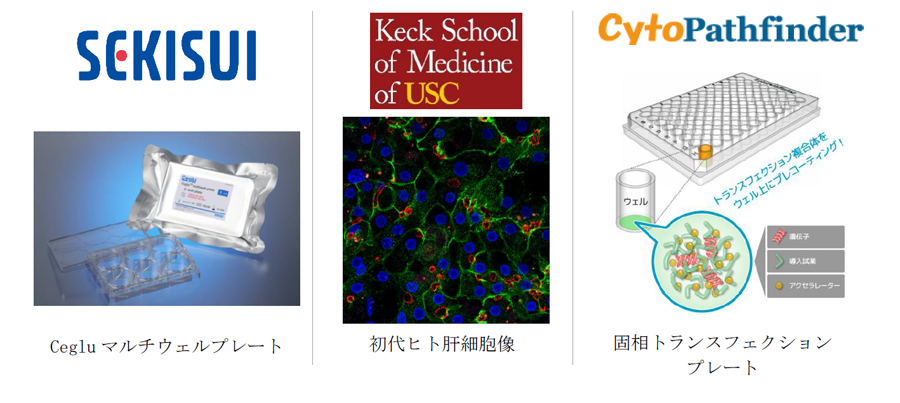
Through collaborative research with Sekisui Chemical, Professor Saito revealed that primary human hepatocytes can be stably and uniformly cultured using the highly uniform Ceglu™. Furthermore, by combining Ceglu™ with sitepathfinder's solid-phase transfection technology, they made it possible to introduce genes into primary human hepatocytes, which had previously been difficult.
Thus, by using primary human cells, we expect to achieve highly accurate cell function analysis, deepen our understanding of liver disease pathogenesis, and accelerate drug discovery research—all things that were difficult with conventional animal-based research models. This demonstration project was undertaken to verify the potential for this technology to spread widely, particularly in the field of drug discovery support.
2. Details of this demonstration
- Started providing samples to research institutions and companies for social implementation.
Test samples combining Ceglu™ and solid-phase transfection technology
It will be available starting from Site Pathfinder.
At the University of Southern California, we will conduct the following using high-quality human hepatocytes derived from humanized liver chimeric mice and other primary human hepatocytes from PhoenixBio Inc., which are widely used in the fields of drug discovery support and cell biology.
- Further research to improve gene transfer efficiency and evaluation of reproducibility
- Evaluation of the maintenance of hepatocyte function and phenotype (cellular identity) after gene transfer.
Demonstration period: One year from March 16, 2026
Sekisui Chemical has developed Ceglu™, a chemically synthesized scaffold material that enables stable cultivation of pluripotent stem cells, through its accumulated materials technology, and began sales in 2025. With this demonstration, the company aims to contribute to solving problems in the drug discovery support field, in addition to the regenerative medicine field in which it has been focusing its research and development efforts.
Professor Saito of the University of Southern California School of Medicine is an expert in liver biology and disease modeling, and has been promoting research on human primary liver cells using humanized liver mice and metabolic liver diseases. As both a physician and a researcher, he has held key positions in academic activities related to the American Association for Liver Diseases and the National Institutes of Health, and has also been elected a member of the American Society for Clinical Investigation (ASCI) since 2024. He aims to advance this demonstration from both a cell biology and medical perspective, and to make a significant academic contribution.
SitePathfinder has long been engaged in the research and development of a gene transfer technology called solid-phase transfection, developed at the National Institute of Advanced Industrial Science and Technology (AIST) and for which it holds its own patent, as well as its application to cells that are difficult to transfect. Through this demonstration, we aim to make further contributions to the field of drug discovery support and to begin our approach to the field of regenerative medicine.
Related website: https://www.sekisui-cell.jp/products/ceglu/
Related website: https://sites.usc.edu/saito-lab/
Related website: https://www.cytopathfinder.com
Contact information regarding this matter
Corporate Communications Department, Public Relations Group
Email: kouhou@sekisui.com