
First in Japan *1 Using film-type perovskite solar cells
We have started using agri-photovoltaic power generation equipment in rice paddies.
March 24, 2026
SEKISUI CHEMICAL CO., LTD.
SEKISUI Solar Film Co., Ltd.
SEKISUI Solar Film Co., Ltd. (hereinafter referred to as Sekisui Solar Film), TERRA Inc. (hereinafter referred to as TERRA), Chiba University (hereinafter Chiba University), Chiba Bank, Ltd. (hereinafter Chiba Bank), and Himawari Green Energy Co., Ltd. (hereinafter referred to as Himawari Green Energy) have signed a memorandum of understanding regarding industry-academia collaboration (hereinafter referred to as this collaboration), and we are pleased to announce the installation of agrivoltaic solar power generation facilities using Film-type Perovskite Solar Cells at the Chiba University Kashiwanoha Campus in March 2026, initiating initiatives through this collaboration.
1. background
Expanding the introduction of renewable energy (hereafter "renewables") is required to achieve carbon neutrality by 2050. Solar power generation is considered the main power source for this, but Japan's limited flat land area and the limited suitable sites for conventional silicon-based solar cells remain a challenge. To address these challenges, farmland holds enormous potential domestically, and agrivoltaic solar power is expected to be a strong option for balancing agriculture and solar power.
Since August 2024, SEKISUI CHEMICAL CO., LTD. (hereafter, Sekisui Chemical), the parent company of Sekisui Solar Film, and TERRA have been installing lens-type modules using film-type perovskite solar cells in Sosa City, Chiba Prefecture and conducting verification. In this collaboration, we aim to introduce them into rice paddies, which have high potential among farmland, and will further acquire and verify useful data unique to film-type perovskite solar cells, such as power generation performance in actual fields and the growth environment of crops (rice).
2. Details of this collaboration
1) Location
Chiba University Kashiwanoha Campus (Kashiwa City, Chiba Prefecture)
2) Period
For three years starting in March 2026
3) Content
- Verification of performance evaluation of lens-type modules in paddy fields
- Verification of the impact on agricultural work and the yield and quality of crops (rice)
- Verification of the impact on greenhouse gas (methane) emissions
4) Others
In this verification, the electricity generated from the installed film-type perovskite solar cells will be purchased by Chiba University based on a power supply agreement utilizing Chiba University and TERRA's on-site solar power generation facilities.
Chiba University Connect Co., Ltd. acted as an intermediary for this collaboration.
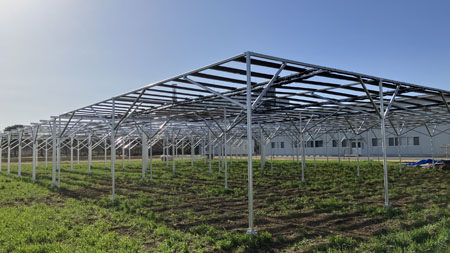
Overall view of the mounting frame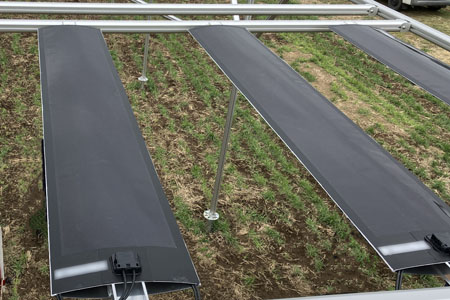
Perovskite solar cells that have been installed.
3. Roles of each company
|
Sekisui Solar Film: |
Provision of film-type perovskite solar cells for verification and consideration of installation specifications. |
|---|---|
|
TERRA: |
Construction, operation, and maintenance of power generation equipment used for verification. |
|
Chiba University: |
Provision of fields to be used for verification, assessment of impacts on farm work and crops. |
|
Chiba Bank: |
Financial support for the introduction of power generation equipment used in verification, and feasibility assessment of agricultural management models utilizing perovskite solar cells. |
|
Sunflower Green Energy: |
Feasibility study of agricultural management models utilizing perovskite solar cells and promotion of their widespread adoption by local governments and businesses in Chiba Prefecture. |
4. Future Developments
Through this collaboration, the five parties will work to solve the challenges of implementing film-type perovskite solar cells on agricultural land and contribute to the local production and consumption of renewable energy.
Through this collaboration, Sekisui Chemical and Sekisui Solar Film aim to contribute to the realization of a decarbonized society by expanding the application of film-type perovskite solar cells.
Through this verification process, TERRA aims to accelerate the development of desirable agricultural solar power generation (solar sharing) throughout Japan, particularly in consideration of natural ecosystems, by commercializing agricultural perovskite solar cell modules. This will contribute to solving regional issues, ensuring agricultural sustainability, and ultimately realizing a decarbonized society.
Through this verification, Chiba University will build up scientific evidence regarding solutions to global warming, the problem of high summer temperatures in agriculture, and the usefulness of solar sharing. Furthermore, as the university aims to achieve RE100 (100% renewable energy) by 2040, it will utilize this achievement as one of its steps toward carbon neutrality in its future strategies.
Chiba Bank and Himawari Green Energy aim to contribute to Chiba Prefecture's achievement of carbon neutrality through the social implementation of film-type perovskite solar cells, in order to realize GX throughout the region.
*1: As of March 24, 2026, according to research by Sekisui Solar Film Co., Ltd.
<Contact information regarding this matter>
SEKISUI CHEMICAL CO., LTD.
Corporate Communications Department, Public Relations Group
E-mail:kouhou@sekisui.com
TERRA Co., Ltd.
Mirai Development Department
Email: info@terra-sence.jp
Chiba University Public Relations Office
Email: koho-press@chiba-u.jp
Chiba Bank, Ltd. (Himawari Green Energy Co., Ltd.)
Sustainability Promotion Department, Planning Group
Email: stb@chibabank.co.jp