
Supporting liver organoid research using iPS cells at the University of Southern California
October 17, 2024
SEKISUI CHEMICAL CO., LTD.
SEKISUI CHEMICAL CO., LTD. (President and CEO: Keita Kato, hereinafter referred to as Sekisui Chemical) will support the "Sekisui Program iPS Cell-Derived Metabolic Alcohol-Related Liver Organoids" (hereafter: Research Program) through donations to the University of Southern California Research Center For ALPD and Cirrhosis (Director: Professor Hidekazu Tsukamoto, hereinafter: Research Center). Professor Hidekazu Tsukamoto, Director of the Research Center and consultant at Sekisui Chemical, will lead the research program. This activity is expected to accelerate research in the field of iPS cells related to liver diseases.
1. Background of the Research
iPS cells have the ability to differentiate into various tissues and organs depending on the external environment. Organoids, which are three-dimensional structures created from iPS cells outside the body, such as in a test tube, are also called mini-organs and are expected to have applications in elucidating disease mechanisms and drug discovery. The liver, in particular, has a very complex structure and function, so research on liver organoids that mimic organs is considered a field of future development.
The research center brings together 60 researchers from leading academic institutions in Southern California to lead research on alcohol-related liver and pancreatic diseases and cirrhosis. The center focuses on progressive chronic liver disease that combines alcohol and obesity-related metabolic dysfunction, for which a new nomenclature, "MetALD," has been adopted internationally since last year. The research center is a pioneer in developing preclinical models for molecular research on multiple cell types involved in the pathogenesis of MetALD, and is currently collaborating with leaders in this field to develop iPS cell-derived organoids with similar phenotypes to obtain clinically applicable insights.
Related website: Southern California Research Center for ALPD and Cirrhosis
Sekisui Chemical is developing materials and processes, such as scaffolding materials, to stably achieve iPS cell culture and differentiation through its accumulated materials technology. Sekisui Chemical's technology is expected to broaden the scope of iPS cell research and make a significant contribution to the industrialization of regenerative medicine. This time, we have decided to make a scholarship donation to contribute to the development of the research center and, by extension, to the development of the field of iPS cell research related to liver diseases.
Related Websites: Coating Liquids | Scaffolding Materials | Life Science Business
2. Objectives of the Research Program
This research program aims to develop and use iPS cell-derived liver organoids for the study of metabolic alcohol-related liver disease. Metabolic alcohol-related liver disease is a disease that is increasing globally, yet treatment options are limited. Novel cellular and molecular pathways identified by the research center in preclinical models will be reflected in the human liver organoids under development, and their potential as therapeutic targets will be verified. Donations to the research program are planned for two years, from 2024 to 2025, and it is expected that the research results will lead to the development of new treatments and other improvements.
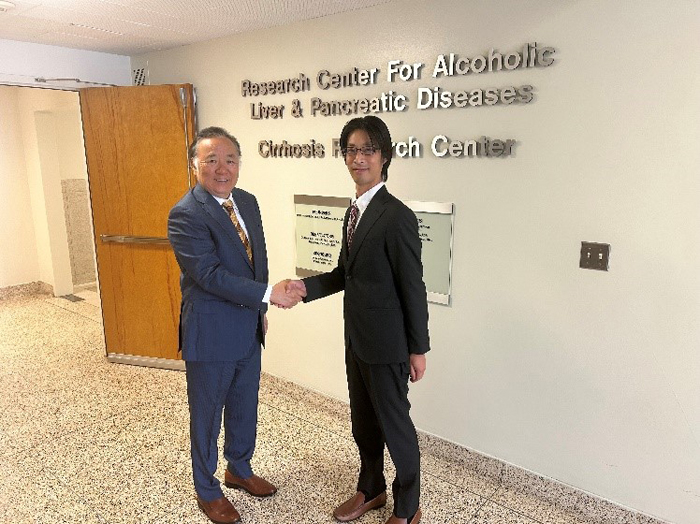
Professor Tsukamoto of the Research Center and Senior Researcher Haneda of Sekisui Chemical
<Contact information regarding this matter>
Corporate Communications Department, Public Relations Group
Email: kouhou@sekisui.com