
Sekisui Chemical and Hitachi begin collaborative creation using advanced digital technologies to promote MI in materials development.


September 20, 2022
SEKISUI CHEMICAL CO., LTD.
Hitachi, Ltd.
SEKISUI CHEMICAL CO., LTD. (President and CEO: Keita Kato, hereinafter "Sekisui Chemical") and Hitachi, Ltd. (President and CEO: Keiji Kojima, hereinafter "Hitachi") have begun co-creation to promote materials informatics (MI) in materials development.
This co-creation initiative aims to promote MI, which enables efficient discovery of material properties and insights in a short period by leveraging data-related data and digital technologies such as AI, aiming to accelerate new material development and improve the efficiency and sophistication of research and development. In addition to various solutions developed by Hitachi's Lumada *1, advanced technologies advanced as pioneering research will be widely utilized to verify their usefulness in Sekisui Chemical's actual operations.
Specifically, we will build an environment that automatically collects, organizes, stores, and integrates the knowledge and experimental data necessary for materials development from both inside and outside the company, enabling their maximum utilization. Furthermore, by constructing a digital twin that represents the experimental workflow in cyberspace, we will demonstrate the usefulness of cyber-physical systems in the field of materials development. These verifications will begin with Sekisui Chemical's research on functional materials.
By combining Sekisui Chemical's advanced knowledge and track record in the field of materials development with Hitachi's advanced digital technologies and knowledge, we aim to realize a data-driven materials development platform for a sustainable society.
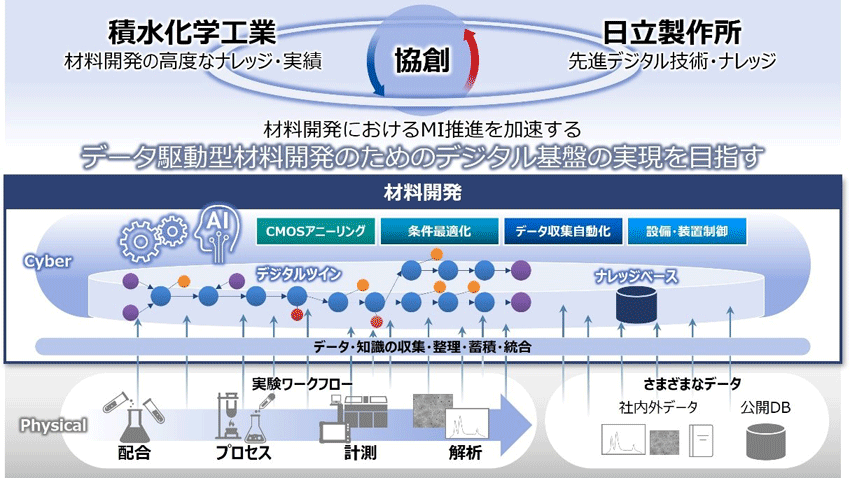
Collaboration between the two companies to promote MI
Background of co-creation
MI (Materials Informatics) is an initiative to improve the efficiency of materials development through informatics methods that utilize statistical analysis and other techniques. Previously, materials development relied heavily on researchers' experience and intuition, resulting in extremely long timeliness and high costs before practical application. Meanwhile, the market is seeing increasingly diverse and sophisticated demands on materials development, driven by factors such as shorter product lifecycles and resource constraints. To meet these demands, MI initiatives are gaining momentum globally.
As part of its efforts to realize "Vision 2030," which aims to create a sustainable society and achieve sustainable growth as a company, Sekisui Chemical is working on innovative materials development utilizing MI (Material Informatics) by specialized departments. As a result, it has achieved further acceleration and sophistication in the research and development of various new materials.
Hitachi has been continuously developing technologies to realize a data management and analytics platform that streamlines the materials development process by utilizing data, and has been providing a "Materials Development Solution *2" that applies MI as one of its Lumada solutions, meeting the needs of various customers, including those in the materials industry.
This collaborative project was realized through an exchange of ideas based on actual experiments conducted at Hitachi's "Co-creation Forest *3 (Kokubunji City, Tokyo)" in fiscal year 2021, where Hitachi's research and development division presented three technologies, and Sekisui Chemical's "Minase Innovation Center *4 (Mishima District, Osaka Prefecture)." By applying Hitachi's advanced digital technologies to Sekisui Chemical's MI and verifying their usefulness, we will accelerate the creation of innovation.
Content of co-creation
① Advanced material development through the search for optimal material properties using CMOS annealing.
We will apply CMOS annealing *5, a technology developed by Hitachi that simulates a quantum computer, to the field of materials development and verify its effectiveness. Developing new materials requires repeated experiments such as prototyping and evaluation, which is time-consuming and costly. By utilizing annealing technology, which can predict the optimal combination of conditions from many options at high speed and with high accuracy, we aim to accelerate complex formulation design using MI, a specialty of Sekisui Chemical, and further shorten and improve the development cycle of new materials.
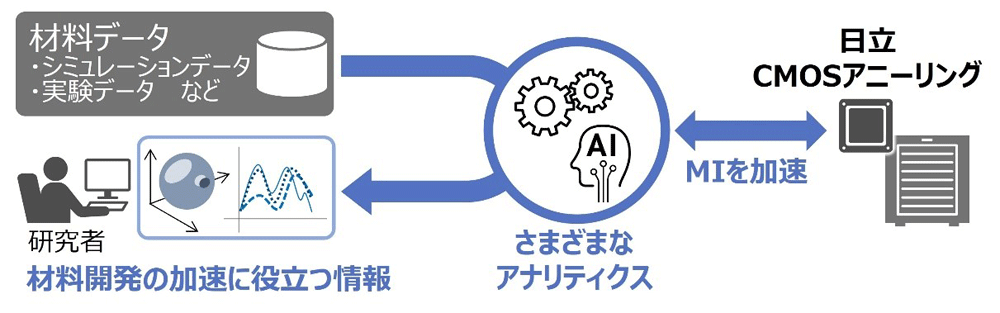
Image of MI promotion using CMOS annealing
② Automate the organization of materials development knowledge using AI and build a knowledge base that accumulates diverse knowledge.
Using Hitachi's proprietary AI, we will automate the organization of various internal and external data, and further integrate it with databases published by the government and research institutions to build an "integrated materials development knowledge base" that accumulates diverse knowledge of interest to researchers, and then verify its usefulness.
In addition to organizing existing data, the system automatically supplements missing information by integrating it with publicly available data, and uses AI to assess uncertainties, such as whether the information has been correctly organized, thereby improving the reliability of the information. Researchers can expect to improve the efficiency of materials development by being able to search across accumulated materials development knowledge, reducing the effort required to collect experimental information, and enabling advanced predictions of new material candidates using a large amount of data.
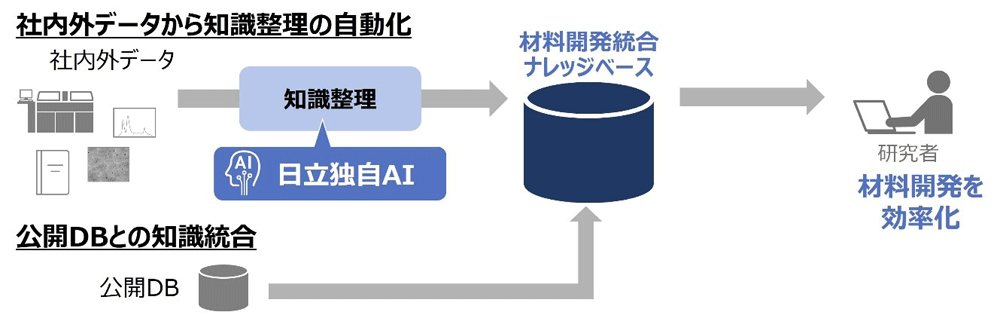
An image of promoting MI through the accumulation of materials development knowledge using AI.
③ Digital transformation of materials experiment operations through the construction of experimental digital twins and automation of experimental data collection.
We will recreate the experimental workflow performed in the materials development field in cyberspace, link the experimental data for each process (e.g., materials, methods, equipment, operators, etc.) to construct an experimental digital twin. Furthermore, we will explore ways to link the measurement equipment used in experiments with the experimental digital twin, in order to automate and remotely operate experimental tasks, and verify the effects on improving the efficiency of materials development.
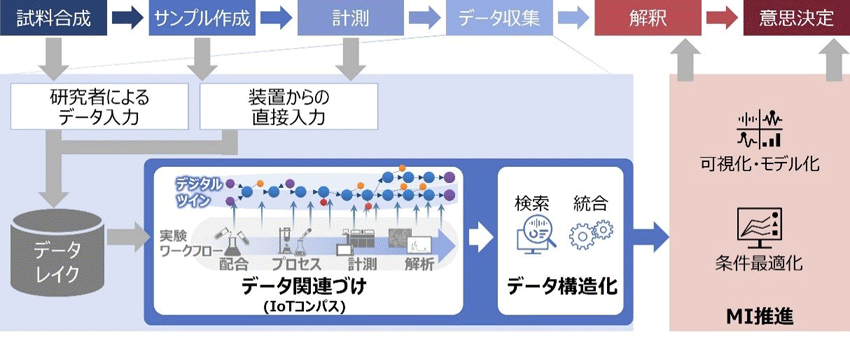
Image of promoting MI through experimental digital twin construction
We collect various data generated during the experimental process, such as sample synthesis and measurement, and link each data point with the experimental workflow using Hitachi's "IoT Compass *6" to manage the data in an integrated manner. Furthermore, by directly linking measurement devices with "IoT Compass," we aim to automate data collection and analysis.
This system allows for the centralized management of vast amounts of experimental data, which were previously difficult to manage. By linking these individual data points, it facilitates comprehensive analysis, reduces the burden of data searching and formatting, and is expected to speed up the interpretation of experimental results and decision-making. Furthermore, the centralization of experimental data leads to data sharing among researchers and reuse of data in other studies.
<Note>
*1 Lumada: A collective term for solutions, services, and technologies utilizing Hitachi's advanced digital technologies to create value from customer data and accelerate digital innovation. https://www.hitachi.co.jp/lumada/
*2 Material Development Solutions: Services supporting the development of new materials for customers through MI. https://www.hitachi.co.jp/app/mi/
*3 Hitachi Co-creation Forest: https://www.hitachi.co.jp/rd/open/kyosonomori/
*4 Sekisui Chemical MINASE INNOVATION CENTER: https://www.sekisuichemical-hppc.com/mic/
*5 CMOS annealing: A new computer developed by Hitachi to solve combinatorial optimization problems using the Ising model, which was devised to explain the properties of magnetic materials.
https://www.hitachi.co.jp/rd/sc/qc/
*6 IoT Compass: A solution that links OT data such as equipment operating status and quality information with IT data like planning and inventory management in a digital space, making digital data easily accessible and supporting the optimization of the entire production process.
https://www.hitachi.co.jp/products/it/IoTM2M/list/iotcompas/?nr0920
Future prospects
Prior to the start of this collaboration, the two companies have been verifying the practicality and usefulness of a data management and analytics platform since fiscal year 2021. Moving forward, Sekisui Chemical and Hitachi will continue to conduct joint demonstrations applying various new technologies, aiming to accelerate the promotion of DX and MI in research and development, with the goal of shortening the lead time from understanding market needs to material development. This will enable them to propose solutions using new materials and contribute to solving social issues, including the realization of a sustainable society.
Regarding exhibiting at events
This collaborative project will be presented at the collaborative session "Research DX Utilizing the Latest Digital Technologies with Sekisui Chemical Co., Ltd." at the "Hitachi Social Innovation Forum 2022 Japan," which Hitachi will hold from October 25th (Tue) to 27th (Thu), 2022. For more details, please visit the official website. https://www.service.event.hitachi/ Please see below.
Contact information regarding this matter
【SEKISUI CHEMICAL CO., LTD.】
R&D Center, Information Science Promotion Center
E-mail:i3c_prsk@sekisui.com
Hitachi, Ltd.
Public Systems Sales Division, Customer Relations Center
Hitachi Omori Building, 6-23-1 Minami-Ooi, Shinagawa-ku, Tokyo 140-8512, Japan
https://www.hitachi.co.jp/public-it-inq/