
Development of a "resin fiber composite material" to address the ignition of high-capacity LiB cells for EVs: A highly flame-retardant battery pack cover material that can withstand intense flames and ejection of cell contents.
March 31, 2022
SEKISUI CHEMICAL CO., LTD.
SEKISUI CHEMICAL CO., LTD. (President and CEO: Keita Kato, hereinafter referred to as "our company") High Performance Plastics (HPP) Company (Company president: Ikusuke Shimizu) has developed a "flame-retardant lightweight sheet" that can withstand the intense ignition of high-capacity lithium-ion batteries by utilizing proprietary high-flame retardant resin (chlorinated PVC) and fiber-reinforced composite technology. Going forward, we will accelerate development toward trial sales together with our partners.
Note
1. Background of Development
In recent years, the introduction of electric vehicles has been progressing as an environmental measure, but extending their driving range is said to be one of the challenges to further accelerating their widespread adoption. To address this challenge, efforts are being made to reduce vehicle weight by using resin for parts and to increase the capacity of lithium-ion batteries. Furthermore, improvements in safety have also been pointed out, and given the frequent occurrence of fires in electric vehicles caused by lithium-ion battery ignition, there is a demand for "lightweight resin materials" that can withstand the intense ignition of lithium-ion batteries. In order to meet these needs, our company has developed a resin fiber composite material that is "flame-resistant x heat-insulating x lightweight".
2. Overview of the product under development
1) Needs
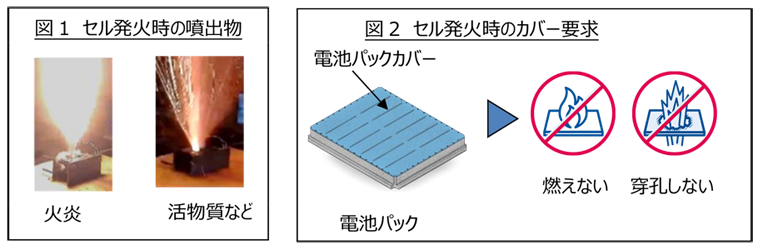
When a lithium-ion battery catches fire, inorganic materials such as the active material of the cell components and metals such as the current collector foil are ejected at high temperature and speed along with an intense flame (Figure 1). The battery pack cover must not only withstand the intense flames but also withstand the thermal shock caused by the inorganic materials (Figure 2).
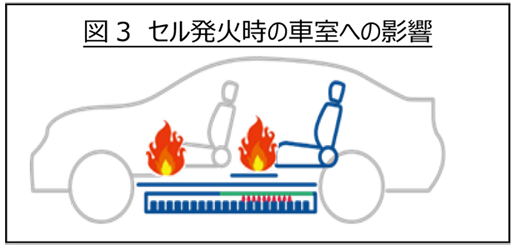
Furthermore, the battery pack has a compartment at its top where many plastic interior components are located. Even without a flame vent, if the pack cover becomes hot, there is a risk of burns to the occupants or the plastic components igniting (Figure 3).
While inorganic mineral-containing sheets and inorganic porous sheets have already been proposed as countermeasures, problems such as increased weight, shedding of inorganic particles from the sheets, and poor conformability to the cover shape when bonded to the cover have been raised.
2) Product overview
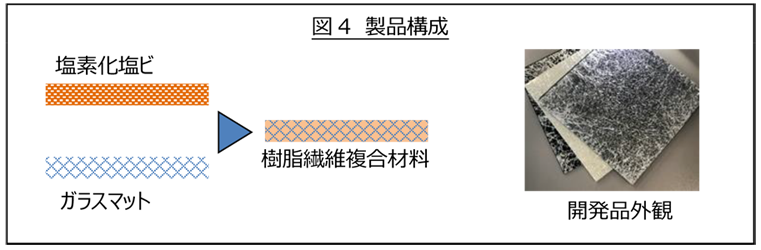
We impregnated a glass mat with our proprietary highly flame-retardant resin (chlorinated PVC) to create a resin fiber composite material (Figure 4). Previously, PVC-based resins had high viscosity even in their molten state, making it difficult to impregnate them into fibers. Therefore, it was not possible to create composite materials with a high fiber content. However, by utilizing our unique resin composite technology, we have made it possible to create composites with a high fiber content.
Because it is a thermoplastic resin, it can be shaped by hot pressing and recycled.
Furthermore, by employing a special three-layer structure, it achieves both high flame resistance (resistance to inorganic material attack, flame retardancy) and heat insulation while maintaining the strength required for a battery pack cover, and is approximately 30% lighter than aluminum (1mm) + inorganic mineral sheet (1mm).
3) Confirmation of the effects
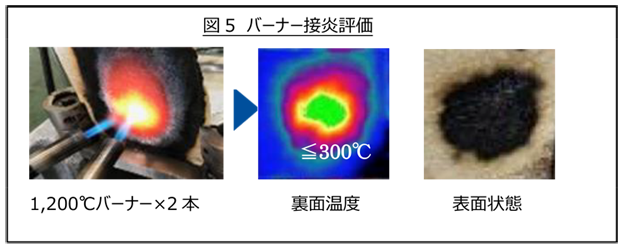
We applied a torch burner flame and observed the back surface temperature and surface condition (Figure 5). After 2 minutes, the back surface temperature was ≤300°C, and after 7 minutes, there was no deformation or perforation on the surface.
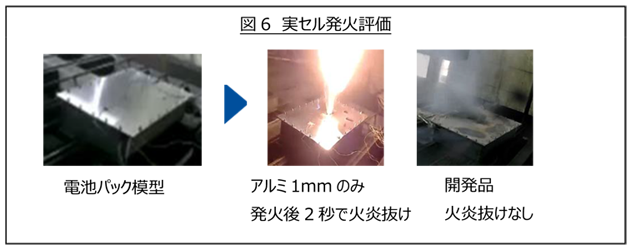
Next, simulating installation in a vehicle, we subjected a high-capacity cell (NMC811/90Ah) to thermal runaway and compared it to aluminum. We set the cell inside a battery pack model with a lid made of aluminum and the developed product, and subjected it to thermal runaway (Figure 6).
While the aluminum sample lost its flame after 2 seconds of ignition, our newly developed product showed no flame loss, confirming its high flame-retardant properties.
3. Future Developments
Currently, we are mainly developing products for automobiles, but in the future, we would like to expand into applications such as stationary batteries for homes, and housings for high-capacity lithium-ion battery systems for aircraft and solar power plants.
<Contact information regarding this matter>
[For members of the press]
Public Relations Department
Email: kouhou@sekisui.com
[General Customers]
High Performance Plastics (HPP) Company Development Research Institute, Development Planning Department
Email:masa_yamagata@sekisui.com