
Representative Director, Senior Managing Executive Officer Message (2023)
By combining "core technologies" and "fusion," we aim to promote commercialization around seven main themes to quickly establish a new business foundation and contribute to performance
Representative Director, Senior Managing Executive Officer
ESG Management Promotion Department, Digital Transformation Department
and New Business Development Department Responsible
Head of Business Strategy Department
Futoshi Kamiwaki
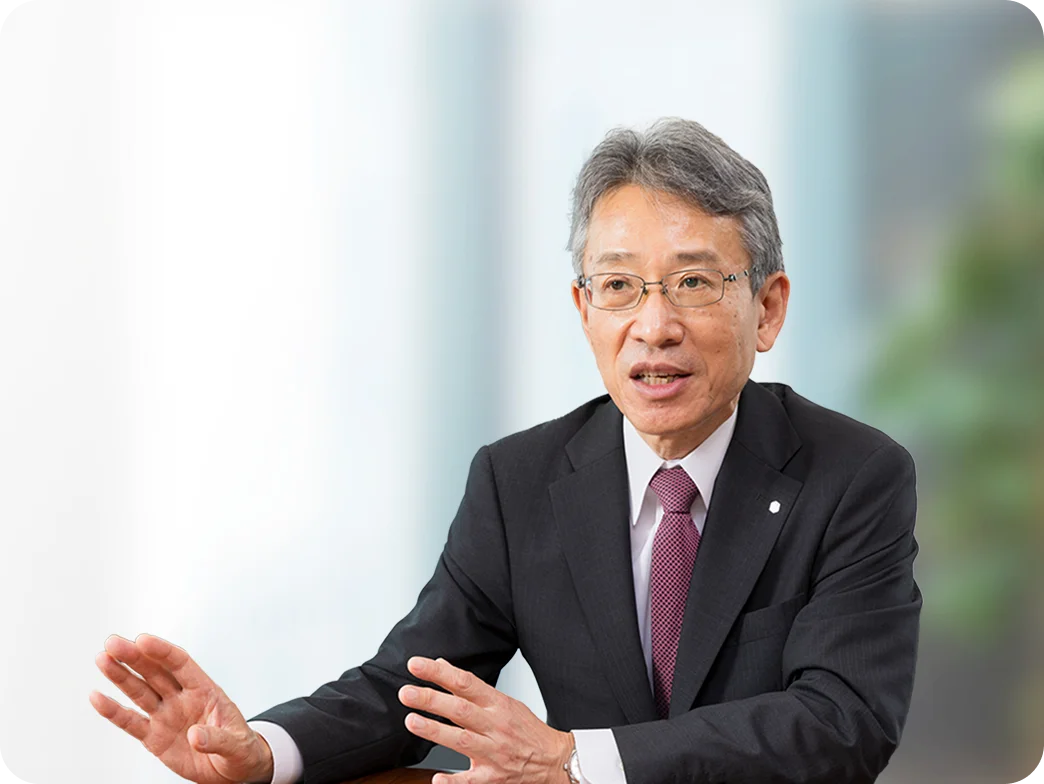
Q.01 Our company has created many products in the past.
Could you tell us about the source of the ideas that lead to the creation of such products, and the process leading up to their commercialization?
When we look at the source of outstanding seeds, they always originate from our "technology platform." However, it is difficult to significantly grow a business without a market-conscious seed-out process. Good products are born from a process of selecting seeds from the "technology platform" and proceeding with commercialization while being mindful of the market. For example, our perovskite solar cells are based on the encapsulation and coating technology of our "technology platform," but we thoroughly explored the possibilities of commercialization in-house and are proceeding with commercialization in a way that highlights our unique durability and productivity as added value.
Q.02 How are the functions and roles divided between the New Business Development Department and the R&D Center?
First, the role of the R&D Center is to initially explore and plan themes and establish the foundational technologies. In numerical terms, it is the part that creates a "1" from a "0" state. In contrast, the role of the New Business Development Department is business development, that is, turning "1" into "10." After the business development reaches "10," each Divisional Company is responsible for driving the business to "100." For example, the biorefinery business is currently in the business development phase, turning "1" into "10."
Before the new Business Development Department was established in fiscal 2019, the R&D department handled everything from "0" to "10." However, since the skills required and the missions assigned to R&D and business development differ, I believe the current promotion system is designed so that each organization can properly perform its functions under clear role division.
Q.03 Regarding "integration" both inside and outside the company, what kinds of initiatives are being undertaken in areas such as technology exploration and new business development?
In the previous medium-term plan, we created a "Strategic Area Map" as a compass for exploring new business areas in which areas. Based on this "Strategic Area Map," we formed teams within the Management Strategy Department to execute open innovation and venture investments, actively accessing external technologies and knowledge. We are also actively promoting research themes by transferring research members between Divisional Company and between Divisional Company and corporate companies. For example, themes such as material informatics and cell culture materials previously under High Performance Plastics (HPP) Company have been transferred to the R&D Center, enabling company-wide research and development progress. I believe that enhancing our discernment of external technologies and knowledge and ventures that possess them, while further refining our outstanding R&D capabilities, will be key to accelerating our "integration" efforts.
Q.04 How do you select promising themes and manage their progress when commercializing your projects?
Regarding theme selection, we assign scores based on two axes: a "market axis" to assess market potential and a "strategy axis" to determine how our existing technologies, patents, and human resources can be effectively utilized. We concentrate our resources on themes that score highly on both axes. Even after theme selection, we regularly analyze market potential and competitive landscape, screening whether our strategic potential has diminished. We manage themes by making the option to discontinue those whose scores have fallen. Actual progress management involves conducting a five-stage gate review before proceeding to commercialization.
Q.05 Please tell us about the ideal promotion system for creating new businesses and for commercializing and monetizing them.
What kind of personnel will be needed?
We believe our current promotion system, which involves creating themes and progressing them in stages—from "0 to 1," "1 to 10," and "10 to 100"—is functioning very well. However, at every stage, we feel the need for individuals with a strong business perspective. A business perspective is the ability to approach a theme from both a "technology axis" and a "market axis," and we hope to cultivate this perspective among our diverse technologically-driven employees through the challenge of commercialization. In 2023, we launched an internal entrepreneurship program to support the commercialization of employees' business ideas. We received nearly 200 applications, far exceeding our initial target of 100, and we are pleased to see that many of our employees are seriously considering commercialization. A business perspective is cultivated through the process of trying to realize an idea as a business, so this kind of human resource base is important for creating new businesses in the future. Furthermore, even if commercialization is not realized, the mere fact that more people are seriously considering and engaging with commercialization will strengthen the foundation for creating new businesses.
Q.06 How are new business creations being discussed at the board of directors meetings?
The Board of Directors discusses R&D at least twice a year, and important company-wide themes such as perovskites and biorefineries are reviewed annually, along with progress reports and confirmation of direction. While the potential of businesses is discussed with a critical eye, the Board as a whole is very supportive of new challenges, and I feel that there is a system in place to fully back the creation of new businesses.
Q.07 Now, please tell us about the seven main themes that you aim to commercialize in the medium term.
In the aerospace sector, we acquired AIM Aerospace Corporation in 2019, deciding to make a full-scale entry into the aerospace industry. Although demand for aircraft plummeted during the COVID-19 pandemic, it is now showing signs of gradual recovery, and in our medium-term plan, we will move forward in earnest to achieve the original objectives of the M&A. Based on our strength in lightweight material processing technology for CFRP (carbon fiber reinforced polymer), we will expand our aircraft and drone businesses. Furthermore, as a foothold for entering a new air mobility market, we also invested in the German eVTOL (electric vertical take-off and landing) company Volocopter in March 2023. We will cultivate this business to become a valuable partner in the aerospace sector.
In
the field of next-generation communication components, we will continue to evolve towards high-capacity, high-speed communication such as 5G and 6G. Our "transparent flexible radio wave reflective film," which we created through corporate venture capital, helps to fully utilize highly directional communication performance within enclosed indoor spaces when properly installed. Leveraging the competitiveness of our reflective film, and with an eye on radio wave environment design services, we will act as a valuable partner to communication-related companies, solving challenges for building 5G and 6G environments and driving business expansion.
In our smart city strategy, we have recently leveraged our strengths in the housing business to promote 'community development' by bringing together knowledge from both inside and outside the company. Currently, we are running more than 20 'community development' projects nationwide. Our initiatives such as energy self-sufficiency and smart and resilience (safety, security, sustainability) have been highly praised by customers who purchase these initiatives as a sense of security. Going forward, based on a safe and secure city, we will mobilize all our SEKISUI CHEMICAL Group efforts to combine our various businesses to further advance safety, health, comfort, and convenience, and further develop our smart city strategy. For example, through integration with the innovative mobility sector, we aim to further improve convenience by combining cars and homes, and by strengthening integration with the life sciences field, we promote "community development" that is not only convenient and secure but also considers health and makes it easier for elderly people to live in.
In the Advanced Lifeline sector, we are expanding infrastructure materials overseas. We will contribute to global infrastructure resilience by capturing demand for infrastructure renewal from overseas markets, including pipeline rehabilitation systems such as the "SPR method," synthetic wood FFU "pillows," and polyethylene pipes, which have been widely used domestically. Already, mainly in Europe and the US, business is being established based on demand for railway sleeper renewal, and the "SPR method" is also attracting overseas sewer pipe renewal demand. We also see many business opportunities for plant pipe materials for semiconductor factories planned to be built overseas, and while considering M&A with local companies overseas, we aim to increase the overseas ratio in the Advanced Lifeline sector. Since regulations and characteristics differ by country, we will compete based on material strength rather than on construction or design.
In
the new pharmaceutical CDMO field, based on the trust relationships established with pharmaceutical companies through CMO (Contract Manufacturing Operations), we are shifting to a business model where we establish the foundation for "D (development)" and become a partner in pharmaceutical companies from the early stages of new drug development. We will establish a foundation of "D" through small molecule synthesis and other areas, add our strengths, and use this as a stepping stone toward entering high value-added pharmaceutical fields such as medium and polymer molecules. In the medium molecule field, we already possess peptide synthesis technology, and in the polymer field, we have protein synthesis technology from Sekisui Diagnostics in the UK. Leveraging these strengths, we will enhance production capacity for active pharmaceutical ingredients and intermediates for small molecule pharmaceuticals while advancing CDMO for protein pharmaceutical raw materials. Furthermore, in the regenerative medicine field, we will leverage our technology to promote the spread and cost reduction of regenerative medicine. By enabling the development of cell culture materials from conventional animal-derived to chemical materials, we aim to reduce costs and stabilize quality. Therefore, we will first focus on materials such as chemically synthesized scaffolding materials, leveraging these strengths to enter the regenerative medicine field.
The development of perovskite solar cells has brought them close to the level of silicon solar cells, with current solar cell power generation efficiency at 15%, approaching the 18-20% level. Our strengths lie in their durability of approximately 10 years when installed outdoors, as well as high productivity achieved by manufacturing 30cm wide cells roll-to-roll. If we can achieve power generation efficiency comparable to silicon solar cells, durability of approximately 15 years, and ultimately manufacture 1-meter wide cells roll-to-roll, we will be almost ready for commercialization. Our greatest strength is the reliable manufacturing and supply of perovskite materials to our partners. Depending on the installation location, unique construction and installation methods are required, so we believe that finding partners with excellent construction and installation capabilities for power generation and developing construction and installation methods together is important, along with the advancement of perovskites.
Regarding
biorefineries, we are currently working on stable operation, cost reduction, and efficient production at a demonstration plant that is one-tenth the size of our current facility. We will complete the demonstration experiment during this medium-term plan period and enter the commercialization phase from the next medium-term plan onward. The business model we are currently considering involves partnering with companies that operate waste treatment facilities and industrial waste treatment facilities, installing ethanol processing equipment next to the waste treatment facilities, and converting the waste from these facilities into ethanol. We believe that this resource recycling process, which converts the entire waste into ethanol instead of burning it and emitting greenhouse gases as in the past, has great value from an environmental perspective, and we plan to brand and sell this ethanol. As with perovskite solar cells, collaboration and integration with external partners are crucial for biorefineries as well.
Q.08 Please tell us about your role as the executive in charge of the New Business Development Department, and what challenges you face as Senior Managing Director Kamiwaki.
My role as the executive in charge of the New Business Development Department is clear. My role is to develop businesses that successfully commercialize major themes, including biorefineries and perovskite solar cells.
While both our "strategy for success" and "market focus" are promising, we often face difficult challenges during the business development process. I believe that having the entire management team, including the board of directors, providing full support is a crucial element in growing these businesses into major enterprises. On the other hand, setbacks are inevitable in business development, so it's important to cultivate a culture where failures aren't blamed and bad news is reported as soon as possible, so that negative information doesn't remain hidden beneath the surface. And when challenges are identified, everyone works hard to find solutions to overcome them. Creating an organization where this process runs smoothly is a major challenge for me. My most important mission is to commercialize our current seven main themes, but just as the "seven samurai" innovators played a key role when our company was founded, I want to revive that spirit through internal entrepreneurship programs and other means, fostering a culture of innovation within the company.