
Roundtable Discussion with Outside Directors (2026)
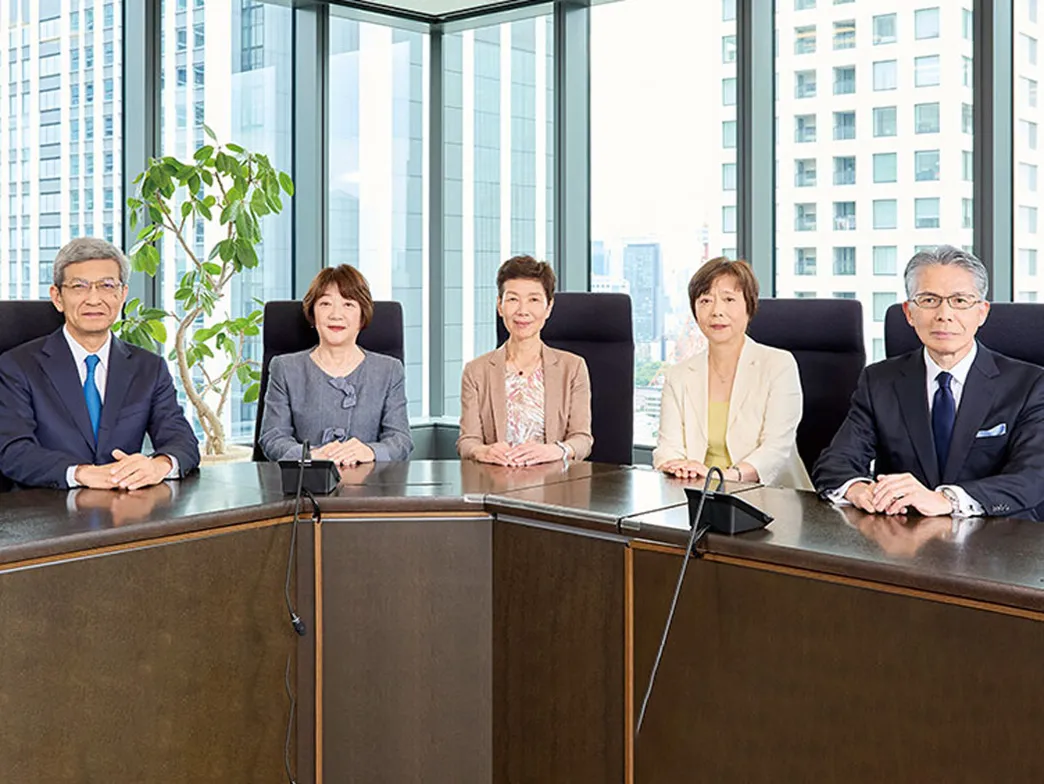
Following this year's general shareholders' meeting, the Board of Directors now consists of nine members: six directors dedicated solely to supervision (five of whom are outside directors) and three directors responsible for both supervision and execution. This new structure ensures that both the proportion of directors dedicated solely to supervision and the proportion of outside directors exceed a majority.
In this session, five outside directors will share their expectations for the new structure, future challenges, and their thoughts on medium- to long-term growth.
Independent Outside Director
Hiroshi Oeda
Independent Outside Director
Miharu Koezuka
Independent Outside Director
Haruko Nozaki
Independent Outside Director
Machiko Miyai
Independent Outside Director
Yoshihiko Hatanaka
Q.01 As we transition to a new organizational structure, could you please freely comment on your expectations for the Board of Directors and what you keep in mind in your activities?
Oeda
One of the essential roles of the Board of Directors is to supervise the executive team responsible for management. This organizational change has made the division of roles between supervision and execution clearer. The Board of Directors will focus on supervision, while the executive team will have significant authority to concentrate on executing management. We believe it is important for both sides to perform their respective roles effectively while maintaining smooth communication and a healthy level of tension.
Nozaki
The foundation of our management lies in continuously increasing corporate value. To achieve this, it is crucial to remain a valuable company for all stakeholders, including shareholders, customers, employees, and suppliers. Moving forward, it will be even more essential to consider what kind of value we can provide to each stakeholder. From the perspective of an ordinary consumer, I constantly keep in mind "what would our employees think?" and "how would our customers perceive this?" when discussing matters at board meetings.
Koezuka
The composition of the board of directors and committees under the new structure were reached after repeated discussions involving members outside the company. With the new structure, I believe the board has become more functionally effective both in terms of strengthening governance and sustainable growth. To fulfill supervisory functions, it is necessary to make harsh criticisms and to approve and approve appropriate proposals. I feel that the board is one where such well-structured discussions can be carried out repeatedly.
Miyai
One of the major advantages of separating supervision and execution is that it allows for faster decision-making. In today's world, it's essential to take appropriate risks while quickly adapting to market changes and taking action. That's why execution focuses on speedy decision-making and execution, while the board of directors ensures transparency and objectivity in its judgments, thereby enhancing the effectiveness of execution. I believe that clearly defining each role is a major value of this new structure.
Hatanaka
We believe that the ideal relationship between execution, supervision, and the Board of Directors changes depending on what the company aims for and what kind of value it intends to provide to society. Our management goal is to accelerate the creation of Products to Enhance Sustainability and market expansion to realize a sustainable society. To achieve this, we believe that the important role of the Board of Directors is to support the execution side in making flexible and agile investment decisions necessary for creating new business areas and reviewing and strengthening existing portfolios.
Q.02 How do you evaluate the current board of directors, and what kind of evolution do you think is necessary going forward?
Oeda
I believe that our Board of Directors has steadily evolved in response to changing circumstances during my eight years in office, and is now at a high level in terms of both effectiveness and transparency. I also commend the fact that we are continuously improving by implementing the PDCA cycle through annual Board of Directors effectiveness evaluations.
Hatanaka
I feel that the fact that each Divisional Company operates autonomously and demonstrates high competitiveness is a major strength of our company. On the other hand, going forward, we need to deepen discussions on cross-Divisional Company resource allocation and optimal resource allocation on a global scale. If the overseas sales ratio increases further and the business structure shifts to a ratio commensurate with the economic scale, it will naturally be necessary to allocate governance and management resources from a global perspective. We also want to actively raise discussions on the Board of Directors that look to the future.
Oeda
While it may sound self-serving, our current board of directors consists of five outside directors, all of whom have experience in corporate management and possess diverse expertise, making it an optimally balanced and diverse composition. We believe that the fact that everyone is passionately committed to their work is one of our company's strengths.
Nozaki
I also think that is a strength, and in terms of effectiveness, I highly appreciate how carefully the executive side prepares to fully answer questions from outside directors. On the other hand, I get the impression that the proposals are too neatly organized at the proposal stage. At board meetings, if you actively exchange questions and opinions with Divisional Company and board members, you can further evolve. Because members from various backgrounds gather, I hope to make greater use of their knowledge and skills.
Q.03 What perspectives did outside directors take in the formulation of the new Medium-term Management Plan" Accelerate 2028"?
Hatanaka
Our company is one where the business vision we aim for and the value we want to provide to society clearly align. In this Medium-term Management Plan, we have focused on discussing what kind of investments to make based on Long-term Vision "Vision 2030" and how to strengthen organizational capabilities. In particular, for our company, which values business creation and future growth potential in innovative fields, M&A as a means to bridge the gap in time and capability for innovation generation is an extremely important theme.
Koezuka
Regarding growth three or five years from now, I trust that we will steadily improve performance and achieve results as planned. On the other hand, when considering further growth with a ten-year perspective, the key to that is still M&A. Although we were unable to fully utilize the investment quota for M&A in Previous Medium-term Management Plan, we understand that the executive side is steadily considering the matter. That is why we propose projects with a sense of speed and thoroughly discuss them at the board of directors. We believe that building up these efforts is the most important thing.
Hatanaka
I believe that being able to discuss medium- to long-term growth strategies from such perspectives was a major feature of formulating this Medium-term Management Plan.
Nozaki
From the perspective of developing next-generation human resources, efforts are underway focusing on indicators such as successor fulfillment rates. However, at present, this perspective is limited to five years from now. Nevertheless, there is a possibility that business portfolio will change significantly in ten years. We believe that the ability to flexibly respond to these changes in human resources is a key factor determining future growth. On the other hand, in times of high uncertainty, it is necessary to quickly review the measures (To Do) that should be undertaken in response to environmental changes. At the same time, the vision we want to be (To Be) must be shared across the entire organization from a long-term perspective. I feel it is important to continuously communicate this vision in clear and easy-to-understand language.
Q.04 What are your expectations for Film-type Perovskite Solar Cells?
Miyai
Film-type Perovskite Solar Cells has finally entered the commercialization phase this year, amid high expectations not only from within the company but also from outside. ESG E (Environment) is a cross-border social issues, and Film-type Perovskite Solar Cells can be a trump card for renewable energy. If we can establish technology, we will gain competitiveness that allows us to go global. Furthermore, from the perspective of economic security, this is a highly significant business. In my career, I have had the bitter experience of Japan being globally leading in solar panels but being overtaken by China. Because of that frustration, I strongly feel that iodine, the main raw material of perovskite, is one of the world's leading producers. If we can secure the raw materials ourselves, we can avoid the risk of having our supply network taken over by other countries. Therefore, I sincerely hope our company will take the lead in advancing commercialization in Japan and quickly grow into a business that can be launched globally.
Hatanaka
Film-type Perovskite Solar Cells is a project of great value both for our company and for society as a whole. That is why speed in decision-making is so important. Competitors are rapidly improving their technological capabilities and social implementation capabilities, and because this project involves many stakeholders, we must not lose the speed of decision-making. When making decisions in an uncertain future, the question is how much risk we can take. For the success of this project, it is essential to leverage our current business structure's high risk tolerance and take bold risk-taking.
Oeda
I also believe that new products with such promising markets spreading worldwide are a once-in-50-years level. It is well worth taking every risk and actively investing both capital and talent to take on the challenge. However, what worries me is the presence of China. In the long term, it is essential to consider how to protect the Japanese market from Chinese companies, but at the same time, I expect not only to protect the Japanese market but also to take the lead in overseas markets ahead of Chinese players. President Shimizu also said at the press conference upon his appointment that Film-type Perovskite Solar Cells is a business that determines the fate of our company.
Miyai
I agree completely. In order for our company to take the lead in this field ahead of Chinese companies, collaboration with partner companies is essential, not just within our own company. In that process, I believe the role of management is to determine the right balance between prioritizing speed and profitability. I think prioritizing speed is also necessary in order to expand globally.
Q.05 How do you evaluate our company's ESG management, and what kind of evolution do you expect in the future?
Koezuka
I believe our company practices ESG linked to management, with Products to Enhance Sustainability accounting for a large proportion of our sales. In particular, efforts in the environmental field are steadily progressing, and it is an important role of the Board of Directors to closely supervise this direction. On the other hand, human resources is a key theme that needs further strengthening going forward. From a diversity perspective, there are challenges in the management talent pipeline, career recruitment, and the development of female managers, and the executive side is strongly aware of the necessity of these issues.
Miyai
Having joined our management team, I strongly feel that there are not many companies that are so sincerely committed to ESG as well. Setting a ten-year Long-term Vision and sharing it throughout the organization was also a major advantage. I believe that this mindset is firmly rooted from top to ground is a major strength. On the other hand, because of our integrity, our initiatives have become a comprehensive phenomenon. Since ESG is management itself aimed at enhancing corporate value, I have said that from now on, we should shift to a more "proactive ESG." Products to Enhance Sustainability is the very first place in that area. I believe that communicating that value clearly to society will lead to further enhancement of corporate value.
Q.06 What kind of personnel do you think will be necessary for future growth?
Koezuka
To compete globally in Film-type Perovskite Solar Cells, nurturing global talent—such as those responsible for overseas sales and lobbying—is more important than ever. Furthermore, our company is also nurturing seeds of technologies that will become second and third Film-type Perovskite Solar Cells. With this in mind, we are also discussing at board meetings how to develop the talent necessary for long-term growth and how to acquire them through career recruitment.
Nozaki
I believe it's especially important to send overseas management talent abroad at an early stage and develop them through practical experience. We should start working on this now, while we still have the capital and human resources, with the mindset that "it's a great success if 10 out of 100 people we send abroad stay."
Oeda
Corporate personnel, especially executive personnel, feel there is room for improvement compared to Divisional Company talent. In specialized fields such as DX and AI, more companies are recruiting Executive Officer-class talent from outside, and mid-career recruitment will likely become an important option going forward. Also, while women and foreigners are steadily developing in managerial positions, management is still not fully developed. Executive Officer I hope mid-career recruiters and diverse talent, including women and foreigners, will thrive.
Q.07 What kind of organizational structure is necessary to encourage each employee to take on challenges?
Nozaki
In talent development, I believe it's crucial to firmly establish the culture of challenge we've fostered and provide opportunities for employees to test their abilities. We already have systems in place such as internal transfers, volunteering for new projects, and internal competitions, but overall, the system design is a bit too detailed. If we could incorporate a little more flexibility, employees would be able to perform more freely and effectively.
Miyai
I agree. Our company is technology-based, and while the strong management is a positive aspect, I feel that the excessive management leaves little room for flexibility. I think we need to create more "room for error."
Nozaki
A challenge isn't just about creating something from nothing. Turning 10 into 100, 100 into 1000, and improving quality step by step are all challenges. That's how we accumulate small challenges in every situation. Of course, there will be failures, but accumulating small failures through daily challenges helps to avoid big failures. In fact, at our company, the top management themselves encourages employees to take on challenges without fear of failure, and this is steadily bearing fruit.
Miyai
I've been in this position for four years now, and I truly feel that the concept of "taking on challenges" has been correctly understood and embraced by all employees.
Q.08 Finally, what do you consider most important for us to achieve sustainable growth?
Hatanaka
Our company, which advocates "Innovation for the Earth," has many innovative technologies and interesting research themes. On the other hand, to quickly commercialize these and scale up to the global market, it is important not only to develop internal talent but also to actively utilize external forces. From the perspective of human resource development, based on my own previous experience, I feel that people are more often nurtured by products or businesses than by training systems. From this viewpoint, current Growth-driving and Growth potential businesses such as the interlayer and Film-type Perovskite Solar Cells businesses not only enhance corporate value but also play a significant role in nurturing people. I feel that further expanding opportunities for such challenges will lead to human resource development that is unique to our company.
Nozaki
I believe that abandoning "self-reliance" is also important to leverage external forces. Our company grew through technological Prominences and has a culture that values technological capability. However, innovation has its beginning, development, turn, and conclusion: creating from zero to one through "initiation" and expanding it through "succession." Currently, I sometimes feel that awareness of "initiation" is somewhat excessive. Considering initiatives at the Perovskite Council, we should identify our greatest strengths—sealing technology, durability, demonstration technology, procurement and construction capability, and challenge capability—and combine them with other companies' strengths to aim for a de facto position worldwide. It might be worth re-examining the diverse strengths of Group, such as persistent personnel who challenge and support technical Prominences.
Miyai
As you said, our company operates on Divisional Company-core management, but I also feel that interesting seeds are sleeping between Divisional Company and Divisional Company. By looking at personnel and R&D from a corporate perspective, the value as a Group should increase even further.
Oeda
Considering our company's recent size and growth rate, I am truly impressed with how well we have developed our own talent. While cherishing our company culture of nurturing people, I will continue to support our efforts as an outside director so that we can achieve the next level of growth.
Roundtable Discussion with Outside Directors (2026)
Following this fiscal year’s general meeting of shareholders, the Board of Directors transitioned to a new nine-member structure comprising six Directors focused on supervision (including five Outside Directors) and three Directors responsible for both supervision and business execution. Under the new structure, both Directors focused on supervision and Outside Directors account for a majority of the Board.
In this roundtable discussion, the five Outside Directors share their expectations for the new structure, the challenges ahead, and their views on medium- to long-term growth.
Independent Outside Director
Hiroshi Oeda
Independent Outside Director
Miharu Koezuka
Independent Outside Director
Haruko Nozaki
Independent Outside Director
Machiko Miyai
Independent Outside Director
Yoshihiko Hatanaka
Q.01 As the Company transitions to a new structure, could you once again share your expectations for the Board of Directors and what you personally keep in mind in carrying out your duties?
Oeda
One of the fundamental roles of the Board of Directors is to supervise the executives responsible for management. The new structure has drawn a clearer line between supervision and business execution. The Board can focus on supervision, while management has greater authority to execute business operations. I believe it is important for both sides to fulfill their respective roles while maintaining smooth communication and an appropriate degree of constructive tension.
Nozaki
The essence of management is to sustainably enhance corporate value. To achieve this, the Company should continue creating value for all stakeholders, including shareholders, customers, employees, and suppliers. Going forward, it will be increasingly essential to consider what value we can provide to each stakeholder. I approach Board discussions from the perspective of an individual member of society, always asking myself, “What would employees think?” and “How would customers view this?”
Koezuka
Both the composition of the Board of Directors and that of the committees under the new structure were decided after repeated discussions in which we Outside Directors participated. I believe the new structure enables the Board to function more effectively in terms of both strengthening governance and achieving sustainable growth. Fulfilling the supervisory function sometimes requires making pointed observations, while at other times it means recognizing and approving sound proposals. I feel we now have a Board capable of conducting discussions with this kind of clear focus and balance.
Miyai
One major benefit of separating supervision from execution is faster decision-making. Today, companies must respond quickly to changes in the market while taking appropriate risks. That is precisely why executive management should focus on swift decision-making and execution, while the Board makes judgments with transparency and objectivity and helps enhance the effectiveness of execution. I believe the great value of this new structure lies in clearly defining these respective roles.
Hatanaka
I believe the ideal relationship between execution, supervision, and the Board of Directors depends on what a company seeks to achieve and what value it aims to provide to society. In pursuit of a sustainable society, the Company has set a management objective of accelerating the creation and market expansion of Products to Enhance Sustainability. An important supervisory role of the Board is to support executive management so that it can make flexible and agile investment decisions regarding the investments needed to create new business domains and review and strengthen the existing portfolio.
Q.02 How do you assess the current Board of Directors, and how do you think it needs to evolve going forward?
Oeda
Over the eight years I have served as a Director, the Board has steadily evolved in response to changes in the business environment, and I believe it has reached a high level in terms of both effectiveness and transparency. I also value the fact that the Board continuously improves by running a PDCA cycle through its annual effectiveness evaluation.
Hatanaka
I see the autonomous management and strong competitiveness of each divisional company as major strengths of the Company. At the same time, we need to deepen discussions on resource allocation across divisional companies and the optimal allocation of resources on a global basis. As overseas sales continue to grow and Japan’s share of sales comes to more closely reflect the relative size of its economy, it will become increasingly important to take a global perspective in governance and the allocation of management resources. I hope to actively raise such forward-looking issues for discussion at Board meetings.
Oeda
At the risk of sounding self-congratulatory, I believe the current Board has an optimal and highly diverse composition: all five Outside Directors have corporate management experience and each brings different expertise. The commitment and enthusiasm that every member brings to the role is one of SEKISUI CHEMICAL Group’s strengths.
Nozaki
I agree that this is a strength. In terms of effectiveness, I also highly value the careful preparation by executive management to ensure that it can fully answer questions from Outside Directors. On the other hand, I sometimes feel that agenda items are already too neatly packaged by the proposal stage. The Board can become even more effective if the divisional companies and Directors engage in a more open exchange of questions and views—asking, for example, “What about this perspective?” or “How are we addressing this?” With members from such diverse backgrounds, we should be making greater use of the knowledge and expertise they bring.
Q.03 From what perspectives did the Outside Directors participate in discussions on the formulation of the new Medium-term Management Plan, Accelerate 2028?
Hatanaka
This is a company whose vision for its businesses is clearly aligned with the value it seeks to provide to society. In formulating this Medium-term Management Plan, our discussions focused on what investments should be made and how organizational capabilities should be strengthened in light of the Long-term Vision, Vision 2030. M&A is an especially important theme for the Company, given its emphasis on creating businesses in innovation areas and strengthening future growth potential, because it is a means of bridging gaps in the time and capabilities required to generate innovation.
Koezuka
I am confident that over the next three to five years the Company can steadily grow its earnings and deliver the results set out in the plan. However, looking further ahead to growth ten years from now, M&A will clearly be a key factor. We did not use the full M&A investment allocation under the previous Medium-term Management Plan, but I understand that management has been steadily exploring potential opportunities. That makes it all the more important for management to bring potential deals to the Board promptly and for the Board to discuss them thoroughly. I believe continuing that process is critical.
Hatanaka
I believe the ability to discuss medium- to long-term growth strategies from these perspectives was a major feature of the process for formulating this Medium-term Management Plan.
Nozaki
From the perspective of developing the next generation of human resources, initiatives are also progressing with attention to indicators such as successor candidate preparation rate. At present, however, even this perspective extends only about five years ahead. The business portfolio could look very different ten years from now. Whether the Company can respond flexibly to those changes from a human resources perspective will be an important factor in determining future growth. At the same time, amid heightened uncertainty, we need to be ready to quickly reassess what needs to be done—our “To Do”—as circumstances change. The Company’s desired future state—our “To Be”—must meanwhile be shared throughout the organization from a long-term perspective. I believe it is important to continue communicating that desired state in clear, readily understandable terms.
Q.04 What are your expectations for film-type perovskite solar cells?
Miyai
With expectations running high both inside and outside the Company, film-type perovskite solar cells have finally entered the commercialization phase this year. The “E” in ESG—environment—represents social issues that transcend national borders, and film-type perovskite solar cells could become a game changer for renewable energy. If we can establish the technology, it should give us the competitiveness to expand globally. The business is also highly significant from the standpoint of economic security. During my career, I had the bitter experience of watching Japan lose its global lead in solar panels to China. That experience makes me feel particularly strongly about this: Japan is one of the world’s leading producers of iodine, the principal raw material for perovskite solar cells. If we can secure the raw material domestically, we can avoid the risk of other countries controlling the supply chain. I very much hope SEKISUI CHEMICAL Group will take the lead in commercializing the technology in Japan and quickly grow it into a business capable of competing on the global stage.
Hatanaka
Film-type perovskite solar cells are a project of enormous value both to SEKISUI CHEMICAL Group and to society as a whole. That is precisely why speed in decision-making is so important. Competitors are rapidly strengthening both their technological capabilities and their ability to implement the technology in society, and because this project involves many stakeholders, we cannot afford to lose momentum in decision-making. Since decisions must be made without a clear view of the future, the question is how much risk we are prepared to take. Success will require us to capitalize on the high risk tolerance afforded by the Company’s current business structure—one of its strengths—and take bold risks.
Oeda
I also believe that a new product with such a promising market worldwide comes along perhaps once every 50 years. It is well worth taking substantial risks and committing both capital and human resources aggressively to the challenge. My concern, however, is China. Over the long term, we must consider how to protect the Japanese market from Chinese companies. At the same time, rather than simply protecting the domestic market, I hope we can establish a presence overseas ahead of our Chinese competitors. As President Shimizu said at the press conference following his appointment, film-type perovskite solar cells are a business on which the future of SEKISUI CHEMICAL Group rests.
Miyai
I completely agree. For SEKISUI CHEMICAL Group to take the lead in this field ahead of Chinese companies, collaboration with partner companies as well as our own efforts will be essential. Management will therefore need to determine the right balance between prioritizing speed and emphasizing profitability. To compete globally, there may be times when speed must take priority.
Q.05 How do you assess the Company’s ESG management, and how would you like to see it evolve?
Koezuka
I believe the Company practices ESG in a way that is closely integrated with management, as demonstrated by the large share of sales accounted for by Products to Enhance Sustainability. Initiatives in the environmental field in particular are making steady progress, and an important role of the Board is to ensure that they continue in the right direction. Human resources, meanwhile, is an area that needs to be strengthened further. From a diversity perspective, challenges remain in areas such as the management talent pipeline, mid-career recruitment, and the development of female managers, and executive management is also keenly aware of the need to address them.
Miyai
Since joining the Company’s management, I have been struck by how seriously the Company takes ESG. Establishing a ten-year long-term vision and sharing it throughout the organization has likely played a major role. The fact that this thinking has thoroughly permeated the organization from top management to the front lines is a major strength. At the same time, that very sincerity has sometimes led to initiatives becoming too broad and diffuse. ESG is management itself when viewed as a means of enhancing corporate value, so I have argued that we should now shift toward a more proactive ESG. Products to Enhance Sustainability are at the heart of that effort.
Communicating their value to society in a clear and compelling way should lead to further enhancement of corporate value.
Q.06 What kind of human resources will SEKISUI CHEMICAL Group need to achieve future growth?
Koezuka
To compete globally in film-type perovskite solar cells, it will be more important than ever to develop global talent, including people capable of handling overseas sales and lobbying activities. The Company is also nurturing technological seeds that could become the second and third film-type perovskite solar cell businesses. With an eye to developing these technologies into businesses, the Board continues to discuss how to develop the human resources needed for long-term growth and how to acquire such talent through mid-career recruitment.
Nozaki
Overseas management talent in particular should be sent abroad at an early stage and developed through hands-on experience. We should start now, while we still have sufficient financial and human-resource capacity, with the resolve that sending 100 people abroad and having 10 emerge as successful global leaders would itself be a success.
Oeda
I believe there is room to strengthen corporate human resources, particularly executive talent, compared with talent at the divisional companies. In specialized fields such as DX and AI, an increasing number of companies are appointing executive officer-level personnel from outside, so mid-career recruitment will also become an important option for us. We are making steady progress in developing women and non-Japanese employees at the managerial level, but diversity at the executive management level is not yet sufficient. I would like to see a diverse range of people such as mid-career hires, women, and non-Japanese employees play active roles as Executive Officers.
Q.07 What kind of organization is needed to encourage every employee to take on challenges?
Nozaki
When it comes to developing human resources, I believe we need to make taking on challenges part of our organizational DNA and give employees opportunities to test their capabilities. Systems are already in place for internal transfers, volunteering for new businesses, and internal competitions, but overall the institutional design can be somewhat too detailed. With a little more room for flexibility and experimentation, employees may be able to exercise their abilities more freely.
Miyai
I agree. The Company is a technology-based company, and being well managed is certainly a strength. At the same time, I sometimes feel that there is too much management and not quite enough room to experiment. I think we need to create more “white space” for people to explore.
Nozaki
Taking on challenges does not only mean creating something from zero to one. Turning 10 into 100, turning 100 into 1,000, and making one quality improvement after another are all challenges too. It’s about continually pushing ourselves in small ways across everything we do. Of course, not everything will work out, but learning from small failures along the way can help us avoid bigger ones. In fact, top management itself encourages employees to take on challenges without fear of failure, and those efforts are steadily bearing fruit.
Miyai
In my four years with the Company, I’ve seen the concept of “challenge actions” become well understood and increasingly embraced by employees across the organization.
Q.08 Finally, what do you consider most important for the Company to achieve sustainable growth?
Hatanaka
Under Innovation for the Earth, the Company is developing numerous innovative technologies and intriguing research themes. To commercialize them quickly and scale them up in global markets, however, we need to develop our own people while actively drawing on external capabilities. From a human resource development perspective, my own experience at my previous company has taught me that people are often developed more by products and businesses than by formal development programs. From this standpoint, today’s growth-driving and growth-potential businesses themselves—including the interlayer film business and the film-type perovskite solar cell business—play a major role not only in enhancing corporate value but also in developing people. Expanding these opportunities to take on challenges further could lead to a form of human-resource development that is unique to the Company.
Nozaki
To make effective use of external capabilities, I also think it is important to move away from a “not-invented-here” mindset. The Company has grown through the prominence of its technologies and has a corporate culture that places great value on technological capabilities. Innovation, however, unfolds in stages: first creating something from zero to one, and then growing it. I sometimes feel that we are focusing a little too much on these initial stages. The Japan Perovskite Solar Cell Promotion Council (JPSC), is a good example. We need to pinpoint the Company’s core strengths—whether in sealing technology and durability, verification technology, procurement and construction capabilities, or our ability to take on challenges—and complement them with the strengths of other companies to establish the global de facto standard. Perhaps we should take a fresh look at the Group’s diverse strengths, including the enterprising, tenacious people behind our technological capabilities.
Miyai
Exactly. Although SEKISUI CHEMICAL Group is managed around its Companies, I also sense that interesting seeds may be lying in the spaces between them. By taking a cross-Company view of human resources, R&D, and other areas from a Corporate perspective, we should be able to further enhance the value of the Group as a whole.
Oeda
Considering SEKISUI CHEMICAL Group’s recent scale and growth rate, I am impressed by how successfully the Company has developed so much of its talent internally. I want to see SEKISUI CHEMICAL Group build on its strong tradition of developing people and reach a new level of growth, and as an Outside Director, I will continue to support that journey.