
Dialogue between Outside Director and Director of Human Resources (2025)
SEKISUI CHEMICAL Group places "human capital" as one of our materialities, and believes it is important to remain a "vibrant company that makes all employees want to take on challenges."
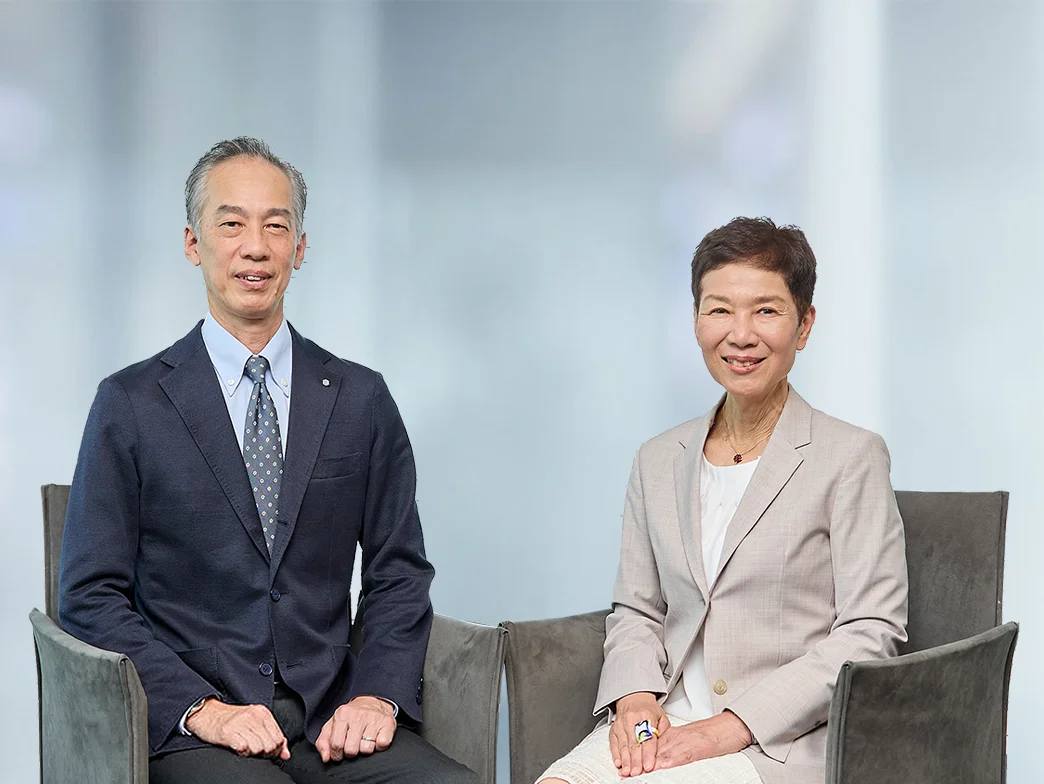
Regarding the relationship between these initiatives and management strategy, Director Nozaki, who serves as the chair of the Diversity Promotion Committee as an outside director, and Director Murakami, who serves as Human Resources Department chairman, held a dialogue.
Let me introduce the details.
Director Executive Officer
Kazuya Murakami
Outside Director
Haruko Nozaki
Q.01 Please tell us about your current efforts regarding human capital, your assessment of them, and what you feel you have achieved.
Murakami
Our company upholds the human resources philosophy that "employees are a valuable asset entrusted to us by society," and our commitment to investing resources in employee growth has remained consistent. In recent years, we have focused on developing a human resources system linked to our management strategy, and have made a strong effort to make our efforts in human capital visible and communicate them both internally and externally. Furthermore, in order to verify the effectiveness of our implemented measures, we are also working on introducing productivity indicators to check whether they are linked to management indicators.
Nozaki
Just as we have created innovation through our products, I feel we are pioneering in human resource strategy as well. Medium-term Management Plan We also highly value the fact that we have clearly stated that we will invest 12 billion yen in human capital over three years, as a sign of the management's determination. For those currently employed, "personal growth" is a major keyword, and visualizing and matching what capabilities you have and what the company is seeking is extremely important for future HR management. As a company developing diverse businesses, I think it is wonderful that the system is designed to carefully and carefully visualize the balance between Divisional Company and to reflect the unique characteristics of each business.
Murakami
Going forward, we intend to continue formulating and executing HR strategies from a medium- to long-term perspective, linking Divisional Company and corporate management.
Nozaki
I believe the area where corporations can leverage their grip is to be involved in Divisional Company 's succession plans and to advance the right people in the right places beyond Divisional Company. In any case, I feel that the cautious yet bold approach to exploring what suits our company is truly a symbol of our corporate culture.
Q.02 How do you evaluate the degree of challenging behavior and engagement?
Murakami
"The degree of expression of challenge behaviors" is currently a key KPI for human capital in our Group, and the president himself continues to promote the challenge of each employee. Although the recent figure of 56% has risen significantly, we are still not satisfied with this figure. We strongly feel that further efforts and measures are needed regarding whether the evaluation of challenges is appropriate and whether employees are experiencing real growth.
Nozaki
The occurrence of challenging behaviors and engagement score tend to be higher and more likely overseas. Japan tends to score lower due to humility and the desire to improve, so it's important to observe changes in scores rather than absolute values. Furthermore, to compete in the increasingly intense global market, developing the mentality of saying "I'm taking on a challenge" or "That's why I want you to do this" is also a future challenge.
Murakami
Furthermore, now, with the numbers on an upward trend, is a crucial moment. For example, how can we address situations like, "I worked hard and tried my best, but am I being properly evaluated?" I believe this is where the real challenge begins.
Nozaki
One of the opportunities to deepen understanding of challenging behaviors is a project called "Town Hall Style Meeting with President / Top Management," where employees directly discuss work styles and innovation with executives. I have participated several times, and what I feel is that employees speak without bias, and executives like the president respond honestly. The leadership themselves welcomes failure and encourages challenges, which I think leads to increased trust and engagement among employees.
Q.03 Promoting diversity Please tell us about the committee's initiatives and the significance of being directly connected to the Board of Directors.
Nozaki
I serve as the chair of the Promoting diversity Committee, and all outside directors are members, and there is lively discussion and proposals every time. For example, there are proposals such as "Let's further raise the target for the ratio of women hired," opinions such as "Why not strongly promote welcoming women even in mid-career recruitment?" and "How about further utilizing the position of Group company executive to develop executive candidates?" Many of these have actually been implemented as initiatives, and I feel the committee functions effectively. It is rare even in Japan for the committee to be positioned as an advisory body to the Board of Directors.
Murakami
We have adopted the advisory committee format because we believe that the executive team should carefully consider the experience and knowledge of the outside directors and implement them under the executive team's will and responsibility. In fact, we have received many questions and suggestions regarding human resources and organization from Mr. Nozaki and others.
Nozaki
Speaking from the perspective of someone not on the implementation side, I feel that there could be a bit more speed in the implementation of these policies.
Murakami
It's a painful spot for my ears. Human Resources Department Although I think I'm reforming with a sense of speed, I've received even more feedback than that, which has been a great source of inspiration.
Nozaki
We discuss not only superficial initiatives such as increasing the proportion of women, but also D(Diversity), E (Equity), I (Inclusion), and B (Belonging) as a whole. Ultimately, we believe that the same meaning as engagement—Belonging—that is, being part of our Group—is pride in being part of our company, leveraging our strengths to be ourselves, and ultimately leading to growth for both individuals and the company—our ultimate goal is diversity.
Q.04 What specific initiatives are you planning to take in the future to realize the "active participation of diverse talent"?
Murakami
Currently, the percentage of women hired is about 30%, the percentage of women in newly appointed management positions is about 10%, and the percentage of women in all management positions is only 5%. We still have a long way to go to reach our numerical targets. However, the real goal is not the numerical targets themselves, but rather to create a workplace environment that recognizes diverse working styles, allowing employees to thrive in their own way, which in turn will contribute to the company's growth. For example, we are promoting a mentoring program for female managers as a new initiative. Since the majority of female managers' superiors are men and their career paths differ, many concerns that were not shared within the usual organizational structure are emerging. Through these efforts, we are seeing some positive effects, such as identifying areas for improvement and ways to bridge the gap between the experiences of those involved and those perceived by others. Furthermore, we believe that improving the workplace environment will expand opportunities for senior employees, including those with responsibilities such as caring for elderly parents. We believe there are still many areas where we can improve.
Nozaki
I agree completely. When we talk about "the active participation of diverse talent," the focus tends to be on "female managers," but in reality, we need to achieve a broader sense of diversity that goes beyond external diversity such as gender, and includes internal diversity as well. Even if we start by increasing the percentage of women hired or in management positions, I believe that achieving broad diversity that is not limited by age, nationality, job type, or organization will lead to improved performance and innovation.
Q.05 Given the current labor shortage, how do you evaluate our talent portfolio, and which segments of the population should we focus on?
Nozaki
To drive innovation, we need not only people who can create something from nothing, but also people who can build from 1 to 10, and expand from 10 to 100, and even to 1,000. Furthermore, as a manufacturing company, we have even more detailed processes and skills. For our next medium-term plan, we hope to visualize the surplus or shortage of manpower and skills that will be needed in the future, and by creating opportunities to broaden our mission and possibilities in all directions, we expect to create a talent portfolio that is aligned with the strategic portfolio that our medium-term plan aims for. On the other hand, it is clear that the labor shortage will become even more serious in the future, so we need to consider how much we can leverage the strengths of foreign talent, senior talent, and people with disabilities. We hope that our company can put our heads together and become a pioneer in this area.
Murakami
In terms of recruitment, Mr. Nozaki once pointed out "How much do we rely on new graduate hiring?" Currently, Group hires over 1,000 people annually, just over half of whom are new graduates, but in reality, we struggle every year to secure the target number of employees. From forming the workforce to selecting new hires and following up on new hires, the recruitment team invests significant energy. We believe it is time to shift to a recruitment model that can respond more flexibly and promptly to meet the types of people we seek and changes in the recruitment market.
Nozaki
From an academic perspective, I would like to see companies actively promote the interesting and socially beneficial work that can be done by PhD holders, and encourage them to recruit and offer internships for PhD holders.
Q.06 Please tell us about your initiatives and evaluations regarding the acquisition and development of DX, ESG, and global talent.
Murakami
Currently, about 30% of our Group 's overseas sales are overseas, and since we anticipate further expansion, developing global talent is an urgent task. Until now, management has mainly been handled by expatriates from Japan, but in the next medium-term plan, we plan to strongly select the right talent from within the entire Group workforce. We aim to further promote successor development under each overseas local law, and in the future, entrust management under overseas laws to a large number of local personnel. Regarding ESG personnel, we will focus not on "ESG experts" but on developing management personnel who can accurately understand and explain the significance and social impact of our company's business.
Nozaki
For overseas subsidiaries, it's essential to provide examples of multiple career paths to reach the top. This applies to executives at headquarters as well. It would be good to motivate ESG personnel so that they can take pride in their roles. Rather than internal company evaluations, I think that recognition of their expertise, such as being recognized as a leading expert in their industry or academic circles, will be a source of motivation, so I feel it's important to effectively communicate the appeal of such recognition.
Murakami
On the other hand, speed is essential for DX. To acquire external talent who can become immediate assets, we are working to enhance their treatment as professionals. However, in reality, recruiting such professional talent is difficult, so we believe that developing DX talent in-house is key, and we are actively promoting the reskilling of internal talent.
Nozaki
We highly appreciate the alignment between the management strategy and the human resources strategy, and the integrated development of systems for recruitment, promotion, and training.
Q.07 How do you view the decision-making process and effectiveness of the board of directors?
Nozaki
Information about the agenda is carefully shared, including the background and detailed background, creating an environment where outside directors can communicate with confidence. Opportunities are provided to view our company from a multidimensional perspective, such as inspecting production Plant and Institute (subordinate research units: Laboratories) to understand employees' enthusiasm and awareness of challenges. Additionally, outside directors have built relationships that go beyond mere formal exchanges to allow for frank exchanges of opinions and questions, and I feel the quality of discussions has improved compared to before. On the other hand, in reality, there are many situations where outside directors constantly question each other, Divisional Company and I would like to see more time spent on discussions during board meetings. I think it's wonderful that it is strict and efficient, but it might be better to have a bit more playfulness, such as recognizing and praising each other's efforts.
Q.08 How do you evaluate the diversity of the board of directors, and how do you think it should be increased in the future?
Nozaki
There is diversity in the career paths of both men and women, and the auditors speak from their professional perspectives, ensuring ample diversity. Our common sense is not necessarily the common sense of society. Common sense changes with the times, and I believe that different experiences, positions, and sensitivity to the changing times are important. If I were to be picky, the average age of our outside directors is currently high, so I would be happy if we could have more younger people. Looking ahead to the next 10 years, I think that the perspectives of younger generations will become increasingly important as they continue to play this important role.
Q.09 Please tell us about the "challenges" for Director Murakami, who is in charge of human resources.
Murakami
My challenge is to make employee challenges visible and to establish a fair and transparent evaluation system. It's meaningless if employees only do things because "the president said so" or "the boss said so." I believe my challenge is to create a system where superiors and subordinates can set realistic and convincing challenges, execute them, and be appropriately evaluated, thereby fostering an atmosphere and corporate culture that encourages continuous challenges.
Q.10 As an outside director, what aspects of our company would you like investors to expect from us?
Nozaki
Our company possesses a strong supply chain that connects outstanding technical capabilities with diverse markets. Earning power is truly a unique strength of companies with multiple businesses. In addition, the management team is bright and has the ability to discern the essence, and employees take pride and responsibility in solving social issues problems. We believe that the power of such talent is the Source of Value of the company. Furthermore, the corporate culture symbolized by "3S Principles (Service, Speed, Superiority)" and the ability to flexibly Value Transformation business portfolios in line with the times are key to competitiveness in uncertain times. We hope you will focus on the power of human capital and culture, which are not easily reflected in financial indicators, and expect long-term growth for SEKISUI CHEMICAL Group.