
Roundtable discussion with outside directors
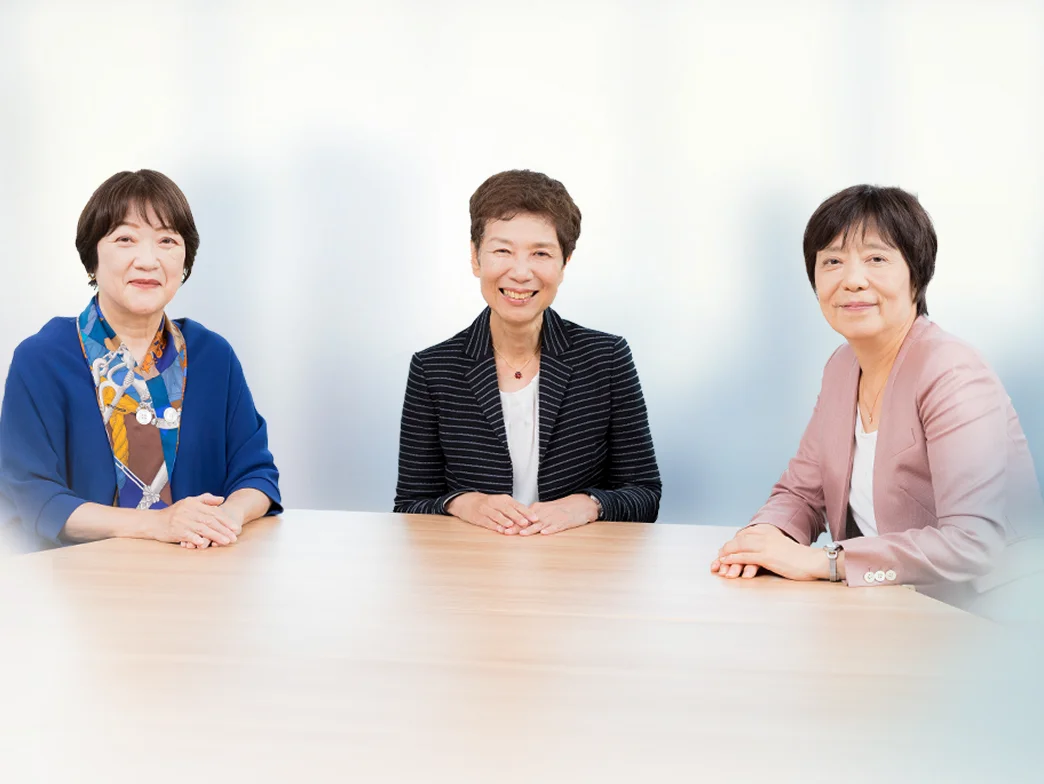
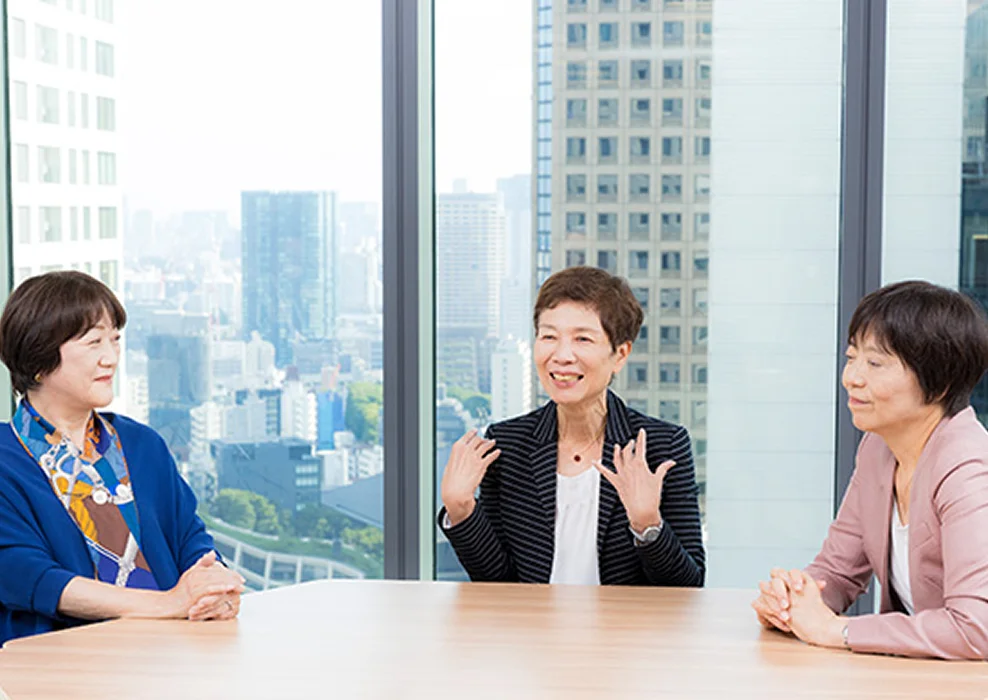
In June 2022, we held a roundtable discussion with Directors Nozaki, Koezuka, and Miyai, who were newly appointed as outside directors. The content is introduced below.
Outside Director
Miharu Koezuka
Outside Director
Haruko Nozaki
Outside Director
Machiko Miyai
Q.01 How do you perceive the role expected of you as an outside director?
Nozaki
I have built my career mainly in areas such as human resources, education, diversity promotion, and next-generation development. When I was approached to become an outside director, I was told, "I want to make diversity the engine of Sekisui Chemical. The goal is not to increase the number of female executives, but to seriously promote diversity." I recognize this as one of the roles expected to contribute to our company's Promoting diversity.
Koezuka
In addition to my previous job, I have management experience in various industries, and during that time, I was involved in the restructuring of loss-making companies. I believe that I can leverage this experience to contribute to enhancing the corporate value of our company.
Miyai
In my previous role, I was responsible for business operations and also worked as a researcher in a science-related field. I believe my management experience in the consumer goods industry, which is completely different from ours, will bring a fresh perspective to our company's management, and I would like to offer my opinions and suggestions accordingly.
Q.02 Please tell us about your impressions of the SEKISUI CHEMICAL Group Board of Directors and the content you made in your remarks.
Miyai
Recently, there was a discussion about corporate branding, and we proposed which brands—such as logos and company names—should be communicated externally to enhance corporate value, as well as suggestions on the ideal approach to branding. We also mentioned the need to organize brands including "SEKISUI HEIM" and similar items.
Nozaki
I suggested that we "make a solid investment in people." Our board of directors provides thorough explanations beforehand, but I also feel that we learn a lot from the chairman's explanations at board meetings, including past events and background.
Koezuka
The chairperson's management of the meeting was excellent, fostering an atmosphere where it was easy to express opinions. Furthermore, I believe that if there were off-site meetings outside of the board meetings where outside directors could exchange opinions more freely, discussions would deepen further and lead to improved effectiveness.
Miyai
The effectiveness of our Board of Directors is already at a high level, and I agree with Koezuka that the chairperson's excellent management of proceedings is outstanding. At other companies, outside directors also hold regular meetings, so we are also making such proposals.
Nozaki
Board meetings tend to be Q&A sessions between outside and internal directors. Before going to the board, it's hard to see what kinds of discussions took place between different Divisional Company, so if different opinions and debates arise from each Divisional Company 's perspective on a proposal, it would further enhance its effectiveness.
Q.03 Please share your evaluation of the long-term vision and the medium-term plan "Drive 2.0".
Miyai
We appreciate that the company places ESG at the core of its management, as well as the way it has outlined its growth scenario and direction for 2030. However, we believe there are still challenges in terms of implementation, and we recognize the need for further discussion, including among ourselves as outside directors.
Koezuka
That's right. The implementation aspect and how to cultivate the personnel to carry it out in the future are crucial. Human resource development is a major challenge not only for domestic companies but also for overseas companies. Human resource development will become increasingly important in the future, and I think it's a topic that needs to be discussed.
Nozaki
I value not only the content of the management plan but also the measures for internal penetration. We strive for horizontal collaboration beyond the Divisional Company framework, and sometimes even with the president, we have many opportunities for discussion and dialogue. I feel that the conglomerate has a significant advantage in being able to incorporate diverse perspectives and good examples from other Divisional Company.
Koezuka
That's right. I believe that our ability to flexibly find new opportunities in line with changing times is one of the advantages of being a conglomerate.
Miyai
To avoid becoming a conglomerate discount, I think it's also necessary to strengthen headquarters functions so that the overall strategy of the Group can be more concretely presented, including creating synergies between Divisional Company.
Koezuka
While strengthening individual Divisional Company, it is essential for headquarters functions to maintain a balanced grip.
Nozaki
If only corporate companies are strong, the execution team will be weak due to only planning, so balance is extremely important. Because we have diverse seeds, if we can show examples such as the number of projects created by Divisional Company from a single seed, I believe we can properly demonstrate our value as a conglomerate.
Koezuka
The key point is capital allocation, including human capital.
Koezuka
That's right. It's clear that Divisional Company, as a profiting division, is important, so I believe such an overall strategy will be crucial for achieving sustainable growth over the long term.
Q.04 What are your thoughts on the role of M&A in growth investment?
Koezuka
As our company seeks growth opportunities overseas, the use of M&A is a major theme. We recognize that we must clearly define our objectives, whether it is to supplement areas where we are unable to operate on our own through M&A, or to expand our global market share, and then thoroughly examine and discuss at the Board of Directors meeting the expected revenue contributions from M&A and the governance structure after the acquisition.
Nozaki
M&A, in essence, involves acquiring talent with deep knowledge of technology and the market. Therefore, it's crucial to consider how to retain the talent we need, not only by securing personnel at the acquired company, but also by strengthening our own talent pool to accommodate them.
Miyai
Sustainability will be a major pillar of our company's future growth, so we cannot overlook it. Given the differences in corporate culture, it will take some time to create synergies across a wide range of people, so it is important to consider that timeframe and determine whether we can properly govern the company.
Koezuka
Whether it's a defensive or offensive M&A, it's crucial to clearly define the purpose and intent of the M&A and continuously express the company's intention to pursue it; otherwise, information may stop flowing in. On the other hand, many successful M&A deals involve the management themselves searching for target companies. Finally, determining whether the price is acceptable is also extremely important.
Q.05 Our long-term vision aims to accelerate our growth overseas.
Please share your thoughts on global governance.
Koezuka
In addition to establishing a global governance system that includes audits, I believe that the success of global governance depends on how well management and responsible departments communicate with overseas subsidiaries. When looking at successful global governance examples from other companies, I see that management is always in close contact with each other, and I believe that both a governance system and communication are essential.
Miyai
That's exactly right. Communication is absolutely essential for global governance. On top of that, I think it's also effective for Regional Headquarters to work more closely with headquarters.
Nozaki
When we hear the word "governance," the negative aspects that tend to come to mind are often the ones that put the brakes on things. However, it is essential to work together towards common goals while respecting each other. Furthermore, if the relationship between the head office and overseas subsidiaries becomes one-to-many rather than one-to-one, and multiple overseas subsidiaries are brought together to discuss the same topics, a healthy sense of competition will be fostered among the subsidiaries, and governance will also improve in some ways.
Q.06 How do you evaluate our company's sustainability?
Miyai
Our company has been actively working on climate change countermeasures from an early stage, and we appreciate this point. Going forward, social demands will increase, such as discussions on Scope 4 in addition to Scope 3, so it will be a challenge to continue responding to these issues in detail. Also, I think it would be good to actively communicate our own initiatives.
Koezuka
Yes, that's true. Sometimes I feel it's a waste when companies have the technical skills but don't utilize them.
Nozaki
Regarding human capital, I feel that our company has a very strong commitment to its people and values its employees. The revised personnel system is excellent, and I feel the atmosphere within the company is warm, but it feels a little too neatly organized. I have a feeling that it would be even more enjoyable if we could have a little more freedom and flexibility.
Koezuka
To become a sustainable company, utilizing DX as a tool is also indispensable. This is not a challenge for DX teams alone; each department must be conscious of DX from both growth investment and operational efficiency. It is also necessary to develop DX personnel capable of defining such requirements.
Miyai
Social demands regarding human rights are also increasing. Human rights are a key theme in our medium-term plan, and although it will require effort, we must address high-risk areas thoroughly.
Koezuka
When we ventured out into the world, I suggested that in order to ensure that our company's common sense regarding global human rights issues did not become uncommon in the world, we should benchmark global companies as we advanced our human rights practices.
Nozaki
Since many foreign workers are employed on-site, it would be good to start by identifying human rights issues from that group and prioritizing the well-being of people.
Q.07 Promoting women's participation in the workforce is an urgent issue for Japan, but under what circumstances do you think "promoting women's participation in the workforce" would cease to be a goal?
Koezuka
Just as baseball teams have first, second, and third teams, it is absolutely essential for companies to have layers of female employees. The lack of a substantial female workforce in Japanese companies as a whole is the responsibility of Japanese companies that have not hired women for generalist positions, and this is precisely where companies should make efforts. We must make it a time when we can properly recruit women, give them the same conditions as men, and make efforts to improve the situation. Furthermore, does our company have a system in place that allows women to continue working regardless of the lifestyle they choose, such as marriage or child-rearing? This requires interviewing women and creating a system that reflects their actual needs. These are minimum requirements, but they will also be appealing points that make a company attractive to women. Companies must be aware of what they need to do now and what they need to prepare for in the future.
Miyai
I often hear the number 30%, and statistically speaking, it's a number that means women are no longer a minority. I believe that if women make up more than 30% of decision-making positions, companies will change. Of course, numbers aren't everything, but I've personally experienced that the atmosphere of meetings changes when the number of female executives increases.
Nozaki
In addition to including women of all ages, from young to senior, in decision-making processes, I hope that younger male employees will also be given opportunities. For talent to thrive, it's absolutely essential that everyone has an equal chance and a process that allows them to get a starting line. Up until now, women haven't been invited from the start. So it's important to send invitations to women as well, and encourage those who want to come to do so. It would be great if such best practices emerged from our company. And I think the true goal is for the era of "women's empowerment" to disappear altogether.
Q.08 Please share your thoughts on what you expect from our company and the challenges we believe we need to overcome in the future.
Miyai
We place ESG at the core of our management, which we highly value, but at the same time, we are concerned that our ESG may be becoming somewhat defensive. climate change I hope the response will be more "offensive E," and for human capital, we will actively invest even if it takes time to recover investment, so that we can shift from defensive to offensive approaches that exceed societal demands. I feel that we are a very serious company, but I hope we can shift to a more proactive approach in a freer atmosphere.
Nozaki
I hope that our company, with its strong technological capabilities, will create new industries. I believe that if we can engage with young entrepreneurs and ventures, not just through in-house incubators, and make Japan and the world a better place through investment, we will be able to attract a more diverse range of talent to our company.
Koezuka
Currently, our company has set "challenge" as a company-wide challenge, but we already possess sufficient foundational skills in technological development, sales, and motivation. I believe this challenge can be overcome simply by encouraging each individual to express their opinions more flexibly and proactively. Company growth stems from the combined strengths of each employee, so if we can foster a culture where each person can confidently showcase their own efforts, there will be no need to set challenging behavior as a KPI. And then, we want to improve corporate value and shareholder value and grow as a global company.