A new way to protect what lies beneath the road: Co-creation brings pipeline protection technology to life.
公開日:
What thoughts and stories were behind its development?
How will that connect to the people and societies living on Earth?
"SEKISUI | Connect with" is a future-creating media platform that connects you with Sekisui Chemical.
We use smartphones and the internet every day. Behind the scenes, these communications are supported by "underground communication conduits" laid out beneath the roads. However, conduits buried at shallow depths face the challenge of being damaged by excavation work. This led to the development of "shallow buried conduit protection technology," which protects communications from the inside of the conduit. How did Sekisui Chemical turn NTT's concept into components that are ready for mass production and on-site installation? We delve into the behind-the-scenes story of this co-creation.
- There is communication infrastructure beneath the road that cannot be protected by existing construction methods.
- If you can't put it outside, put it inside. A new type of component has been created.
- A two-pronged approach that uses haptic feedback and visual cues to alert of abnormalities.
- Having completed a 250m-long demonstration, the focus is now shifting to social implementation.
There is communication infrastructure beneath the road that cannot be protected by existing construction methods.
Road repairs and waterworks projects often involve cutting into the pavement and digging the ground. This is a common sight in cities. Beneath these digging sites run underground conduits that house communication cables. However, in sections where the conduits are buried shallowly, road cutters and heavy machinery can reach the conduits and accidentally damage them. If the damage extends to the communication cables inside, it could lead to a disruption of communication services.
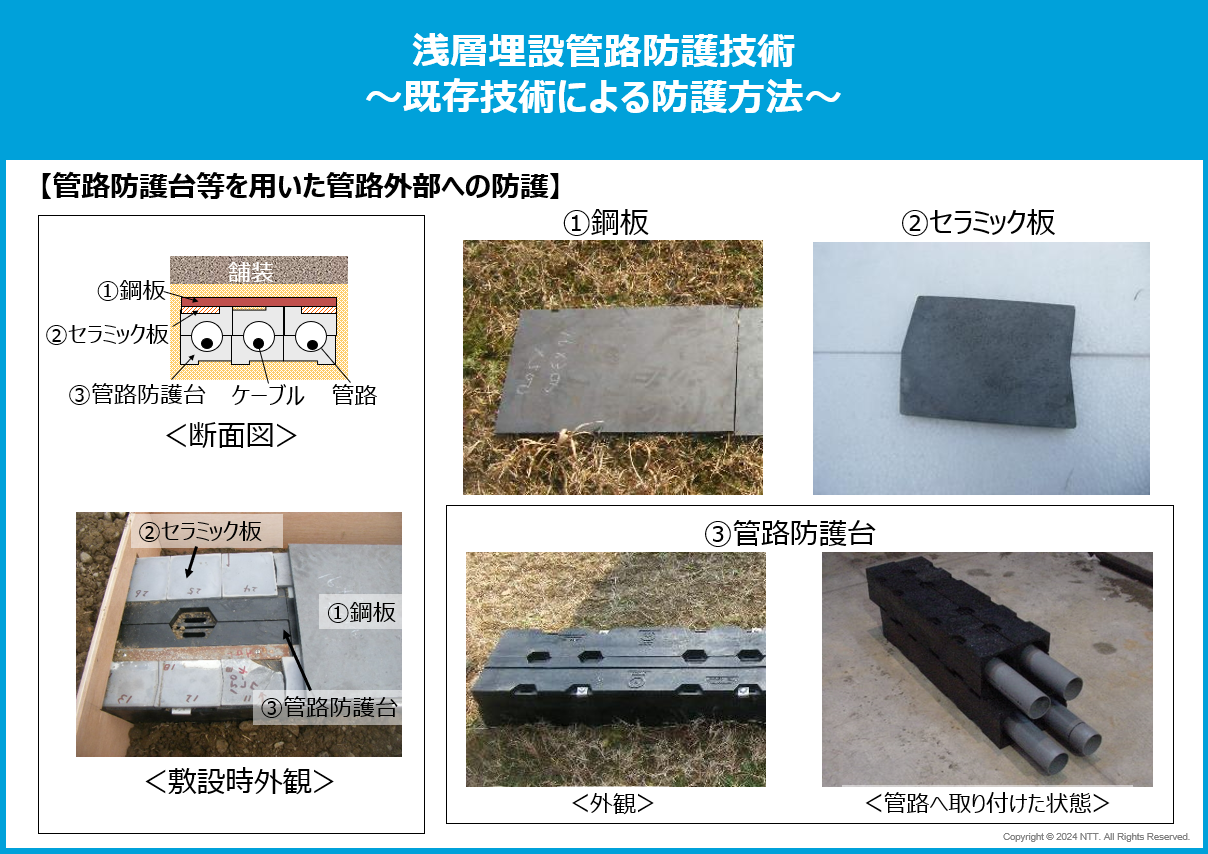
To prevent such accidents, protective materials are installed on the outside of the pipelines. However, there are some locations where this method is not feasible. Yoshihiko Tashiro of NTT, which promotes the introduction of new technologies and external communication, explains.
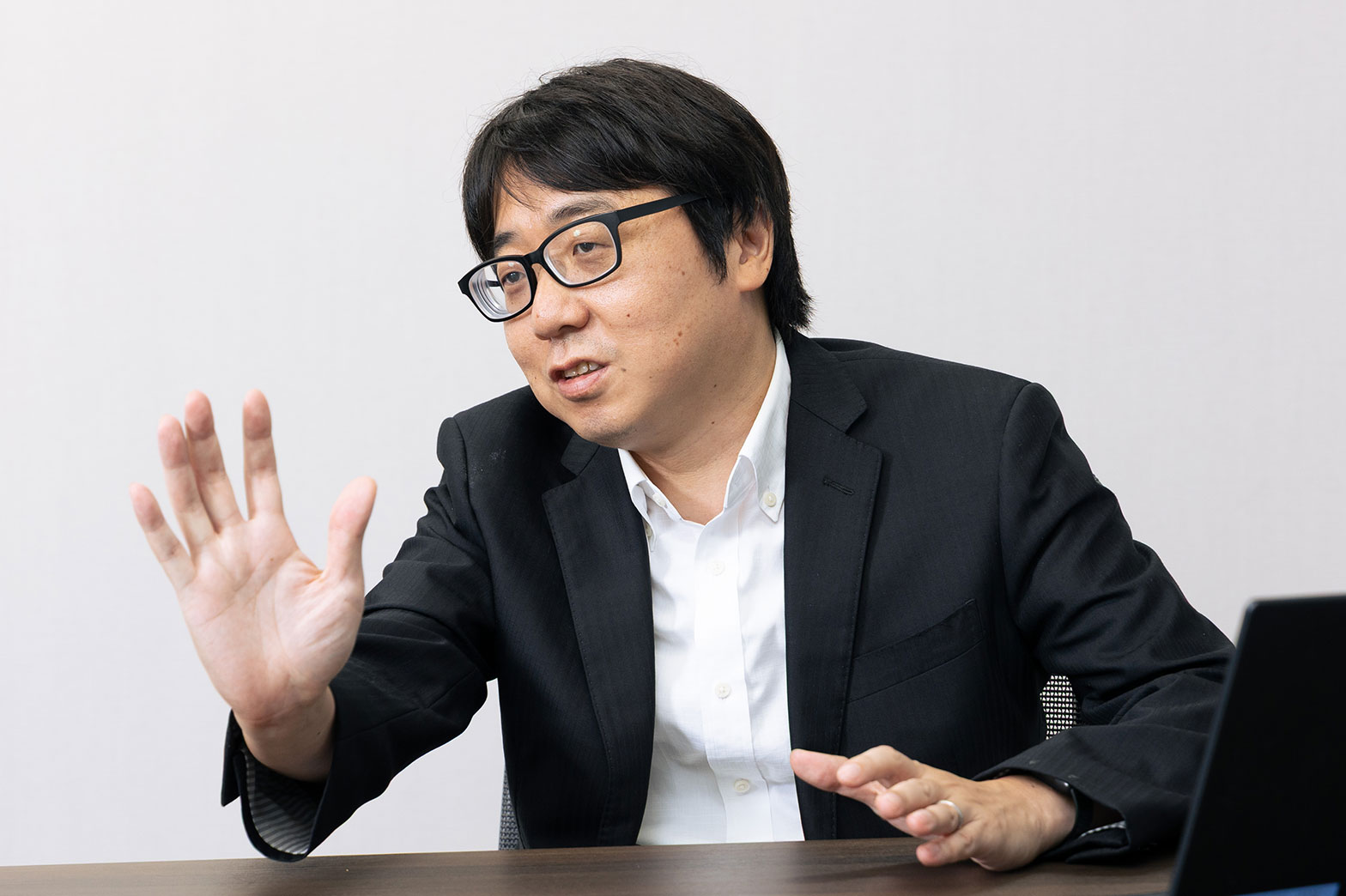
"Conventional protection methods require excavation work to install protective materials on the outside of underground pipelines. This is costly and places a significant burden on the scale and environment of the construction. What's even more difficult are the 'shallow sections' where the pipeline is located very close to the surface. There is simply no space to place protective materials on the outside, making it difficult to address with existing methods."
As the main person in charge of developing this protective technology, Eiki Watanabe of NTT Infrastructurenet, who was then part of NTT's Institute (subordinate research units: Laboratories) and led the process from technical concept to concretization, also touched on the difficulties of this challenge.
"The space inside the conduits is barely enough to run communication cables. Adding protective materials on top of that is physically difficult. Even though we knew countermeasures were necessary, we were in a situation where we couldn't easily move forward with full-scale development."
It cannot be protected from the outside. There is not enough space inside either. How did they overcome this impasse?
If you can't put it outside, put it inside. A new type of component has been created.
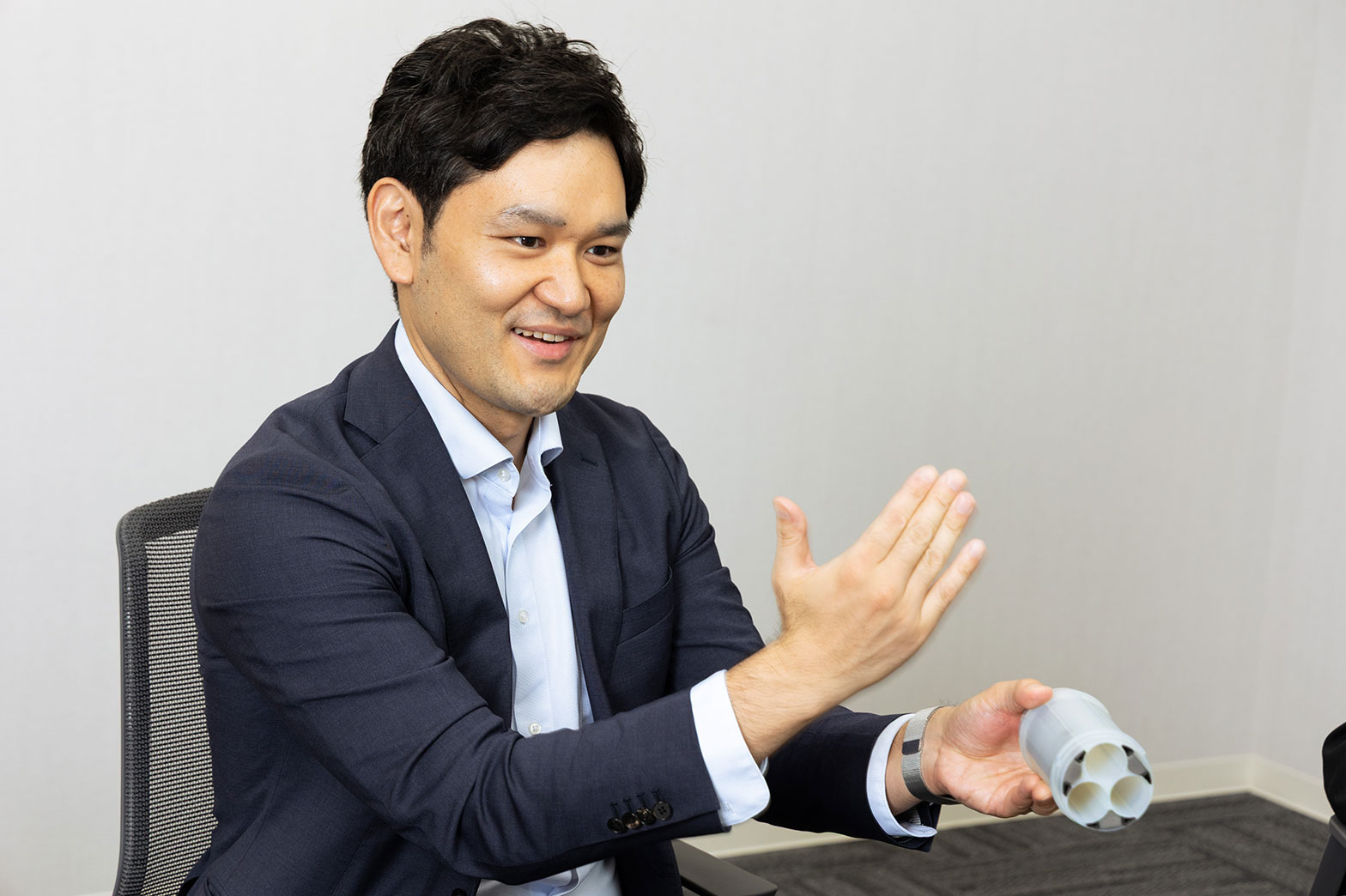
NTT's solution was to incorporate protective features inside the conduits. The idea was simple, but its implementation was not easy.
Mr. Watanabe and his colleagues began their research in 2021, defining each condition for the protective function one by one. NTT approached Sekisui Chemical as a partner to overcome this obstacle. They proceeded with joint development, utilizing the knowledge cultivated with the existing in-pipe insertion tube "PIT". After aligning the concept and requirements, they will begin full-scale design of a new "PIT" that will lead to a breakthrough.
The development was handled by Kanade Kawachi from Engineering Center. In her second year at the company, Kawachi faced unprecedented development and reflected on the process.
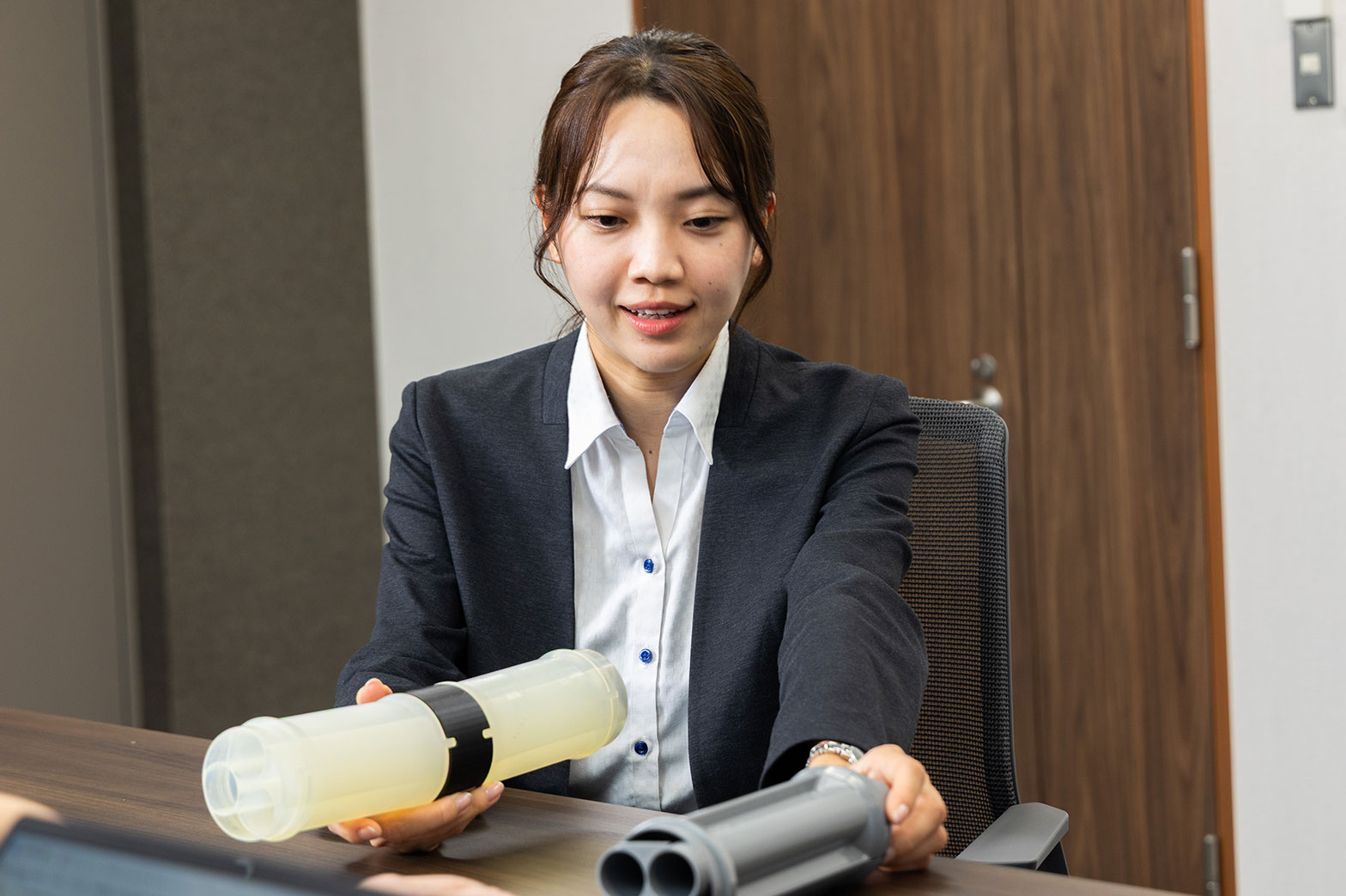
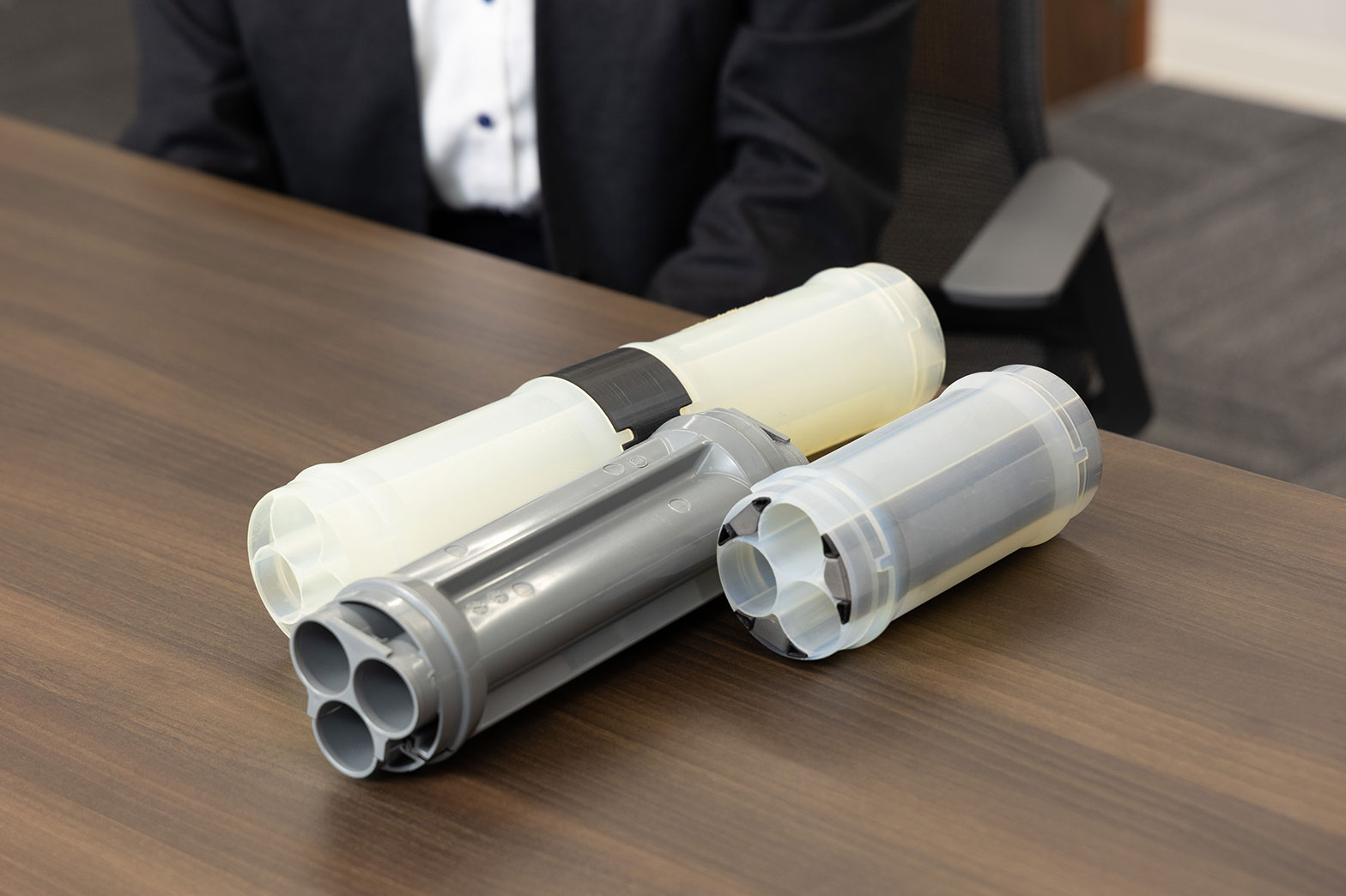
"The conventional 'PIT' had a 'split structure' that combined two components to accommodate already laid cables from both sides. However, this time, in addition to cables, we also had to accommodate ceramics and tubing. The upper and lower mating mechanism in the 'split structure' also took up space, so we first considered abandoning the 'split structure' and making it a single integrated unit."
By creating a single integrated unit, the internal space can be expanded by eliminating the need for joints. However, making the tubing too thin would reduce its strength. Space is also needed for sealing components to maintain watertightness, and the shape must be easily injection molded for mass production. How to accommodate these conflicting conditions in a single cross-section? Kawachi and his team searched for the optimal design solution.
"We consulted with the Yamanashi Sekisui representative, who has expertise in injection molding at SEKISUI CHEMICAL Group, and checked whether the resin would flow properly through the mold and if the shape would allow it to be removed from the mold after molding. Changing one condition would affect other parts as well, so we repeatedly reviewed the shape as we refined the process."
Even with uncertain demand, it was necessary to consider whether it was technically feasible from a different perspective, and to confirm that the required performance could be met before investing in mass-production molds.
This is where stereolithography and 3D printers came into play. The necessary material properties were organized for each evaluation item, and prototype materials with properties similar to PVC were selected. This established an evaluation method that allowed for the determination of the actual product's performance even before molds were created.
The three-dimensional prototypes also proved useful in coordinating between the two companies. Sekisui Chemical designed "PIT," and NTT considered ceramic components to confirm the fit of the cross-section. This allowed them to share issues that were difficult to see from drawings alone, and significantly increased the speed of development.
A two-pronged approach that uses haptic feedback and visual cues to alert of abnormalities.
The design for fitting the protective components into the limited space is becoming clear. The next question is how to make it function on a construction site. How will the communication cables be protected when a road cutter cutting the pavement comes into contact with the pipeline?
The first feature adopted was "force detection." When the cutter blade hits a hard material, the cutting speed decreases, and the operator feels an unusual resistance. This unusual sensation alerts the operator to the abnormality.
However, there are size constraints on the ceramics that can be placed inside the pipeline, making it difficult to secure enough time to stop work based solely on resistance. Mr. Watanabe says that they had to consider the workers' reactions as well.
"Even when driving a car, it takes time from sensing danger to actually hitting the brakes, right? It's the same on a construction site; it's difficult to rely solely on tactile feedback. So, we added a system that makes it easier to notice abnormalities visually as well."
This is "visual detection" through color. Inside the new "PIT," there are tubes containing powdered coloring agents. When the cutter blade reaches the tube, the coloring agent dissolves in the coolant, and red-colored water appears on the road surface. Red was chosen as a color that workers can easily perceive as a danger.
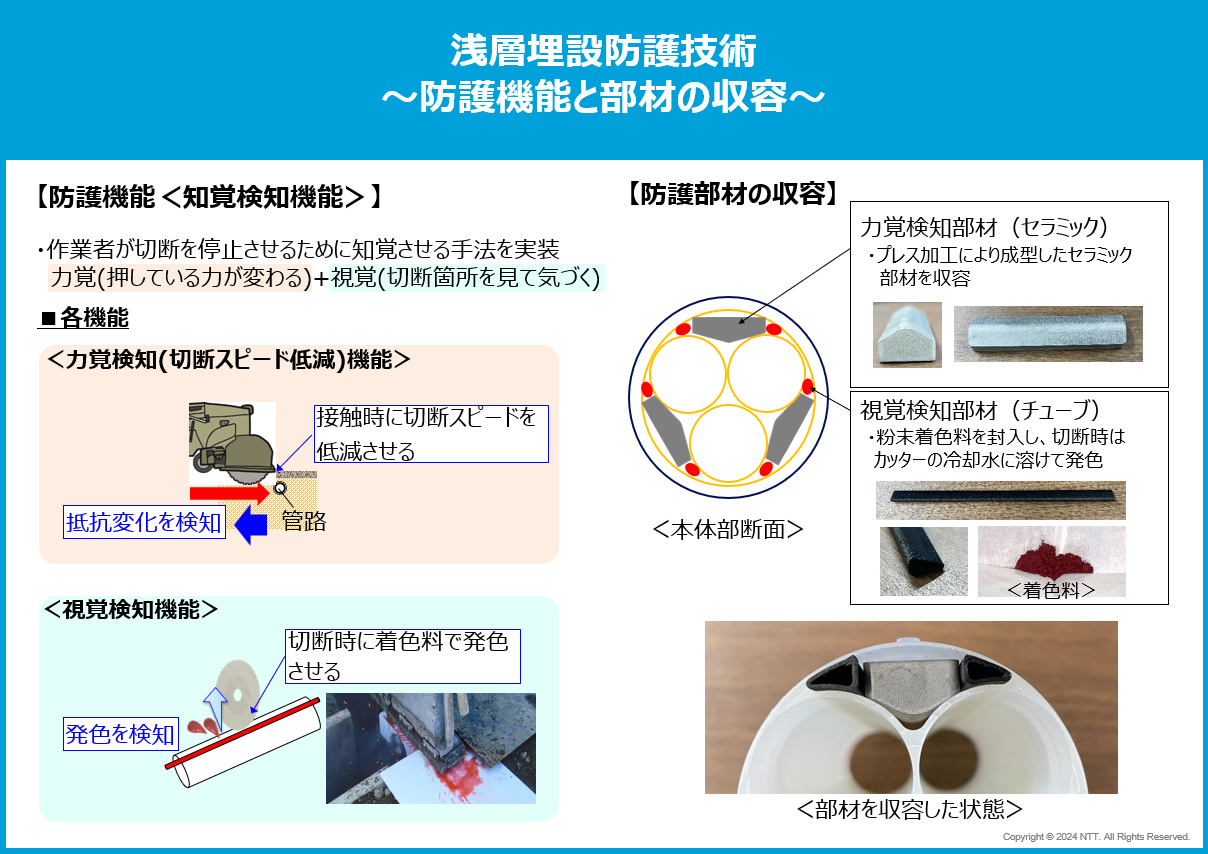
"Furthermore, inside the actual pipeline, the inserted components may rotate due to twisting or other factors," says Watanabe. Road cutters don't always enter vertically from directly above.
Therefore, they positioned the ceramic components in multiple directions and conducted tests where the blade was applied not only from directly above, but also from angles of 15 and 30 degrees. They confirmed that the tactile feedback and color development functions worked even when the components rotated or when the blade made contact at an angle. Mr. Watanabe recalls:
"The goal of this technology wasn't to create a material that could never be cut by any blade. It was to alert workers to an anomaly before a blade could reach a communication cable in a limited space, so that they could stop the work. From 'protecting conduits' to 'protecting communications.' I think that was a major turning point for this technology."
Having completed a 250-meter-long demonstration, the focus is now shifting to social implementation.
Technologies equipped with protective functions can only demonstrate their value when they can be installed on-site. The climax of development was a 250-meter-long constructability evaluation test conducted within NTT's Institute (subordinate research units: Laboratories) premises.
The test recreated a pipeline on the ground, consisting of complex curves running both vertically and horizontally. The resistance to pushing increased with distance, and in the upward-curving sections, the weight of the components themselves also became a load. Mr. Watanabe recounts that time.
"250 meters is the maximum length expected for a single section of a communication conduit. We proceeded step by step, making adjustments to auxiliary jigs and pushing techniques on-site. I was truly relieved when we were able to complete the entire section. It was a moment when we felt confident about implementing it on-site."
Kawachi, who was in charge of the design, also expressed his relief upon completing the tests.
"Evaluating individual components alone doesn't tell us whether they can maintain their strength and be completed in a long, connected state. By completing the 250-meter section, we were able to truly see how the design translates to real-world environments."
From component design and performance evaluation to verification of constructability in a simulated real-world environment, overcoming challenges at each stage, this technology reached the milestone of "development completion" in terms of research and development in 2024.
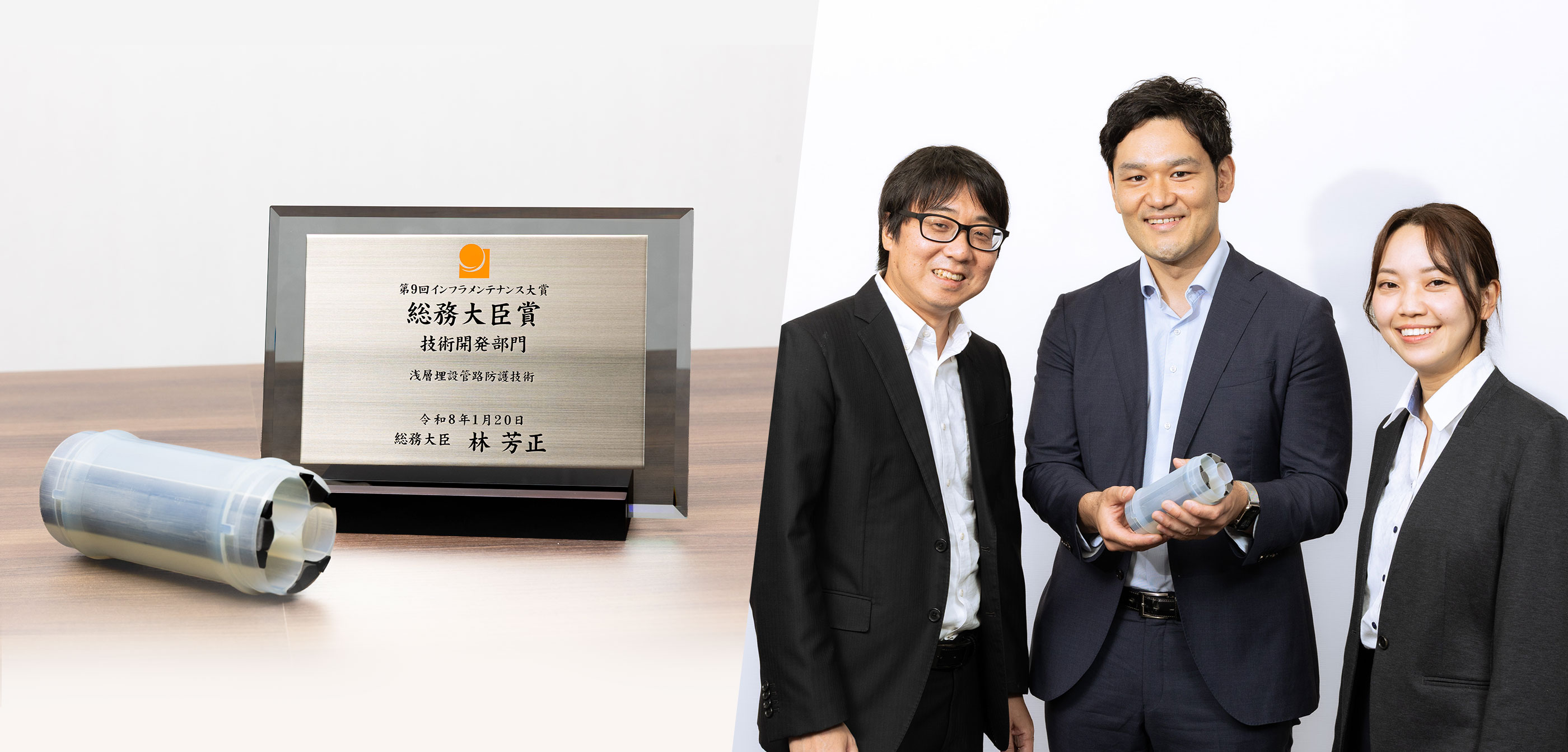
In January 2026, it received the "Minister of Internal Affairs and Communications Award" at the 9th Infrastructure Maintenance Awards, in recognition of its ability to protect shallow sections without requiring open-cut construction, while minimizing costs and environmental impact.
The next step is to consider how to translate established technology into the introduction of equipment. Mr. Tashiro says that it is important to first build a track record of implementation in the telecommunications sector.
"We plan to explore the potential of this technology while consulting with NTT East, NTT West, NTT Infranet, and others. We will also consider internally whether it can be used to strengthen new network routes related to IOWN."
Winning the award is not the end goal. Moving forward, the focus will be on determining the sections where the system is expected to be introduced, the demand, and the scale of investment required for mass production, while preparing the conditions for practical implementation. Kawachi looks beyond that.
"We take it very seriously that this technology has been established and has received recognition from external parties. We hope to deliver it to society as an actual product and contribute to the safety and security of infrastructure."
NTT, which identified the challenges on the ground, and Sekisui Chemical, which has cultivated expertise in pipe design and molding technology, have combined their knowledge to create a new option for shallow sections that were previously difficult to protect. In order to establish this technology in society and support the future of communication infrastructure, the collaboration between the two companies will continue.